

REQUEST DEMO
Robot CATALOG will be sent to your mailbox immediately after submission.
SUBMIT
Hospitality management across diverse hospitality venues has reached a clear operational inflection point. The traditional approach to maintaining sprawling physical spaces is colliding with structural labor changes and evolving guest expectations. This shift is happening now because several distinct factors are converging simultaneously. Technology maturity has significantly improved, making autonomous navigation reliable in dynamic public environments. Furthermore, the cost curve of automation has flattened, transforming capital investments into predictable operational expenditures. Meanwhile, guests continue to demand pristine environments despite ongoing staffing constraints. As a result, facility leaders can no longer rely solely on expanding headcount to meet baseline expectations. Therefore, commercial cleaning robots have emerged as a highly effective, industry-level solution. These systems directly address the growing gap between service demands and available resources. Above all, they shift floor care from a constant daily struggle to a managed, predictable infrastructure process.
These pressures point to a single conclusion: the traditional manual cleaning model is fundamentally unsustainable.
The OrionStar CleaniBot series addresses this precise operational gap with a differentiated, dual-model strategy. Rather than forcing a single machine into every space, the portfolio provides specialized units for specific environments.
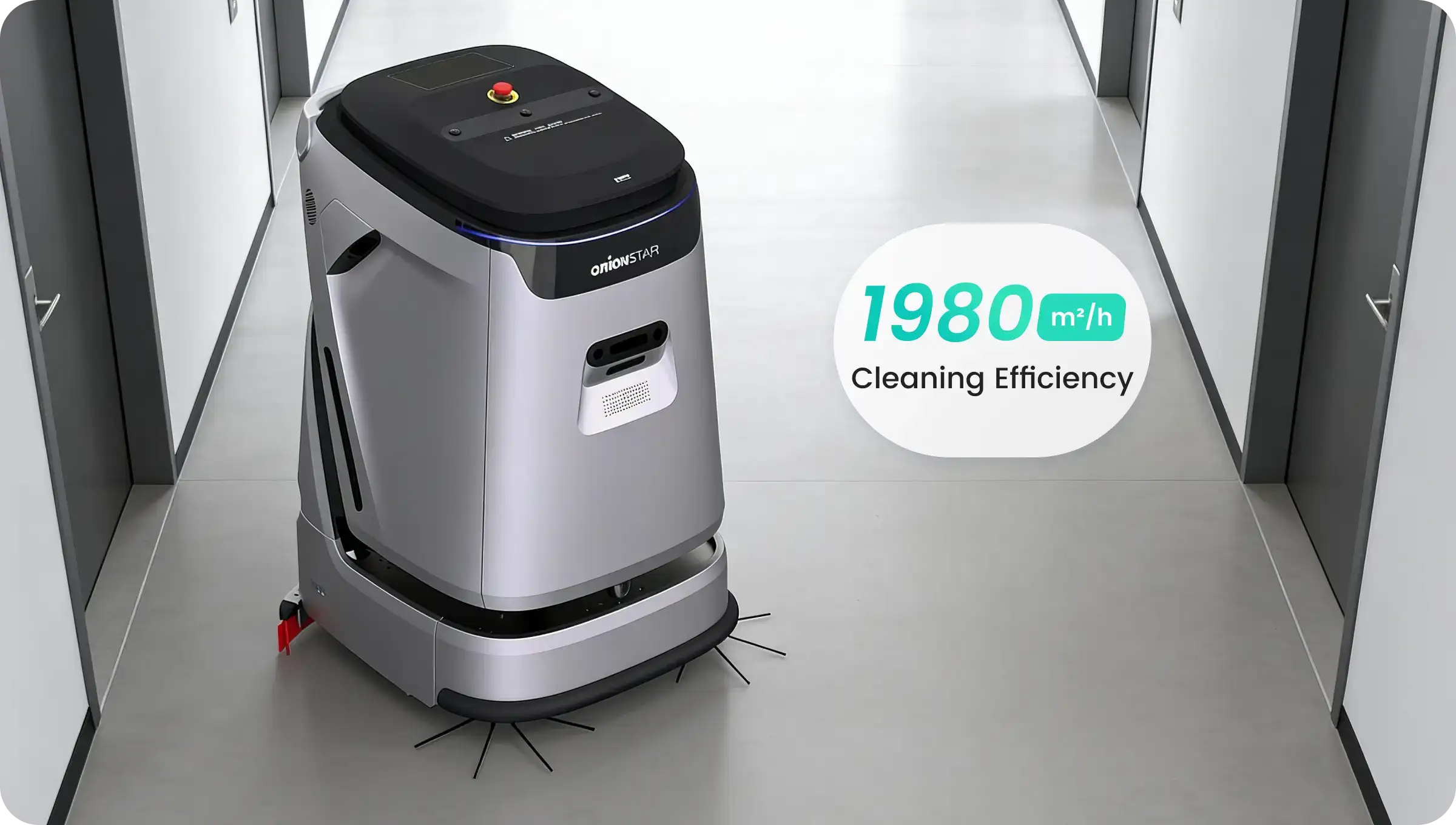
The CleaniBot C5 serves as a high-performance system for expansive, heavy-traffic areas like ballrooms, banquet halls, and pre-function areas. According to manufacturer data, it covers up to 1,980 square meters per hour and features a combined 90-liter water capacity. This makes the C5 highly suitable for aggressive scrubbing in large lobbies after major events.
In contrast, the CleaniBot S55 Pro is engineered for continuous, quiet operation in guest-facing zones such as corridors and guest floors. Operating at noise levels as low as 45 decibels in dust-mopping mode, according to manufacturer specifications, this model navigates narrower hallways without disturbing guests. According to manufacturer data, the S55 Pro can run up to 28 hours in dust-mopping mode, ensuring consistent upkeep across multiple shifts.
These two models operate with a strict complementary logic. They do not compete; instead, they divide tasks efficiently to cover distinct spatial requirements. Moreover, both robots integrate robust digital connectivity. They utilize Wi-Fi and 4G networks to enable remote deployment, cloud-based maintenance, and data reporting. As these systems utilize cameras and process spatial data to navigate, they are designed to be deployed in alignment with regional data protection frameworks, including the GDPR. Ultimately, this multi-model approach creates a unified, highly adaptable floor care ecosystem.
These results are not theoretical; they are realities that hotel operators, facility managers, and housekeeping directors are already validating daily.
Automation in hospitality does not exist to replace human workers. Instead, it serves to elevate human potential within the service environment. Robots are assigned the most physically demanding and repetitive tasks, such as vacuuming endless corridors or scrubbing expansive hard floors. As a result, human staff are directed toward higher-value work that requires judgment and empathy. Real-world deployments confirm this shift. In documented industry deployments, staff have been able to step away from manual vacuuming to focus on banquet room setup and detailed guest care. Moreover, this transition creates entirely new skill sets within the workforce. Cleaning staff are evolving into fleet managers, monitoring digital dashboards, overseeing route data, and interpreting proof-of-service reports. Empathy and complex decision-making remain central to the guest experience. In short, robots manage the square footage, allowing human professionals to manage the hospitality.
Commercial cleaning robots are rapidly transitioning from operational novelties to core infrastructure within modern hospitality management. As labor constraints stabilize into permanent realities, autonomous floor care provides a reliable baseline of predictable, consistent operation. The OrionStar CleaniBot series demonstrates how deploying multiple models adapts directly to the complex spatial demands of modern properties. This approach ensures tailored solutions for diverse operational zones without operational friction. Moving forward, the integration of robotics will define competitive facility operations. Properties that adopt these digital tools will navigate cost pressures more effectively while maintaining exceptional standards of environmental cleanliness. Ultimately, autonomous robotics will become a standard utility in the ongoing evolution of global hospitality venues.