

REQUEST DEMO
Robot CATALOG will be sent to your mailbox immediately after submission.
SUBMIT
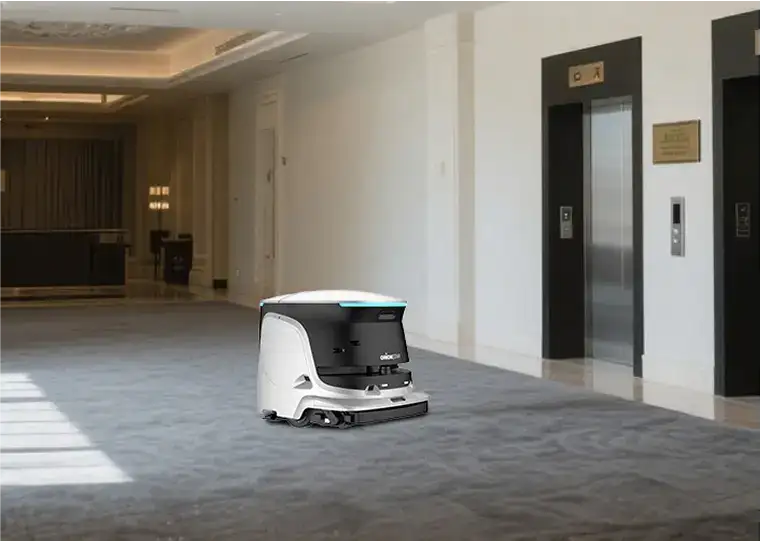
For facility managers, hotel operations managers, and housekeeping directors, maintaining high standards of cleanliness across expansive properties is a constant balancing act. The hospitality industry faces a distinct set of operational challenges, from significant labor shortages to rising operational expenses. According to industry analyses, hospitality labor can account for approximately 35 percent of hotel operating costs, yet operators still struggle to fill repetitive roles, with roughly 1.5 million job vacancies reported across the broader U.S. hospitality sector.
Housekeeping teams spend significant portions of their shifts on physically demanding, repetitive tasks such as vacuuming large expanses of carpet or mopping extensive hard floors. This limits their availability for higher-value, guest-facing service. To address these structural challenges, commercial cleaning robots have emerged as a practical intervention. By automating routine floor care, these systems help stabilize operational costs, ensure consistent cleaning quality, and allow staff to focus on detailed room turns and guest requests.
This guide assesses the OrionStar CleaniBot S55 Pro, evaluating how its specifications and capabilities align with the specific demands of hospitality venues.
Hospitality venues are complex environments requiring different cleaning approaches depending on the time of day, floor surface, and foot traffic. The OrionStar CleaniBot S55 Pro integrates sweeping, scrubbing, vacuuming, and mopping into a single robotic platform. Its versatile cleaning modes and compact physical footprint (650 × 580 × 550 mm) make it suitable for various hotel sub-spaces.
Event spaces require rapid, large-scale cleaning between functions. The CleaniBot S55 Pro is equipped with a LiDAR sensor capable of supporting map construction for areas up to 10,000 square meters. For post-event cleanup in ballrooms and banquet halls, the robot can be deployed in Sweep & Vacuum or Sweep, Vacuum & Mop modes, achieving a cleaning efficiency of up to 1,368 square meters per hour, according to manufacturer data. Its zigzag cleaning path ensures systematic coverage of expansive pre-function areas, allowing human staff to focus on moving furniture, clearing tables, and setting up the next event.
Guest floors demand consistent carpet maintenance without disrupting guest comfort. The CleaniBot S55 Pro features a minimum passing width of 700 mm, allowing it to navigate standard hotel corridors even when housekeeping carts or room service trays are present. Furthermore, noise control is critical in these zones. The robot operates at approximately 55 dB in scrubbing modes and 45 dB in Dust Mopping mode, according to manufacturer data. It also offers an ECO Vacuum mode designed for quieter, energy-efficient dust removal, capable of running for up to 19.5 hours on a single charge.
Hotel lobbies feature mixed flooring types, from high-pile rugs to polished marble, and experience continuous pedestrian traffic. The CleaniBot S55 Pro utilizes a 15-sensor array—including LiDAR, stereo cameras for cliff and step detection, and ultrasonic sensors—to provide 360-degree sensor coverage for a safer working environment. This allows the robot to dynamically navigate around moving guests, luggage carts, and lobby furniture. For polished hard floors, operators can select the Dust Mopping mode to maintain a consistent clean appearance gently and quietly throughout the day.
Deploying autonomous equipment is ultimately an operational and financial decision. Industry case studies indicate that commercial cleaning robots can generate average labor and time savings of 20 to 40 percent. By offloading the burden of vacuuming large square footage, housekeeping directors can reallocate labor hours to detail-oriented tasks that directly impact guest satisfaction scores.
Furthermore, autonomous robots establish a standardized baseline of cleanliness. While manual cleaning quality can vary by shift or individual fatigue levels, a programmed robot executes its defined route consistently. Industry pilots utilizing similar robotic vacuum solutions have reported guest cleanliness scores rising to 90 percent within months of deployment, alongside reported payback periods in the 18 to 24-month range.
A common friction point with commercial cleaning robots is the maintenance overhead they impose on frontline staff. The OrionStar CleaniBot S55 Pro addresses this through a user-friendly mechanical design tailored for commercial environments.
Key maintenance features include:
It is worth noting that properties vary in size and layout. The OrionStar CleaniBot series offers multiple models, enabling hotel operations managers to select the specific hardware configuration that best matches their property's scale and flooring profile.
Modern hospitality management relies heavily on digital oversight. The CleaniBot S55 Pro supports Wi-Fi and 4G connectivity, enabling remote deployment, cloud-based maintenance reporting, and over-the-air (OTA) software updates. This allows facility managers to monitor battery levels, track cleaning efficiency, and manage fleet operations across multiple venues.
However, the integration of connected devices requires strict attention to data privacy. Because the CleaniBot S55 Pro utilizes LiDAR mapping, stereo cameras for navigation, and cloud connectivity to process operational data, hotel operators must verify compliance with the General Data Protection Regulation (GDPR) and applicable local data protection laws.
Under GDPR, operators must practice data minimization. Facility managers should ensure that visual data captured by the robot’s cameras is processed locally for navigation purposes rather than surveillance, and confirm that Data Processing Agreements (DPAs) are in place with the vendor regarding any fleet data stored in the cloud.
Can the CleaniBot S55 Pro clean close to walls and baseboards in corridors? Yes. The robot is equipped with line lasers designed specifically to help it clean close to walls and corners. According to manufacturer specifications, it can be configured to operate at a distance of 5 cm to 10 cm from the wall, maximizing edge-cleaning coverage.
How does the robot handle changes in ballroom layouts, such as moved tables and chairs? The S55 Pro utilizes automatic positioning and real-time map updating via its LiDAR and ultrasonic sensors. If tables or temporary partitions are moved between events, the robot's multi-sensor navigation system detects the new obstacles, avoids them, and dynamically updates its path planning.
Is the robot capable of continuous overnight operation? Runtime depends heavily on the selected cleaning mode. While intensive scrubbing modes operate for up to 4.5 hours, the ECO Vacuum mode can run for up to 19.5 hours, and Dust Mopping can extend up to 28 hours. When the battery depletes, the robot supports automatic recharging, taking less than 4 hours to reach a full charge at its docking station, according to manufacturer specifications.