

REQUEST DEMO
Robot CATALOG will be sent to your mailbox immediately after submission.
SUBMIT
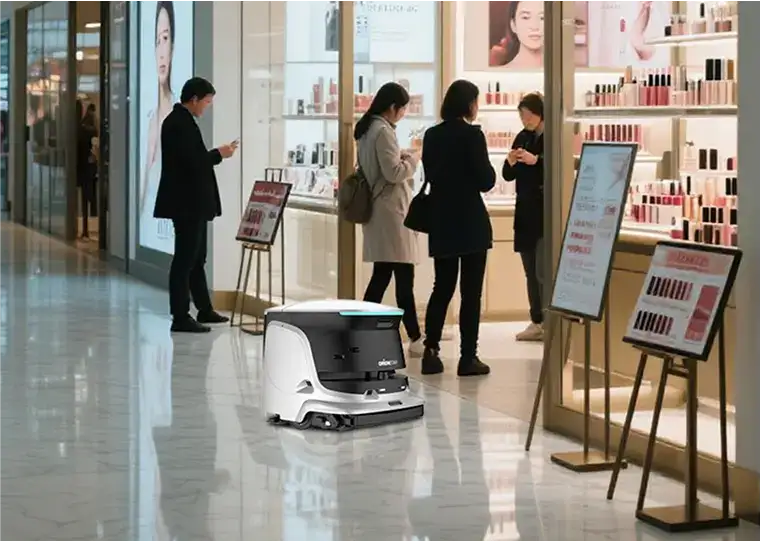
The big-box store sector within commercial buildings currently stands at a critical inflection point regarding facility maintenance. For decades, maintaining vast floor spaces relied heavily on manual labor, a model increasingly strained by structural shifts. Now, a convergence of changing market dynamics makes modernization unavoidable. Commercial building scales are continually expanding, while technological maturity in autonomous navigation has significantly improved. Furthermore, the cost curve for robotic hardware has steadily declined, closely aligning with elevated customer expectations for consistent hygiene in retail spaces. Consequently, facility operators can no longer depend solely on fluctuating human cleaning crews to cover tens of thousands of square meters daily. Therefore, commercial cleaning robots are rapidly emerging as an industry-level solution. These systems offer a scalable response to the immense spatial challenges of modern retail environments. By integrating intelligent hardware into daily maintenance routines, large-scale facilities are successfully shifting from reactive cleaning schedules to predictable, data-driven floor care strategies.
These pressures indicate a significant industry shift—traditional manual cleaning models are increasingly being supplemented by automated solutions to maintain sustainability.
The OrionStar CleaniBot series addresses these diverse spatial demands through a dual-model, complementary strategy. By utilizing a multi-model approach, this strategy recognizes that diverse commercial environments require specialized tools for optimal efficiency. The CleaniBot C5 serves as a heavy-duty, industrial-grade scrubber engineered for demanding environments such as warehouse-style aisles and busy receiving docks. According to manufacturer data, it applies up to 25 kg of downward scrubbing pressure and can map areas of up to 10,000 square meters autonomously [1]. As a result, it is highly effective at removing stubborn grime and heavy industrial buildup in logistics-focused retail spaces.
Conversely, the CleaniBot S55 Pro is designed for complex, customer-facing areas, including active sales floors, congested checkout lanes, and high-traffic entryways. It features a versatile multi-mode cleaning system, operating at a noise level as low as 55 dB [2] during scrubbing, according to manufacturer data. Moreover, it supports a runtime of up to 28 hours [2] in dust mopping mode, ensuring constant upkeep without disrupting shoppers. Together, these models are not competing alternatives but instead form a unified fleet where each machine covers specific sub-spaces efficiently.
Furthermore, this robotic fleet relies heavily on digital management capabilities. Facility managers can utilize Wi-Fi and 4G connectivity to manage remote deployment, conduct cloud-based maintenance, and review performance data reports. Because these systems utilize cameras and 3D-LiDAR to navigate dynamic environments, retail operators must ensure operations strictly adhere to GDPR regulations. OrionStar robots collect navigation data (LiDAR point clouds) and visual data strictly for real-time obstacle avoidance. Visuals are processed on the edge without cloud storage. Cloud connectivity (Wi-Fi/4G) transmits only anonymized telemetry data for maintenance. Use of these features is subject to explicit user consent as detailed in the OrionStar Privacy Policy, ensuring robust privacy compliance during autonomous cleaning cycles [3].
These results are not theoretical; they are the concrete realities that facility managers and retail operators are already verifying in the field.
The commercial cleaning industry maintains a firm stance that automation does not replace skilled cleaning teams but instead elevates their functional role. Modern deployments rely heavily on hybrid cleaning fleets. In this model, robots handle the massive, open, and repetitive hard floor surfaces across mapped routes. Meanwhile, human workers transition to smaller, high-precision zones, detailed sanitation work, and high-touch areas. As a result, facility management teams are experiencing a definitive shift in required skills.
Human operators are steadily stepping into specialized new roles such as fleet supervisors, monitoring leads, and internal automation trainers. Instead of performing physically exhausting manual scrubbing, they utilize digital management systems to track performance data and route efficiency. Above all, automating these physically demanding tasks significantly reduces workforce exhaustion. Retail operators can effectively reallocate their human staff to higher-value maintenance tasks, quality assurance oversight, and direct customer service.
Looking ahead, commercial cleaning robots are steadily transitioning from novel technological additions to essential infrastructure within the big-box store sector. As retail spaces continue to evolve in scale and complexity, the baseline demand for verifiable, consistent, and scalable hygiene solutions will only intensify. The OrionStar CleaniBot series naturally supports this operational shift by offering multiple models meticulously designed to adapt to varied environmental demands and distinct spatial constraints. Ultimately, the successful integration of robotic floor care represents a fundamental maturation of facility management practices. By blending autonomous hardware, digital oversight, and strategic human collaboration, the industry is establishing a much more resilient operational foundation.