

REQUEST DEMO
Robot CATALOG will be sent to your mailbox immediately after submission.
SUBMIT
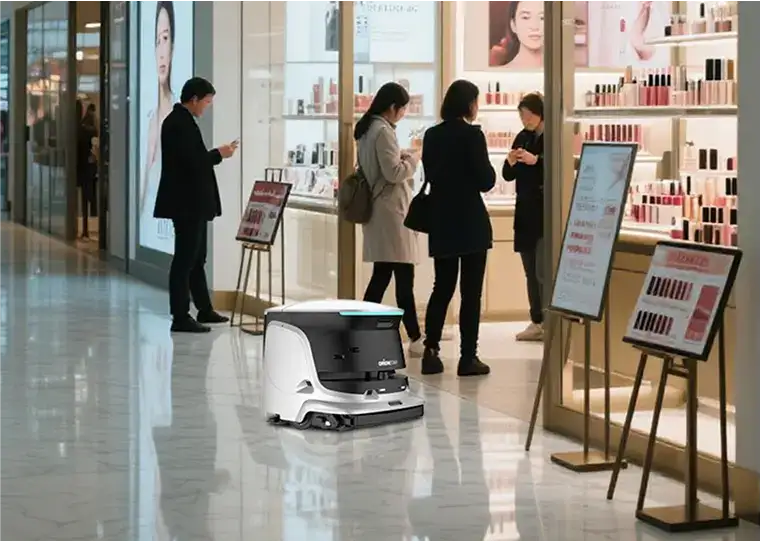
For retail facility managers and store operations directors, maintaining expansive large retail stores presents a continuous operational challenge. High foot traffic brings tracked-in dirt and moisture, while continuous shopping activity leads to localized spills and debris. Facility teams must maintain consistent floor quality across entrance zones, checkout areas, sales floors, and back-of-house corridors, often while navigating around shoppers and merchandise displays.
Industry data highlights the direct operational and commercial impact of these challenges. According to industry research, a negative retail cleanliness experience leads nearly 70% of shoppers to visit a competitor [1], while customers tend to spend up to 40% more time in stores they perceive as clean [2]. Furthermore, slip hazards from spills create concrete liability risks. Simultaneously, the retail sector faces tight labor markets and high staff turnover, making it difficult to execute frequent manual floor cleaning without pulling employees away from customer-facing roles.
To address these spatial and labor constraints, store operations directors are increasingly integrating autonomous commercial floor scrubbers into their daily workflows. This guide examines how the OrionStar CleaniBot S55 Pro functions within a large retail environment, assessing its capabilities against the specific demands of dynamic, multi-zone retail facilities.
Commercial cleaning robots serve to standardize floor care, allowing human staff to focus on high-touch disinfection, customer service, and merchandising. Based on manufacturer data, the CleaniBot S55 Pro integrates sweeping, scrubbing, vacuuming, and mopping into a single platform. For retail managers, the value of this integration lies in how specific cleaning modes adapt to different zones within the store.
Entrance zones and checkout areas experience the highest density of foot traffic and require aggressive management of tracked-in weather elements and spills.
The specifications of the CleaniBot S55 Pro’s Scrubbing and Power Scrubbing modes align closely with the requirements of these zones. Utilizing a 22-liter clean water tank and a 15-liter wastewater tank, the system is designed to provide wet cleaning for hard surfaces. According to manufacturer specifications, the autonomous platform achieves cleaning efficiencies of up to 1,197 square meters per hour* in scrubbing modes. For facility managers, this means high-traffic hard floors can be systematically washed during extended operating windows or overnight shifts, helping to reduce potential public liability and insurance costs associated with wet or soiled entrances.
Cleaning active sales floors during daytime hours introduces constraints regarding noise, customer safety, and aisle navigation. Daytime cleaning is becoming an industry standard, with data-driven daytime cleaning fleets showing productivity gains of nearly 23% in facility research [3].
To support daytime operations without disrupting the shopping experience, the CleaniBot S55 Pro features an ECO Vacuum mode and a Dust Mop mode. Under typical configurations, the dust mopping mode operates at a low noise level of 45 dB, making it suitable for quiet maintenance cleaning around shoppers. The extended battery life in these low-power modes—up to 19.5 hours for ECO Vacuum and up to 28 hours for Dust Mopping—allows the unit to perform continuous dust control across large hypermarket sales floors throughout a full retail shift without requiring frequent returns to its charging dock.
Retail environments feature mixed aisle widths and cluttered back-of-house corridors where inventory is frequently moved. The physical dimensions of an autonomous platform dictate where it can effectively operate.
The CleaniBot S55 Pro features a compact footprint (650 × 580 × 550 mm) and a minimum passing width of 700 mm. This sizing allows it to navigate narrow produce aisles and back-room storage corridors that traditional large-scale scrubbers may find difficult to navigate. In these mixed-debris zones, operators can utilize the Sweep & Vacuum or the combined Sweep, Vacuum & Mop modes to address varied debris profiles, supporting cleaning efficiencies of up to 1,368 square meters per hour*.
Deploying autonomous equipment in environments with shopping carts, strollers, and unpredictable pedestrian movement requires robust safety and navigation systems.
According to product specifications, the CleaniBot S55 Pro utilizes a multi-sensor array for localized path planning and real-time obstacle avoidance. The system utilizes a LiDAR sensor capable of mapping spaces up to 10,000 square meters*, and a stereo camera (which processes incidental images locally on the edge device without cloud storage) for cliff and step detection, and ultrasonic sensors to detect dynamic obstacles. Line lasers assist the unit in cleaning close to walls and display cases, typically operating at a default distance of 10 cm to maximize edge coverage. For store operations directors, this combination of sensors reduces the necessity for constant staff supervision and lowers the risk of collisions with temporary product displays or store visitors.
The success of a retail robotics program depends heavily on ease of maintenance and the ability to verify that cleaning tasks were completed to standard.
The CleaniBot S55 Pro supports Wi-Fi and 4G connectivity, which enables remote deployment, over-the-air (OTA) updates, and cloud-based data reporting. Centralized data access allows regional managers to monitor key performance indicators and verify cleaning coverage across multiple store locations.
To minimize friction for local store staff, the autonomous platform is designed with user-friendly maintenance features. This includes modular cleaning tools that can be swapped without specialized equipment, and a removable, washable wastewater tank that helps reduce bacterial buildup and odor when maintained daily.
Because autonomous commercial cleaning platforms rely on Wi-Fi, 4G, OTA, cloud-based data reporting, LiDAR, and stereo cameras to navigate and generate coverage reports, digital compliance is a mandatory evaluation metric. Retail operators deploying connected robotics in European markets, or those adhering to global privacy standards, must rigorously assess the system under GDPR.
The system processes specific data types, including spatial mapping data (2D/3D point clouds), equipment operational logs (battery levels, cleaned area, fault codes), sensor telemetry, and incidental images of pedestrians potentially captured by the stereo camera. This data is utilized strictly for local obstacle avoidance navigation, generating B2B cleaning coverage reports, remote diagnostics, and OTA software upgrades.
Crucially for privacy compliance, camera images are processed in real-time solely on the edge device (edge-computing) for obstacle avoidance; they are not saved or uploaded to the cloud. Operational log data is retained according to the customer agreement (typically 30 to 90 days).
Furthermore, user consent and privacy policy requirements must be met prior to deployment. At the B2B level, a Data Processing Agreement (DPA) must be attached to the sales contract. At the B2C level, retail malls (acting as Data Controllers) are required to post privacy notices at store entrances indicating the use of automated navigation devices and cameras, fulfilling the duty to inform under Article 13 of the GDPR.
Transitioning to autonomous floor care requires matching the right hardware to the facility's specific foot traffic, floor types, and operating hours. The OrionStar CleaniBot series offers multiple configurations, allowing facility directors to deploy appropriate models across different store formats within their portfolio. By leveraging the data reporting, localized safety sensors, and multi-mode cleaning capabilities of units like the CleaniBot S55 Pro, retail operators can establish a more consistent, auditable, and labor-efficient approach to facility maintenance.
How does the autonomous platform handle changes in store layouts, such as promotional displays? The unit utilizes LiDAR for real-time map updating and ultrasonic sensors for smart obstacle avoidance. When it encounters a new, unmapped obstacle like a temporary merchandise display, the sensor array detects the object and dynamically adjusts the cleaning path to navigate safely around it.
Is the machine easy for standard retail employees to operate and maintain? The CleaniBot S55 Pro is designed for practical daily use, featuring no-tool mode switching and modular cleaning components. The wastewater tank is removable and fully washable, which simplifies the end-of-shift maintenance routine for store staff.
Can the autonomous platform cover an entire large-format store on a single charge? Coverage depends on the selected mode. Heavy scrubbing tasks yield a runtime of up to 4.5 hours, which is typically sufficient for targeted zones like entrances and checkout areas. For broad-area daytime maintenance, the ECO Vacuum and Dust Mop modes provide runtimes of up to 19.5 and 28 hours* respectively, supporting full-shift coverage for expansive sales floors. Automatic recharging allows the autonomous platform to automatically manage its own power cycles when the battery runs low.
[1] 2019 ServiceChannel consumer survey on retail cleanliness experience. [2] University of Warwick research on customer dwell time in clean store environments. [3] Cleaning Maintenance & Management survey on data-driven fleet productivity. *Based on internal laboratory testing. Actual mapping range, cleaning efficiency, and battery life may vary depending on floor type, layout complexity, and environmental conditions.