

REQUEST DEMO
Robot CATALOG will be sent to your mailbox immediately after submission.
SUBMIT
Integrated facility management is currently navigating a structural shift in labor dynamics. For facility managers and building service contractors operating in commercial buildings, maintaining high hygiene standards while managing costs has become increasingly complex. This guide examines how automated solutions address these industry challenges, with a specific focus on evaluating the OrionStar CleaniBot C5 for commercial building environments.
The fundamental challenge in modern facility management is a persistent labor shortage combined with rising operational costs. Demographic trends, including an aging workforce where 27% of soft-services employees are 55 or older, have severely constrained the labor pool available for commercial cleaning.
Consequently, wage pressures have increased, yet productivity has largely flattened. Attempting to force higher output from a limited workforce often leads to burnout and compromised cleaning quality. The financial implications are significant: standard commercial cleaning costs typically range from USD 0.12 to USD 0.35 per square foot per month, but inadequate cleaning carries hidden costs. Industry estimates (e.g., ISSA / CDC reports) suggest that lost productivity and medical costs can reach approximately USD 1,685 per employee annually when facility hygiene standards deteriorate.
In this environment, commercial cleaning robots have shifted from experimental technology to highly effective operational assets. By automating repetitive, large-scale floor care, facility managers can optimize resource allocation, reallocating human staff to high-touch, detail-oriented tasks that require human judgment. To address the varying complexities of different facilities, the OrionStar CleaniBot series provides multiple models, with the OrionStar CleaniBot C5 specifically engineered for medium-to-large commercial and industrial footprints.
Successful robotic deployment requires hardware that adapts to diverse spatial requirements, from tight indoor walkways to expansive utility zones. The OrionStar CleaniBot C5 incorporates features designed to manage these distinct sub-spaces effectively.
Main entrance lobbies and connecting corridors require consistent appearance management but are often highly trafficked and sensitive to disruption.
Navigational Fit and Risk Mitigation: The C5 features a minimal passing width of approximately 880 mm in its typical configuration, according to manufacturer data, allowing it to navigate standard commercial corridors and doorways safely. This precise navigation supports risk mitigation and occupational safety in public areas.
Acoustic Management: Operating noise is a critical factor for daytime cleaning. Under defined test conditions, the C5 operates at less than 68 dB(A), according to manufacturer data, making it feasible for deployment in busy public spaces without causing excessive disturbance to tenants or visitors.
Multi-Modal Cleaning: The robot supports scrubbing, dust-mopping, and water absorption, allowing it to sweep, scrub, and mop in a single cycle to maintain lobby aesthetics.
Subterranean parking areas and large ground-floor common spaces present different challenges, typically involving heavier soil loads, light debris, and vast square footage.
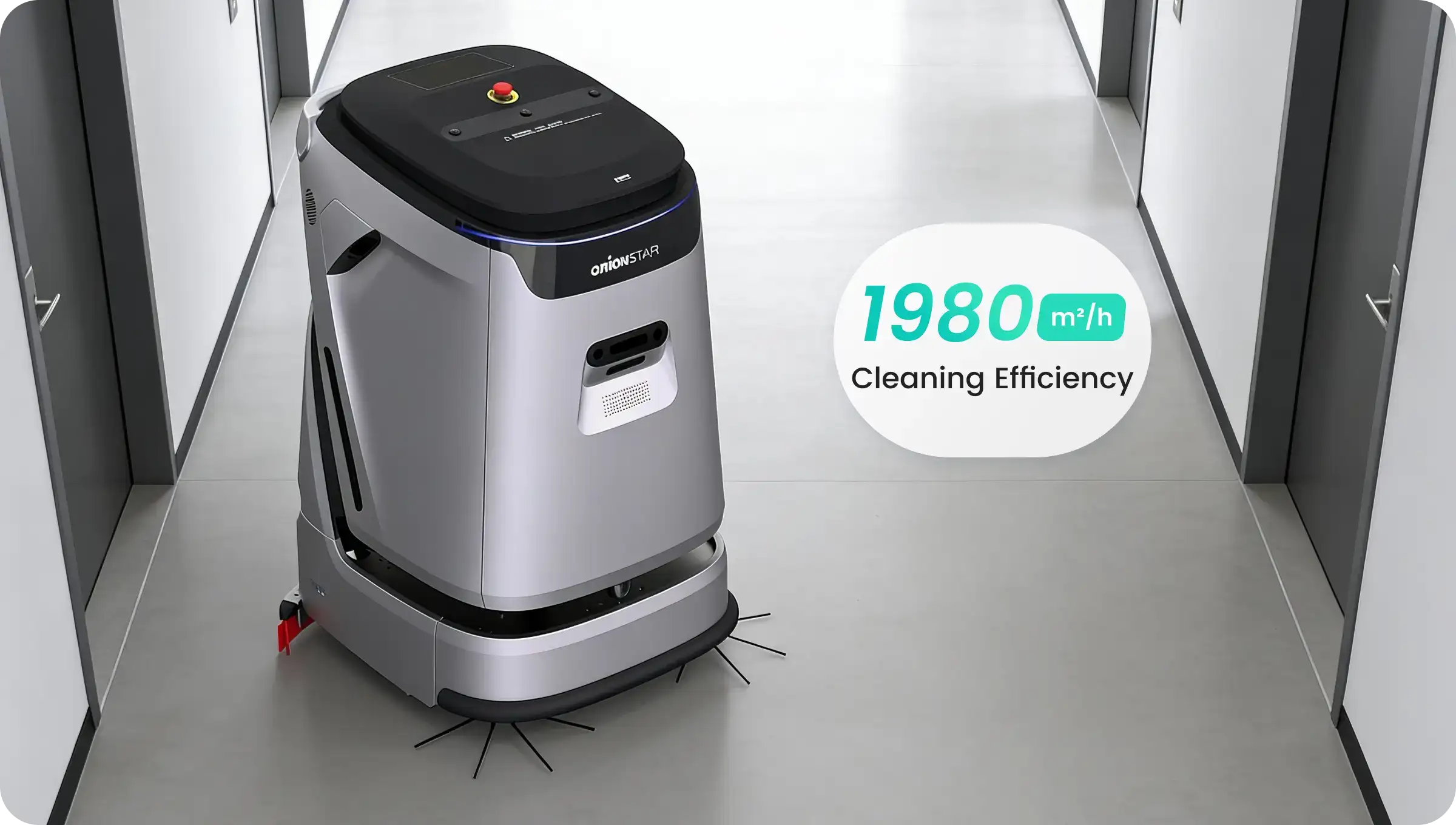
Coverage Efficiency: Equipped with a 550 mm main brush, the C5 offers a maximum cleaning area capacity of up to 1,980 square meters per hour, according to manufacturer data.
Heavy-Duty Scrubbing: For areas with grime or oil stains, the machine applies up to 25 kg of downward scrubbing pressure, according to manufacturer data, via a dual-rolling-brush system.
Debris Handling: To prevent blockages in mixed-use areas, the robot can pick up dry debris up to about 3 cm in height, depositing it into a 1.8 L dust bin, according to manufacturer data.
The operational value of commercial cleaning robots relies heavily on their ability to function with minimal human intervention.
The CleaniBot C5 utilizes an automated docking station that handles auto-charging, clean-water refilling, and waste-water discharge. According to manufacturer specifications, the workstation includes a high-pressure internal tank rinsing feature, and the waste-water tank can self-clean in roughly 4 minutes to help prevent odors. The robot carries a combined 90 L water capacity (45 L clean, 45 L waste), which limits the frequency of required docking.
For facilities where modifying building plumbing to accommodate a permanent dock is not feasible, the C5 offers optional mobile water tanks to maintain deployment flexibility. Its battery supports a scrubbing runtime of about 3 hours and a mopping runtime of up to 8 hours, varying by floor type and operating mode, according to manufacturer data, with auto-charging capabilities that enable multi-shift operations in large commercial venues.
Facility managers expect digital fleet management capabilities, such as cloud-based dashboards, route adjustment tools, and performance metrics, to monitor utilization. However, connected devices introduce compliance responsibilities.
Because the OrionStar CleaniBot C5 relies on multiple sensors and smart obstacle-avoidance systems for autonomous navigation, it maps up to 10,000 square meters of floor space, depending on facility layout and environmental complexity, and processes environmental data. Facility managers and building service contractors must proactively verify that the deployment, cloud-data transmission, and any associated visual or spatial data processing comply with GDPR and other applicable local data protection regulations. Operators should ensure that network connections are secure, that role-based access protocols are enforced, and that Data Processing Agreements are in place before deployment.
Purchasing a robot does not automatically guarantee savings; Total Cost of Ownership (TCO) and ROI depend on how well the machine is integrated into the facility's overall cleaning program.
Industry data indicates that well-managed robotic programs yield substantial benefits. In one documented case study managed by a U.S. facility services provider, redesigning the scope of work and properly training on-site staff led to a 49% increase in robotic utilization within nine weeks, ultimately contributing to a 21% reduction in overall cleaning and maintenance costs. Broad industry adoption points suggest that optimized deployments can generate operational savings ranging from USD 30,000 to USD 150,000 per unit annually, driven primarily by the reduction in manual labor hours required for floor care.
For building service contractors, utilizing the OrionStar CleaniBot C5 allows for more predictable cleaning schedules and stable operational costs. By shifting the burden of floor scrubbing to an automated system, contractors can mitigate the impact of high turnover and wage inflation, ultimately delivering more consistent facility management outcomes.