

REQUEST DEMO
Robot CATALOG will be sent to your mailbox immediately after submission.
SUBMIT
The shopping center sector within commercial buildings stands at a clear operational inflection point. Over the past decade, the foundational economics of facility management have fundamentally shifted. Labor availability is tightening, operating costs are climbing, and customer expectations for consistently clean environments are stricter than ever. Meanwhile, automation technology has matured significantly. Cost curves for sensor technology and navigation software are shifting favorably. Operators are discovering that relying solely on manual labor poses scalability challenges. Facilities face immense pressure to maintain vast square footage without proportionally expanding their budgets. Therefore, traditional manual upkeep alone struggles to meet the demands of modern retail ecosystems. As a result, commercial cleaning robots are emerging as a vital, industry-level solution. These autonomous systems offer consistent coverage, verifiable performance data, and operational predictability. Above all, they allow facility operators to rethink resource allocation across expansive properties. This shift represents a significant advancement in how commercial real estate is maintained.
Persistent Labor Constraints: Labor availability severely restricts daily facility management. In a May 2024 CBRE survey, 42 percent of European retail respondents identified labor shortages as a primary operational concern.
Escalating Operating Costs: Facility operators face mounting financial pressures alongside rising property expenses. CBRE data shows average shopping-center rents increased 7.9 percent year over year in 2023, effectively squeezing budgets for critical cleaning and maintenance.
Intensifying Footfall and Hygiene Demands: Retail environments must handle growing visitor numbers while maintaining strict hygiene standards. Regional shopping-center footfall increased 4 percent in 2023 according to CBRE, driving a constant need for rapid spill management and floor care.
Vast Scale and Verification Challenges: Managing expansive commercial spaces creates immense oversight complexity. At large sites, operators historically lacked the digitized reporting necessary to verify consistent cleaning quality.
Ultimately, these pressures point to a clear industry trend—the traditional manual cleaning model faces increasing operational constraints.
The OrionStar CleaniBot series provides a differentiated, dual-model solution designed specifically for the complex layouts of commercial buildings. Rather than relying on a single uniform machine, facility managers can deploy specialized units that serve distinct operational roles.
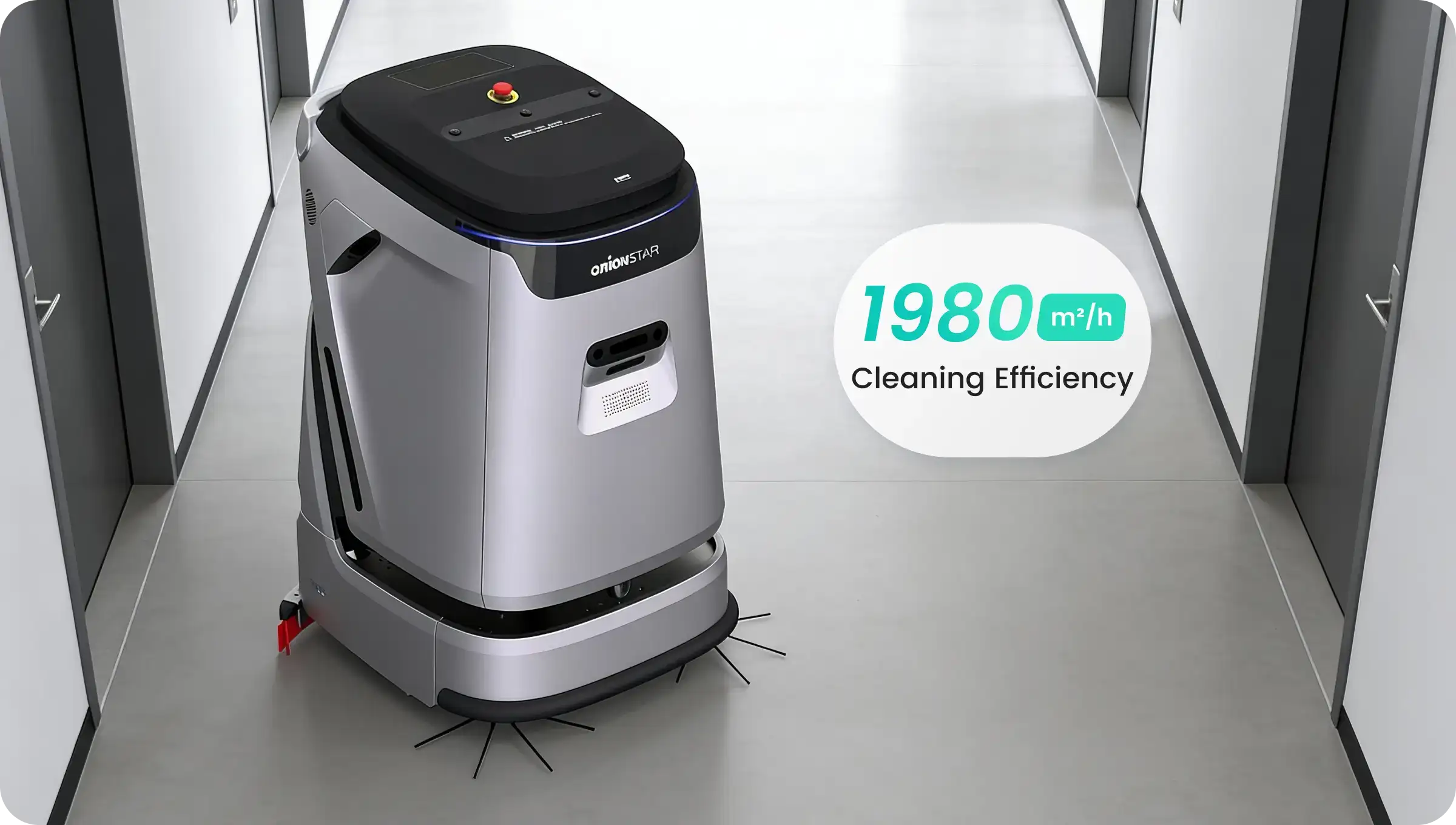
The CleaniBot C5 functions as a high-capacity, industrial-grade system built for wide-open spaces and high-soil zones. It features an expansive 90-liter combined water tank. According to manufacturer data, it delivers a maximum cleaning capacity of up to 1,980 square meters per hour under optimal test conditions, noting that actual results vary by floor layout, obstacle density, and selected cleaning mode. Therefore, it excels in sprawling common areas, heavy-traffic food courts, and adjacent parking areas. It applies up to 25 kilograms of downward scrubbing pressure. This makes it highly effective for removing thick grease or heavy grime found near busy dining zones.
Conversely, the CleaniBot S55 Pro is engineered for agility and quiet operation during business hours. The S55 Pro operates at a minimal noise level of 45 decibels during dust mopping. According to manufacturer data, it achieves a runtime of up to 28 hours under optimal test conditions, noting that actual results vary by floor layout, obstacle density, and selected cleaning mode. This allows it to navigate narrower corridors, tight retail walkways, and zones near restrooms without disrupting the shopper experience. Its ability to autonomously switch between sweeping, scrubbing, and vacuuming allows it to adapt seamlessly to diverse floor types.
These two models operate under a strictly complementary logic. They do not compete; instead, they divide and conquer. The C5 manages heavy-duty, large-scale scrubbing, while the S55 Pro handles nuanced, continuous maintenance in noise-sensitive areas. Moreover, both units integrate robust digital management tools. Facility operators can utilize Wi-Fi or 4G connectivity for remote deployment, cloud-based monitoring, and automated data reporting. Because these robots utilize cameras and cloud data processing for navigation, operating entities must actively verify GDPR compliance to ensure lawful data handling and privacy protection. Data collected via cameras and sensors is processed strictly for real-time navigation and operational mapping. OrionStar adheres to GDPR and local privacy regulations, ensuring no personally identifiable information (PII) is stored, and environmental data is localized or anonymized.
Accelerated Cleaning Frequency: Automation allows sites to maintain higher hygiene standards without proportional labor increases. In typical large-scale retail deployments, automated systems can increase cleaning frequency compared to traditional methods, though results depend on facility conditions.
Measurable ESG Contributions: Autonomous scrubbers actively support corporate sustainability and environmental targets. Field deployments demonstrate that automated systems can reduce water and chemical usage compared to traditional methods, though actual savings and performance may vary depending on facility conditions and operational protocols.
Verified Large-Scale Execution: Robotic systems demonstrate immense durability for long-term commercial application. According to industry observations, deployed autonomous scrubbers have successfully cleaned millions of square meters to date across various large-scale facilities.
These results are not theoretical projections; they are the tangible realities that facility managers and retail operators are already verifying in the field.
Automation within commercial buildings does not replace human workers; rather, it elevates their roles. The most effective operational model is one of calculated task redistribution. Robots take over the physically demanding, repetitive task of large-area floor sweeping and scrubbing. Consequently, human staff are redirected toward high-value, detail-oriented work. Cleaning professionals can focus their attention on hygiene-critical restrooms, glass barriers, staircases, and immediate spill response.
This collaborative structure significantly changes the daily routine of facility teams. Instead of pushing heavy equipment across vast corridors, workers transition into roles requiring judgment and adaptability. Moreover, this shift necessitates the development of entirely new technical skills. Cleaning personnel are learning to manage robot mapping, route scheduling, and remote fleet supervision. They also interpret coverage heatmaps and handle digital quality assurance. Ultimately, human workers remain essential for managing exceptions and ensuring a high-quality customer environment. The integration of technology reduces physical fatigue while creating a more resilient, highly skilled workforce.
Looking to the future, commercial cleaning robots are rapidly transitioning from experimental novelties to essential facility infrastructure. The demands of modern retail environments dictate a more systematic, data-driven approach to physical maintenance. Because no single commercial space is entirely uniform, the OrionStar CleaniBot series provides multiple distinct models to adapt to varying sub-space requirements, traffic patterns, and acoustic limitations.
Facility managers who adopt these automated systems will likely gain a structural advantage in resource allocation and operational transparency. Over the coming years, verifiable digital cleaning records and autonomous fleet management will become standard industry expectations. In short, robotics will not merely clean floors; they will fundamentally redefine how commercial real estate is managed, measured, and maintained for the long term.