

REQUEST DEMO
Robot CATALOG will be sent to your mailbox immediately after submission.
SUBMIT
Workplace management in commercial buildings is currently standing at a distinct inflection point. The traditional approaches to facility maintenance are no longer sufficient to meet modern operational demands. Why is this shift happening now? The evolution of the hybrid market has created highly unpredictable daily occupancy rates. At the same time, employee expectations for workplace hygiene have sharply increased. Visible cleanliness is now a critical factor in driving office return rates. Moreover, robotics technology has reached a mature operational stage. The cost curve of automation has fallen, making these systems highly viable for daily use. Therefore, commercial cleaning robots have emerged as a critical sector-level solution. They bridge the gap between fluctuating foot traffic and the rising demand for pristine corporate environments. Facility teams are moving past short-term, stopgap measures. Instead, they are integrating intelligent systems to maintain a consistent baseline of quality. As a result, these autonomous systems are moving from experimental pilots to essential building infrastructure. In short, automation is reshaping the fundamental economics of floor care.
Unpredictable Occupancy Rates: Hybrid work models have created fluctuating foot traffic across commercial spaces. Consequently, static and traditional cleaning schedules have become highly inefficient and costly to maintain.
Heightened Hygiene Expectations: Employees now demand a visibly clean environment as a condition for returning to the physical office. This expectation pressures facility managers to maintain constant, high-level cleanliness.
Severe Labor Shortages: The facility services sector struggles to attract and retain frontline cleaning staff. Historical industry data indicates annual turnover rates frequently exceed 100 percent.
Inconsistent Quality Standards: High staff turnover directly leads to highly variable cleaning standards across corporate facilities. Onboarding new staff continuously makes it difficult to maintain the baseline hygiene that modern tenants expect.
These pressures together point to one conclusion — the traditional model is reaching its operational limits.
To navigate these shifting demands, the OrionStar CleaniBot series offers a differentiated dual-model approach. These systems are designed to operate as a complementary fleet within commercial buildings. One machine cannot handle every scenario efficiently. Instead, each model has its specific role and covers different spatial requirements.
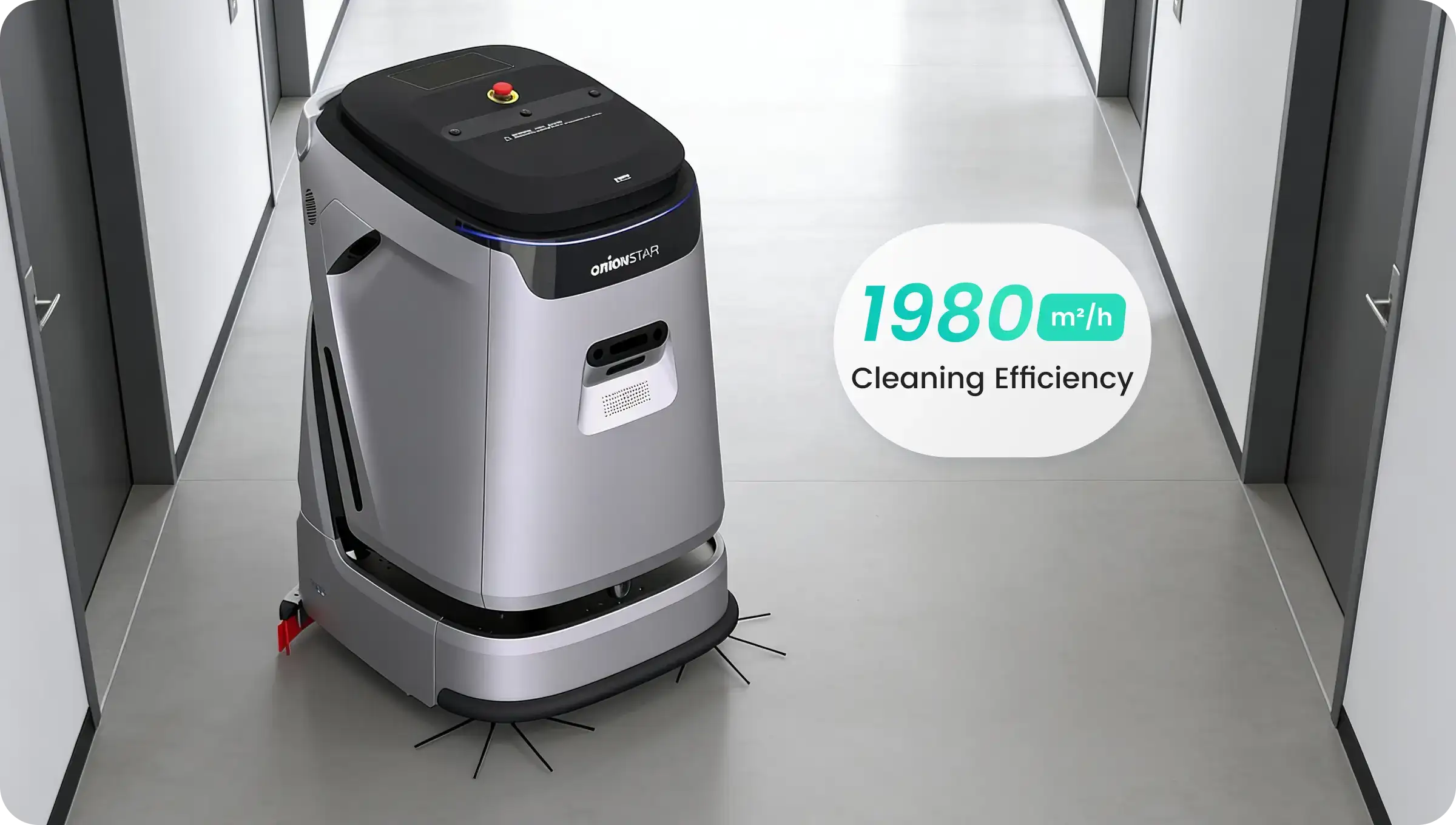
For heavy-duty environments like parking areas, open offices, and wide corridors, the CleaniBot C5 takes the lead. According to manufacturer data, it delivers up to 25 kg of downward scrubbing pressure. It can also cover cleaning areas of up to 1,980 square meters per hour. Cleaning coverage and runtime are based on manufacturer testing under standard conditions and may vary depending on floor types, layout, and environmental factors. Therefore, the C5 excels at removing heavy grime in high-traffic zones. Moreover, its combined 90-liter water tank minimizes manual refilling, allowing for extended autonomous operation.
Conversely, the CleaniBot S55 Pro is engineered for quieter, dynamic spaces such as lobbies, common areas, and coworking zones. It focuses on multi-mode agility rather than sheer industrial power. According to manufacturer specifications, it offers a long runtime of up to 19.5 hours in ECO vacuum mode. Operating at a low noise level of 55 decibels during scrubbing, it cleans efficiently without disturbing active office workers. Above all, the C5 and S55 Pro are not competing alternatives. They work together to address the most common scenarios in building maintenance.
Both models integrate advanced digital management capabilities. Facility teams can utilize remote deployment, cloud-based maintenance, and detailed data reporting to optimize cleaning routes. The use of cloud-based management features and data reporting requires explicit user consent in accordance with the applicable Privacy Policy. Because these robots utilize cameras and sensor arrays for navigation, data privacy remains a critical priority. Operators must verify GDPR compliance when deploying these systems. To mitigate surveillance risks, navigation data should be processed locally on the edge, ensuring no personally identifiable information is stored.
Operational Efficiency and Coverage: Major real estate firms integrate autonomous scrubbers to handle vast square footage during off-hours. This approach helps ensure a consistent baseline of floor care across large corporate campuses.
Labor Reallocation and Quality: Deployments result in the strategic reallocation of human effort rather than direct job replacement. Human cleaners now focus on complex, high-touch sanitization tasks, leading to a marked reduction in tenant complaints.
ESG and Environmental Sustainability: Autonomous floor scrubbers directly support green building certifications like LEED and BREEAM. They optimize water usage through advanced dosing systems and water recycling capabilities, significantly reducing resource waste.
Indoor Air Quality Management: Robotic vacuums equipped with advanced filtration systems ensure the consistent removal of particulate matter. This automated dust control aligns directly with stringent indoor air quality protocols mandated by the WELL Building Standard.
These results are not theoretical; they are already being validated by workplace managers, facility managers, and corporate real estate teams.
The introduction of robotics fundamentally alters the skill profile required for facility teams. Automation does not replace people; instead, it elevates their daily operational focus. By adopting a human-robot collaboration model, facilities can achieve superior maintenance standards. Robots take over the most physically demanding, repetitive, and large-area floor cleaning tasks. As a result, this division of labor reduces ergonomic strain and workplace injuries among janitorial staff.
Human workers subsequently shift their attention to quality control, customer service, and detail-oriented hygiene management. Moreover, this technological integration creates entirely new roles within the workplace management sector. Positions such as robot fleet managers and specialized cobotic technicians are steadily emerging. These roles require a new set of digital skills. Workers now program optimal cleaning routes, interpret data dashboards, and perform hardware troubleshooting. In short, equipping cleaning staff with advanced technology improves job satisfaction and elevates the perceived value of the janitorial profession.
Commercial cleaning robots are rapidly becoming foundational infrastructure for the workplace management sector. As buildings grow more complex, the reliance on automated maintenance systems will only deepen. Facility operations are moving away from reactive labor models toward predictable, data-driven fleet management. In this evolving landscape, a one-size-fits-all approach is rarely effective. Therefore, the OrionStar CleaniBot series offers multiple models designed for different scenarios, which are worth exploring for comprehensive facility planning. Forward-thinking real estate operators are already integrating these systems into their long-term architectural and operational strategies. Ultimately, intelligent automation is no longer a temporary operational fix. Instead, it represents a highly effective approach for commercial facility operations worldwide.