

REQUEST DEMO
Robot CATALOG will be sent to your mailbox immediately after submission.
SUBMIT
Integrated Facility Management in commercial buildings is currently at a critical inflection point. For decades, building operators relied on linear staffing models to maintain expansive floor plates. However, this approach is fracturing under modern demands. The catalyst for change is happening right now due to a convergence of factors. Technological maturity in autonomous navigation has reached commercial viability, altering the cost curve of deployment. Simultaneously, post-pandemic client expectations for hygiene have solidified into permanent, high-stakes mandates. Consequently, facility budgets are stretched thin while the scale of required maintenance continues to grow. To bridge this gap, operators require scalable, reliable interventions. As a result, commercial cleaning robots are emerging as an essential industry-level solution. They transition facility care from a variable manual process to a predictable, digitized operation. By integrating automated fleets into daily routines, managers can establish consistent service levels across millions of square feet. In short, automation is no longer a futuristic concept; it is the immediate operational baseline for modern facilities.
Chronic Labor Volatility: According to Avidbots research, up to 15% of the cleaning workforce may miss shifts daily. This persistent absenteeism makes it highly difficult to maintain consistent service levels across large facilities.
Strained Operational Budgets: Inflation and rising labor costs are forcing facility teams to maintain or improve quality without proportional budget increases. Therefore, operators urgently need interventions that reduce long-term maintenance expenses.
Heightened Hygiene Standards: ISSA survey data indicates that 92% of customers consider cleanliness a deciding factor for repeat business. Consequently, delivering consistent, high-quality cleaning is now a critical commercial requirement.
Widening Skill Gaps: High workforce turnover rates complicate safety compliance and scalable staffing during peak operational periods. Static staffing models simply struggle to deliver consistent quality across millions of square feet.
These pressures collectively point to one conclusion—the traditional model is no longer sustainable.
To address these structural challenges, the OrionStar CleaniBot series provides a differentiated, dual-model solution for commercial buildings. The focus is not on determining which machine is superior. Instead, the strategy relies on a complementary logic where different models cover distinct spatial profiles.
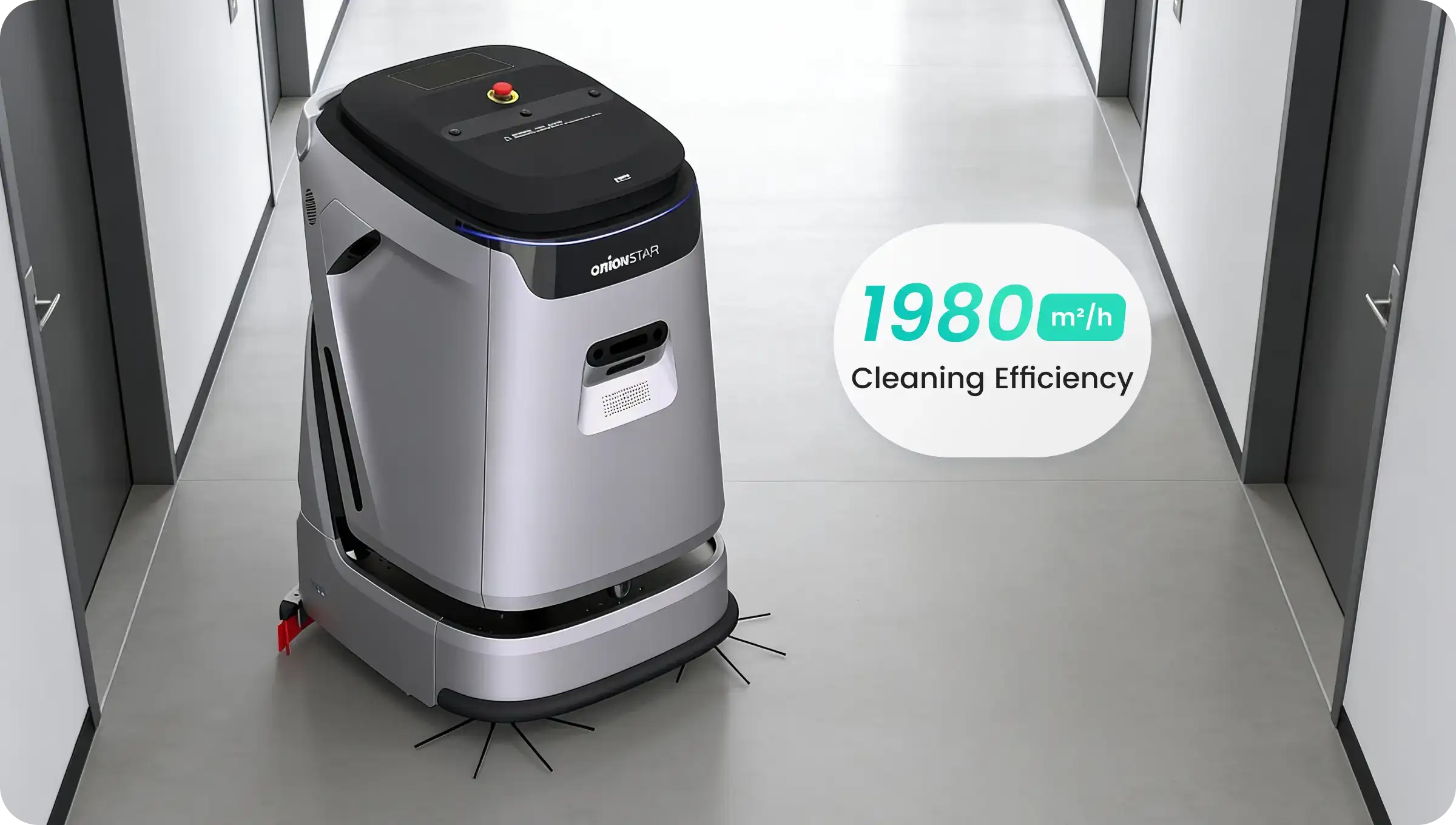
The CleaniBot C5 serves as the heavy-duty asset for expansive, high-traffic zones like parking areas and industrial-style common spaces. It delivers a cleaning capacity of up to 1,980 square meters per hour. Furthermore, its combined 90-liter water tank system minimizes downtime in demanding environments. This makes the C5 ideal for spaces requiring rigorous, continuous floor scrubbing to remove heavy grime.
Conversely, the CleaniBot S55 Pro is engineered for dynamic, pedestrian-heavy spaces such as lobbies, corridors, and carpeted common spaces. It features a minimum passing width of 700 millimeters, allowing it to navigate tight layouts effortlessly. Moreover, its noise levels can drop to 45 decibels in dust-mopping mode. This ensures quiet, low-intervention cleaning during active business hours without disturbing occupants.
Together, these robots execute distinct duties to form a comprehensive floor-care strategy. Above all, both models integrate seamlessly into facility operations through robust digital management. Built-in connectivity enables remote deployment, fleet management, and detailed data reporting. Because these robots utilize cameras and LiDAR for spatial mapping, building operators must verify that data collection and processing comply with GDPR requirements. By implementing local processing and data anonymization, managers can safely leverage this technology while protecting occupant privacy.
Predictable Financial Returns: Optimized robotic cleaning programs can yield measurable long-term cost savings, helping to stabilize fluctuating facility budgets over time.
Optimized Labor Allocation: Deploying automated systems in lobbies and corridors successfully redirects human labor hours toward more intricate tasks. As a result, facilities achieve higher overall maintenance quality without expanding their headcount.
Advanced Sustainability and ESG: According to a JLL report, corporate ESG priorities are heavily driving green building investments. Optimized robotic path mapping directly reduces water waste, while low-light operational capabilities lower the energy costs associated with overnight manual cleaning crews.
These results demonstrate practical benefits that integrated facility managers and building operators are already verifying.
A common misconception is that automation exists purely to eliminate human jobs. In reality, automation serves to elevate the workforce rather than replace it. Commercial cleaning robots take on the highly repetitive, large-area floor care tasks that often lead to physical fatigue. Consequently, human staff can shift their focus toward client-facing duties and intricate cleaning tasks that require human judgment.
According to the IFMA guide on AI for facilities management, this shift optimizes operational processes and monitors equipment in real time. Therefore, new specialized roles are rapidly emerging within the industry. Cleaning personnel are transitioning into fleet management, data monitoring, and quality supervision positions. This hybrid working model combines centralized digital oversight with distributed robotic assets. By decreasing the time required for employees to reach basic proficiency, employers can operate sustainably amid tight labor pools. Ultimately, technology supports the human workforce, enabling teams to deliver higher value services across commercial spaces.
Looking to the future, commercial cleaning robots are rapidly transitioning from experimental novelties to fundamental infrastructure within Integrated Facility Management. As commercial buildings grow in complexity, relying solely on manual labor is structurally inadequate. Facility operators must adopt scalable, predictable tools to meet modern operational demands. The OrionStar CleaniBot series supports this transition by providing multiple models to adapt to diverse spatial requirements and varying soil conditions. By integrating these targeted robotic solutions, managers can build a highly resilient operational framework. In short, the integration of automated floor care is no longer just a tactical advantage. It is becoming the baseline standard for operating efficient, compliant, and sustainable commercial buildings worldwide.