

REQUEST DEMO
Robot CATALOG will be sent to your mailbox immediately after submission.
SUBMIT
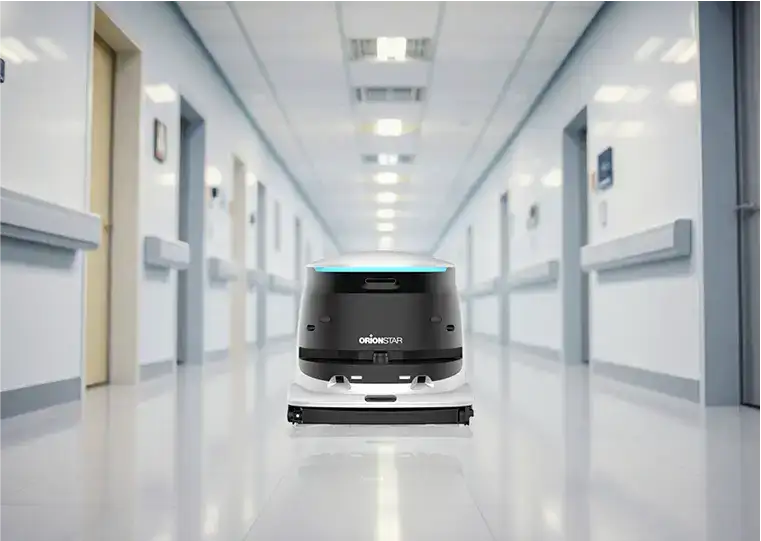
Facilities Services teams operating in hospitals are currently navigating a widening gap between stringent cleanliness standards and available resources, grappling with high labor turnover, downward spending pressure, and strict infection control compliance. To bridge this gap and ensure verifiable patient safety, commercial cleaning robots are increasingly being adopted as a reliable technological solution. By automating routine floor care, these intelligent machines reduce the reliance on variable manual labor and maintain consistent hygiene standards across complex healthcare environments.
Demonstrating these industry-standard capabilities, the OrionStar CleaniBot S55 Pro operates autonomously using a multi-sensor system that includes a LiDAR sensor, a stereo camera, and ultrasonic sensors to support obstacle avoidance and dynamic path planning. According to manufacturer data, the unit can construct maps for areas up to 10,000 square meters and achieves a maximum cleaning efficiency of up to 1,368 square meters per hour in its sweeping and vacuuming modes. By integrating sweeping, scrubbing, vacuuming, and mopping into a single platform that supports auto-recharging, the robot illustrates how modern automated equipment can reliably execute programmed routes and adapt to the complex spatial layouts typical of healthcare facilities.
Hospital lobbies experience heavy, continuous foot traffic that constantly tracks in dirt and debris from outdoors. Commercial cleaning robots can be deployed during off-peak hours or run continuously in quiet modes to maintain floor appearance, utilizing dynamic obstacle avoidance to safely bypass arriving patients and visitors.
Long, expansive hospital corridors require frequent, time-consuming maintenance that quickly drains manual labor resources. Autonomous machines can efficiently scrub and vacuum these extensive stretches using optimized path planning, ensuring consistent coverage while allowing human staff to focus on high-touch surfaces like door handles and handrails.
Cleaning in patient wards demands strict hygiene standards and minimal noise disruption to ensure a healing environment. Robots equipped with quiet eco-vacuuming or dust-mopping modes can maintain these sensitive floors without disturbing resting patients, while providing digital logs to verify that cleaning protocols are being met.
Spills, food debris, and heavy chair movement make cafeteria floors highly dynamic and challenging to keep clean throughout the day. Automated scrubbers can swiftly remove grime and recover water to prevent slip hazards, adjusting their routes in real time to navigate around relocated tables and seating arrangements.
The true operational value of commercial cleaning robots in hospitals is unlocked through their integration with computerized maintenance management systems (CMMS), Internet of Things (IoT) platforms, and emerging building management systems (BMS). Using REST APIs, these robots push structured data—such as asset IDs, zone coordinates, and consumable status—directly into facility management platforms to create a closed-loop workflow. This integration turns every automated cleaning cycle into a documented maintenance event, allowing coverage maps to auto-populate service histories and battery health trends to automatically trigger preventive maintenance work orders.
By optimizing resource usage and establishing accountable operational practices, robotics ultimately help healthcare facilities meet increasingly stringent sustainability and compliance expectations.
Commercial cleaning robots are reshaping the way Facilities Services teams maintain hospitals by alleviating labor constraints, ensuring measurable hygiene standards, and integrating seamlessly into modern digital workflows. As the healthcare sector continues to prioritize efficiency and verifiable patient safety, automated floor care solutions are transitioning from a technological novelty to a standard operational requirement. For facilities managers looking to match specific automation capabilities with their unique spatial demands, the OrionStar CleaniBot series offers multiple models designed to accommodate diverse commercial environments and cleaning challenges.