

REQUEST DEMO
Robot CATALOG will be sent to your mailbox immediately after submission.
SUBMIT
As the demands of global supply chains intensify, Facility Management in warehouses faces mounting pressure from persistent labor shortages, escalating operational costs, and stringent environmental compliance standards. Maintaining expansive logistical spaces has traditionally relied on heavy manual labor, which is increasingly difficult to scale and sustain amidst high absenteeism and rising wage expectations. To navigate these complex challenges while meeting heightened cleanliness requirements, facility managers are increasingly turning to commercial cleaning robots as a strategic solution to automate floor maintenance, optimize resource allocation, and ensure consistent, compliant operational standards.
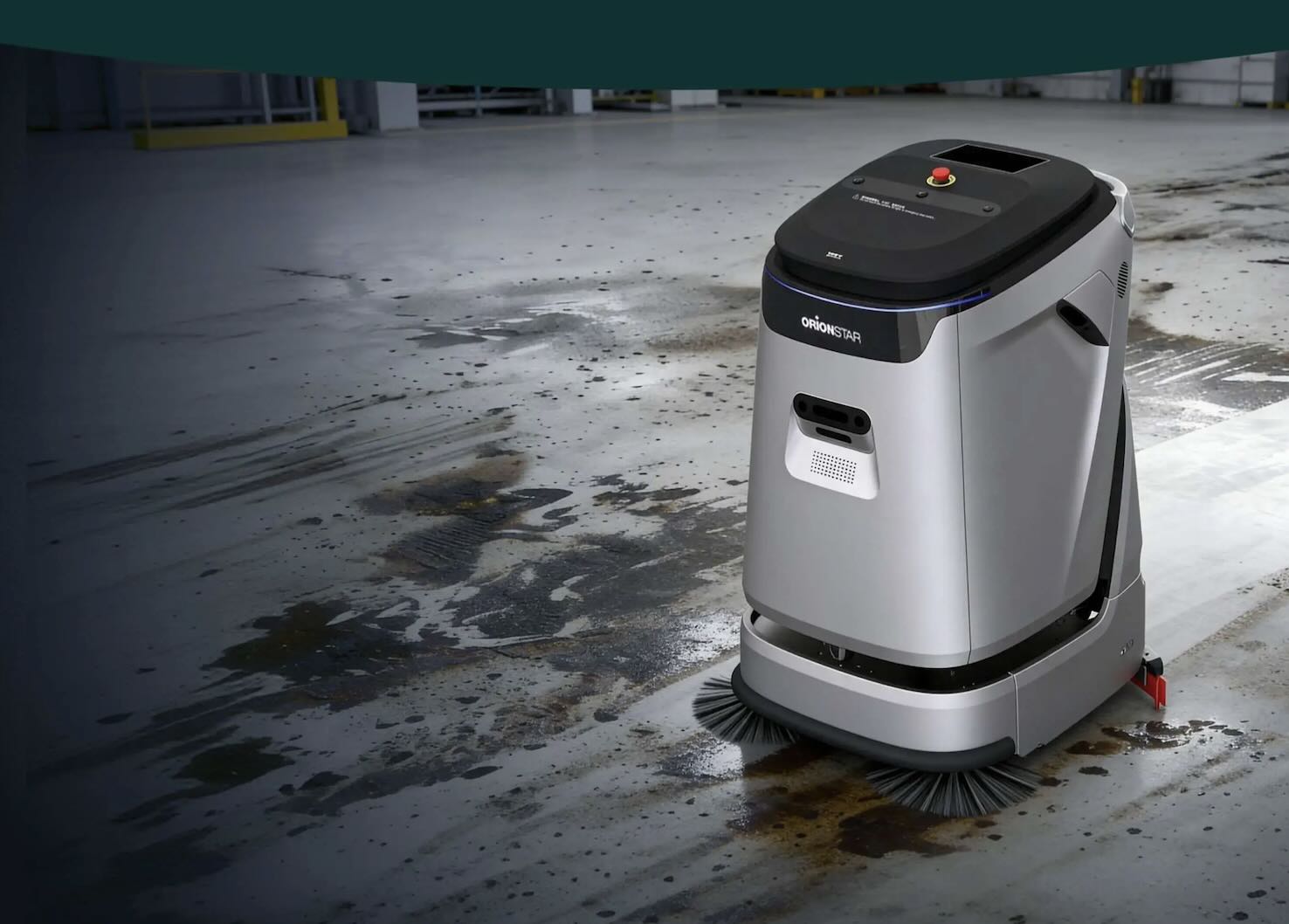
To illustrate how these capabilities materialize in commercial hardware, the OrionStar CleaniBot C5 serves as a practical example of industrial-grade automation applied to logistical environments. Operating with a 550 mm main brush, the robot achieves a maximum cleaning capacity of up to 1,980 square meters per hour, according to manufacturer data, effectively addressing the challenge of vast warehouse floorplates. It translates the concept of autonomous path planning and auto-docking into tangible operations by mapping expansive zones and returning to its station for charging, refilling, and waste discharge, which includes a self-cleaning wastewater cycle that completes in roughly four minutes. Furthermore, it delivers up to 25 kg of downward scrubbing pressure to remove heavy grime, demonstrating how automated solutions can maintain consistent quality in demanding industrial applications.
These high-traffic transition points are constantly exposed to heavy dirt, moisture, and debris brought in by incoming trucks and forklifts. Cleaning robots equipped with heavy-duty scrubbing pressure and dynamic obstacle avoidance can continuously maintain these zones safely, adapting to the constant, unpredictable movement of heavy vehicles and logistics personnel.
Long, narrow pathways between racking systems easily accumulate fine dust and are notoriously tedious for manual crews to clean effectively. Autonomous units utilizing precise LiDAR navigation map the optimal straight-line paths, ensuring efficient and complete floor coverage without risking collisions with valuable stored inventory.
Workers in packing zones generate a constant stream of localized dust, packaging remnants, and foot-traffic grime throughout their shifts. Automated machines with sweeping and dust-mopping capabilities efficiently keep these environments clear of fine particulates, contributing to a healthier and more organized workspace for warehouse staff.
As the critical first point of entry for inbound goods, receiving zones frequently experience sudden spikes in pallet staging and unexpected material blockages. Robots utilizing advanced real-time path planning can navigate seamlessly around these temporary obstacles, ensuring the area remains clean and safe without interrupting fast-paced inbound workflows.
Within modern digitalized warehouses, commercial cleaning robots are increasingly designed to function as connected nodes within broader smart-building ecosystems. By integrating with Building Management Systems (BMS) and Computerized Maintenance Management Systems (CMMS), autonomous fleets can optimize their daily cleaning timetables and routes based on real-time building conditions, IoT sensor inputs, and foot traffic analysis. This deep connectivity allows maintenance alerts to trigger work orders automatically, while centralized fleet-monitoring portals provide facility managers with remote access to productivity metrics, ensuring that robotic operations align seamlessly with overarching facility workflows and cybersecurity protocols.
By combining tangible reductions in resource consumption with transparent, verifiable data governance, robotic automation actively accelerates a Facility Management team's journey toward comprehensive ESG compliance.
Commercial cleaning robots are helping to change the way Facility Management approaches the maintenance of warehouses, shifting the paradigm from labor-intensive manual upkeep to highly efficient, data-driven automation. By addressing severe labor shortages, lowering operational costs, and enforcing strict regulatory compliance standards, these advanced systems enable operators to focus their resources on core logistics functions. For organizations evaluating these operational upgrades, the OrionStar CleaniBot series provides multiple models designed to adapt to diverse spatial requirements and industrial challenges, offering a scalable pathway toward a more resilient, intelligent facility maintenance strategy.