

REQUEST DEMO
Robot CATALOG will be sent to your mailbox immediately after submission.
SUBMIT
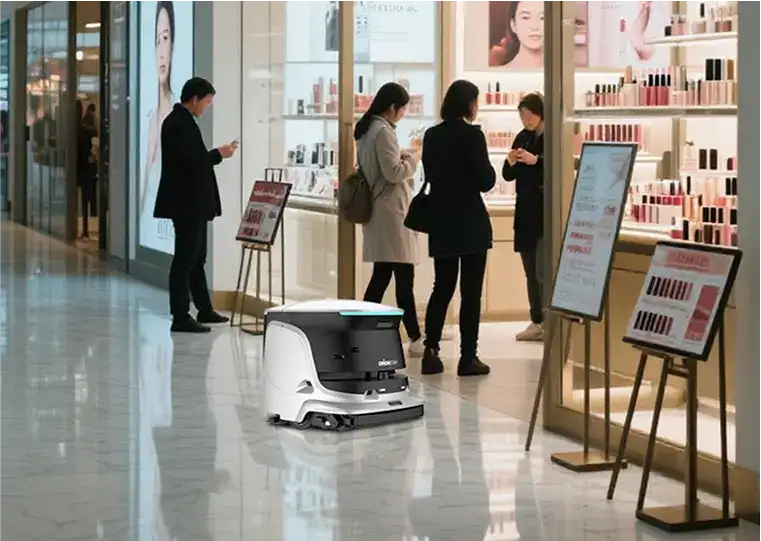
Facility Management in shopping malls has reached a decisive inflection point. The traditional approach to maintaining expansive retail environments is increasingly strained by structural shifts in the labor market and escalating operational costs. Why is this happening now? The industry is facing a perfect storm of rising customer expectations for cleanliness, stagnant budgets, and persistent skilled labor shortages. At the same time, robotics technology has achieved the maturity required for reliable indoor navigation, while the cost curve of automation has fallen to a commercially viable level. Therefore, mall operations teams are actively seeking scalable interventions that do not rely entirely on human headcount. As a result, commercial cleaning robots have emerged as an industry-level solution. These systems provide the consistency, traceability, and efficiency needed to manage massive public spaces. Above all, they shift floor care from a constant staffing struggle to a predictable, digitized utility.
These compounding pressures point to a singular conclusion: the traditional manual operating model is no longer sustainable.
To address these diverse spatial demands, the OrionStar CleaniBot series provides a differentiated, dual-model solution tailored for modern retail environments. The series is not built around finding one generic machine, but rather deploying specialized systems that cover distinct scenarios.
For expansive, high-traffic zones like main atriums and wide walkways, the CleaniBot C5 serves as an industrial-grade workhorse. It is designed to manage heavy dirt and large-scale floor care. According to manufacturer data, the C5 delivers a maximum cleaning capacity of up to 1,980 square meters per hour. It features a combined 90-liter water tank system, ensuring extended operation with minimal manual refilling during busy shopping hours.
In contrast, the CleaniBot S55 Pro is engineered for versatility in mixed-use areas, such as food courts, narrow retail corridors, and spaces near restrooms. It features a compact design with a minimum passing width of approximately 700 millimeters, allowing it to navigate tighter layouts effortlessly. Furthermore, it operates quietly. According to manufacturer data, its dust mopping mode runs at just 45 decibels for up to 28 hours, making it ideal for continuous daytime maintenance without disrupting the shopper experience.
Together, these models form a highly complementary logic. The C5 manages the heavy-duty, wide-area scrubbing, while the S55 Pro handles agile, multi-mode tasks and tighter spaces. Moreover, both units feature strong digital management capabilities. Facility managers can utilize Wi-Fi and 4G connectivity for remote deployment, cloud-based maintenance tracking, and automated data reporting. OrionStar robots are designed with privacy-first principles. Environmental data is processed locally, and cloud analytics utilize strictly anonymized metrics, empowering operating parties to deploy systems in full compliance with GDPR and local privacy frameworks.
These results are not theoretical projections; they represent the reality that facility managers and mall operations teams are already verifying on the ground.
A common misconception is that commercial cleaning robots are designed to replace the human workforce entirely. Instead, automation in shopping malls is fundamentally about elevating human effort. The operational model is shifting toward a blended approach. Robots absorb the repetitive, expansive, and physically demanding tasks of floor scrubbing. Consequently, human workers are freed to focus on high-value work that machines cannot perform.
Facility staff now direct their attention to detailed corner cleaning, proactive customer service, and rigorous quality oversight. This transition creates distinct new roles and skill sets within facility teams. Custodial staff are evolving into fleet managers and route optimizers, monitoring performance data to keep utilization high. They adjust schedules based on actual foot traffic rather than rigid, outdated routines. Furthermore, according to JLL, 46% of large organizations have already embedded AI solutions into their facility operations to address the growing talent gap. In short, automation mitigates critical labor shortages while upgrading the daily work experience of facility personnel.
Looking ahead, commercial cleaning robots are rapidly transitioning from experimental technology to standard infrastructure within Facility Management. Shopping malls, with their massive footprints and high operational demands, require reliable systems that operate consistently regardless of labor availability. Solutions like the OrionStar CleaniBot series provide multiple models to adapt to various spatial requirements, offering facility leaders the flexibility to scale automation across different zones. As data-driven operations become the norm, building management will rely increasingly on integrated, autonomous fleets. Ultimately, the future of mall operations will not be defined by how many individuals are deployed to clean floors, but by how effectively human intelligence and robotic consistency are orchestrated to maintain a flawless environment.
Privacy Notice: OrionStar CleaniBot models rely on advanced sensor suites (including LiDAR and stereo cameras) strictly for autonomous navigation and obstacle avoidance. Visual data is processed locally in real-time and is not stored or transmitted to the cloud. All fleet management data sent via Wi-Fi/4G is anonymized and encrypted to support GDPR compliance. Facility operators remain responsible for adhering to local public surveillance and notification laws.