

REQUEST DEMO
Robot CATALOG will be sent to your mailbox immediately after submission.
SUBMIT
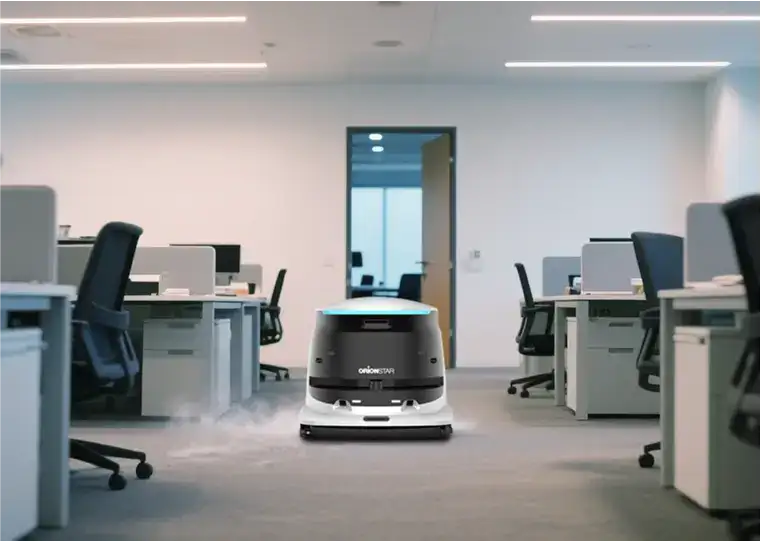
Facility Services in commercial buildings is currently reaching a critical inflection point. For decades, the industry relied heavily on manual labor to maintain expansive properties. Today, that model faces fundamental structural shifts. The total scale of global cleaning services continues to expand, yet the available workforce is shrinking. Concurrently, technological maturity in autonomous navigation has crossed the threshold from experimental to highly reliable. The cost curve for automation has also flattened, making fleet-scale deployment economically viable for building operators. Meanwhile, corporate tenants now demand stricter consistency, digital traceability, and higher environmental standards. Therefore, relying solely on human operators to scrub millions of square feet is no longer practical. As a result, commercial cleaning robots are rapidly emerging as a necessary, industry-level solution. These autonomous systems provide the scale, reliability, and data transparency required to modernize facility maintenance. In short, automation is no longer a luxury for property managers; it is becoming the baseline for operational survival.
Together, these structural pressures point to a single conclusion—the traditional, purely manual operating model is increasingly unsustainable.
The OrionStar CleaniBot series addresses these operational hurdles by offering a differentiated, dual-model solution for varied commercial building environments. Instead of a single one-size-fits-all approach, the series relies on a complementary logic. Each robot takes on specific roles, ensuring comprehensive coverage across diverse facility spaces.
The CleaniBot C5 is an industrial-grade scrubber designed for medium-to-large commercial spaces like parking areas, vast lobbies, and high-traffic transit hubs. According to manufacturer data, it delivers up to 25 kg of downward scrubbing pressure and can clean up to 1,980 square meters per hour. Therefore, it excels at removing heavy grime and stubborn stains from expansive, hard-floor public zones without manual fatigue.
Conversely, the CleaniBot S55 Pro is engineered for versatility in mixed-surface commercial buildings, including corridors, carpeted common spaces, and smaller reception areas. It integrates multiple modes, such as sweeping, vacuuming, and quiet dust mopping. According to manufacturer specifications, its ECO Vacuum mode operates at a low 45 dB and can run for up to 19.5 hours. This makes the S55 Pro ideal for daytime maintenance where minimizing noise disturbance is critical.
Above all, both models function as connected digital assets. Through Wi-Fi and 4G connectivity, they support remote deployment, cloud-based maintenance, and detailed data reporting. Because these connected systems utilize cameras and cloud platforms to process operational mapping data, facility operating teams must verify GDPR compliance and ensure robust data governance during deployment. Ultimately, the two models work in tandem, fulfilling distinct roles to optimize total facility care.
These results are not theoretical projections; they are realities that facility service providers and building service contractors are already verifying in the field.
The transition toward autonomous systems does not mean replacing human workers. Instead, it elevates the human workforce. Commercial cleaning robots are specifically deployed to handle highly repetitive, large-area tasks like scrubbing massive lobbies and sweeping endless corridors. As a result, skilled human operators can shift their focus toward high-value, detail-oriented work. Human staff now manage high-touch surfaces, precision corner cleaning, and direct client service interactions. Moreover, this shift is creating entirely new roles within facility services organizations. Cleaners are transitioning into fleet supervisors, data performance managers, and internal trainers. The technology fills critical staffing gaps caused by labor shortages, ensuring teams can meet their service agreements without burnout. In short, automation acts as a reliable team member. It takes on the grueling physical labor, allowing human professionals to apply their judgment, dexterity, and management skills where they matter most.
The facility maintenance sector is moving steadily into a more structured, data-driven era. Commercial cleaning robots are no longer experimental additions; they are rapidly becoming the core infrastructure of modern Facility Services. As properties grow more complex and labor constraints persist, operators will increasingly rely on automated fleets to guarantee consistency and compliance. The OrionStar CleaniBot series provides multiple models designed to adapt seamlessly to varying scenario demands, offering a flexible foundation for interested facility managers to explore further. Ultimately, the integration of autonomous machines and human expertise will define the next generation of property management. Those who adopt and refine this hybrid operational model will inherently lead the market, setting new benchmarks for quality, sustainability, and efficiency in commercial buildings.
Disclaimer on Privacy and Data Protection: All operational and mapping data processed via the cloud is strictly anonymized and encrypted in transit and at rest. Cameras are utilized exclusively for real-time obstacle avoidance and navigation, and no personal identifying information (PII) or video feeds are recorded, stored, or transmitted to our servers without explicit user configuration and consent, in full compliance with GDPR and relevant regional privacy frameworks.