

REQUEST DEMO
Robot CATALOG will be sent to your mailbox immediately after submission.
SUBMIT
The commercial cleaning industry is undergoing a significant transformation. Autonomous cleaning robots, once a futuristic concept, have become practical tools that facility managers can deploy to improve cleaning consistency, reduce labor costs, and enhance operational efficiency. However, with multiple models available across different price points and capability levels, selecting the right robot for a specific facility can be challenging.
This buyer's guide provides a comprehensive comparison of autonomous commercial cleaning robots, with a focus on OrionStar's CleaniBot product line, to help facility managers make informed decisions based on their specific operational requirements.
Commercial cleaning robots generally fall into three broad categories based on their size, cleaning capacity, and target environments:
The total floor area to be cleaned directly influences the required robot specifications. For facilities under 5,000 m², mid-sized robots like the CleaniBot S55 Pro with its 1,368 m²/h cleaning efficiency may be sufficient. For larger facilities exceeding 10,000 m², the CleaniBot C5 with its 1,980 m²/h capacity and larger 90 L tank system provides better coverage and fewer interruptions for refilling.
Consider the types of flooring in your facility and the typical soil levels. Hard floors, polished concrete, tiles, and low-pile carpets each require different cleaning approaches. The CleaniBot S55 Pro's six cleaning modes offer versatility for mixed-floor environments, while the C5's 25 kg scrubbing pressure is better suited for heavy industrial soils, oil stains, and grime.
Cleaning robots must fit into your facility's operational schedule. The CleaniBot S55 Pro excels in scenarios requiring extended runtime, with ECO Vacuum lasting 19.5 hours and Dust Mopping up to 28 hours. The CleaniBot C5, with its fast 1.5-hour charging and 3-hour scrubbing runtime, is optimized for shift-based operations where quick turnaround is essential.
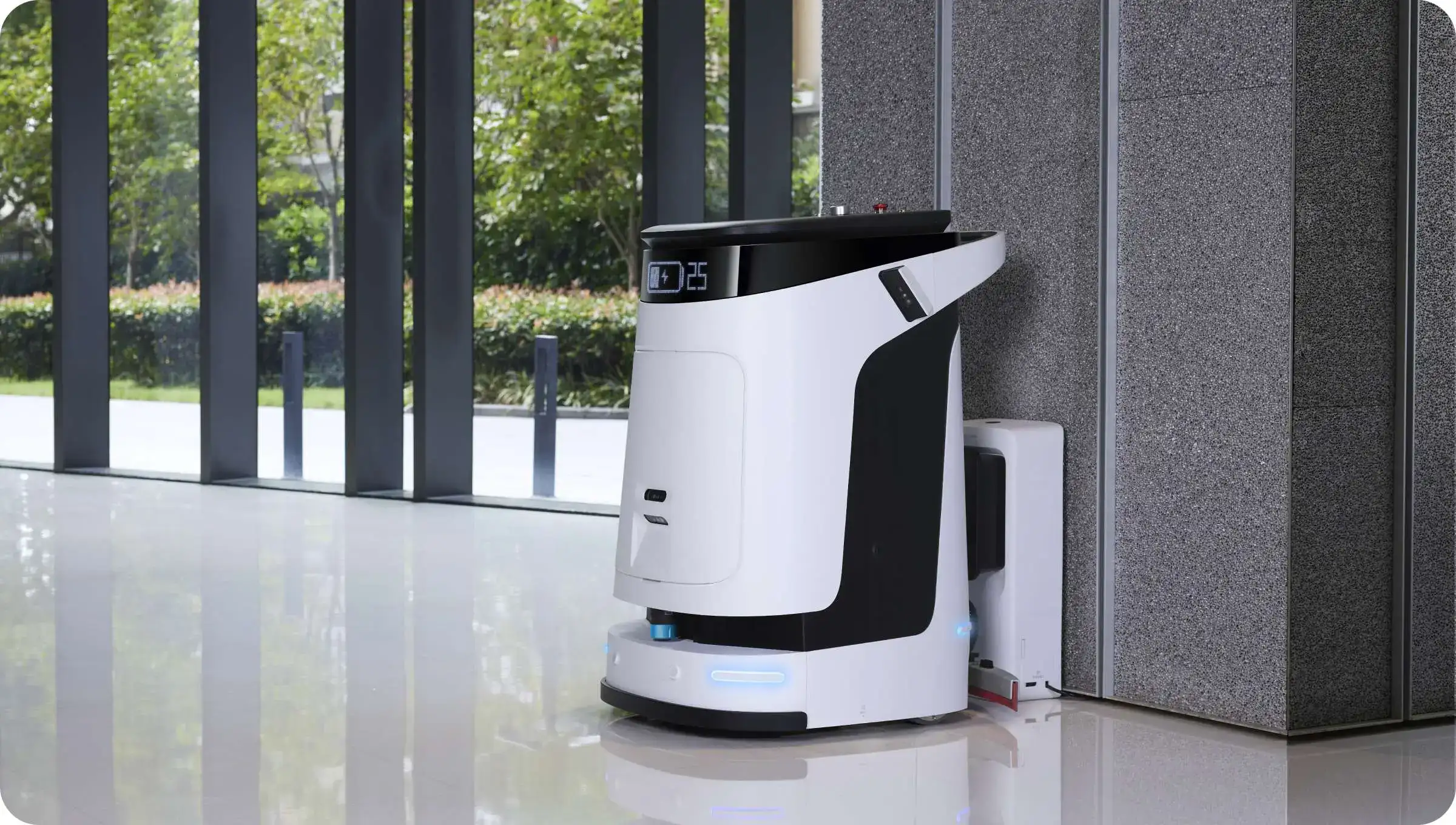
Evaluate the complexity of your facility's layout. Environments with frequent layout changes, narrow corridors, and high foot traffic require robust navigation systems. Both the CleaniBot C5 and S55 Pro use multi-sensor approaches, but the S55 Pro's 15-sensor system provides more comprehensive coverage for dynamic commercial environments, while the C5's heavy-duty construction handles industrial obstacles more effectively.
Tank capacity directly affects operational efficiency. The CleaniBot C5's 90 L combined tank capacity (45 L clean + 45 L wastewater) supports extended operation in large facilities. The S55 Pro's 22 L clean water and 15 L wastewater tanks are more appropriate for typical commercial environments where water refill stations are readily available.
When evaluating the business case for autonomous cleaning robots, facility managers should consider both direct and indirect benefits:
To maximize the value of your cleaning robot investment, consider these deployment best practices:
The commercial cleaning robot market continues to evolve rapidly. Key trends shaping the future include integration with building management systems, AI-driven predictive maintenance scheduling, multi-robot fleet coordination for large facilities, and enhanced data analytics for facility optimization. As connectivity and sensor technologies advance, cleaning robots will become increasingly intelligent and autonomous, further reducing the need for human intervention and enabling truly hands-off facility maintenance.
For facility managers evaluating their options today, investing in a capable and flexible platform like OrionStar's CleaniBot product line provides a strong foundation that can adapt to evolving cleaning requirements and technological advances in the years ahead.
The C5 is a heavy-duty industrial scrubber designed for warehouses and factories with 1,980 m²/h capacity and 90 L tank system. The S55 Pro is a versatile commercial robot with six cleaning modes, 15 sensors, and up to 28 hours runtime, ideal for hotels, offices, and retail spaces.
The CleaniBot C5 can cover up to 1,980 m² per hour with its 550 mm brush and 25 kg scrubbing pressure. The S55 Pro covers up to 1,368 m²/h in certain modes. Both can map up to 10,000 m².
Yes. Both the C5 and S55 Pro are designed for safe operation around people, with multi-sensor obstacle avoidance and noise levels as low as 45 dB for quiet modes.
No special installation is required for the robots themselves. The CleaniBot C5 offers optional mobile water tanks that eliminate plumbing modifications. Both models include charging docks that can be placed in standard power outlets.
The S55 Pro offers six cleaning modes for different floor types including hard floors, polished surfaces, and low-pile carpets. The C5 is optimized for hard industrial floors. Both automatically switch between modes based on designated zones.
Routine maintenance includes emptying and cleaning wastewater tanks, refilling clean water, cleaning brushes and filters, and periodic software updates. Both the C5 and S55 Pro have self-cleaning features to reduce maintenance effort.
Yes. Both models support remote monitoring, cloud-based maintenance, OTA updates, and data reporting through Wi-Fi and 4G connectivity.
ROI varies by facility size and labor costs, but many facilities see payback periods of 12 to 24 months through reduced labor costs, improved cleaning consistency, and reduced equipment maintenance expenses.