

REQUEST DEMO
Robot CATALOG will be sent to your mailbox immediately after submission.
SUBMIT
Commercial buildings present highly diverse spatial constraints and maintenance demands, ranging from expansive multi-story atriums to congested retail displays, standard office doorways, and narrow restroom layouts. The physical dimensions and turning radius of a machine dictate which zones it can safely access without causing disruptions or getting stuck, making spatial accessibility paramount. Labor allocation heavily relies on intervention frequency, determining how often janitorial staff must interact with the equipment to manage power, clean water, and wastewater. Furthermore, mixed-use complexes require task versatility, as daytime maintenance demands silent operation and dry floor management, while high-traffic entryways require aggressive wet scrubbing after hours. Navigating these dynamically changing commercial spaces requires robust spatial awareness, where the method of environment mapping dictates how quickly a unit can be deployed and how it handles unexpected obstacles. Ultimately, facility managers must evaluate spatial fit, infrastructure integration, and navigation architecture rather than relying strictly on raw throughput claims.
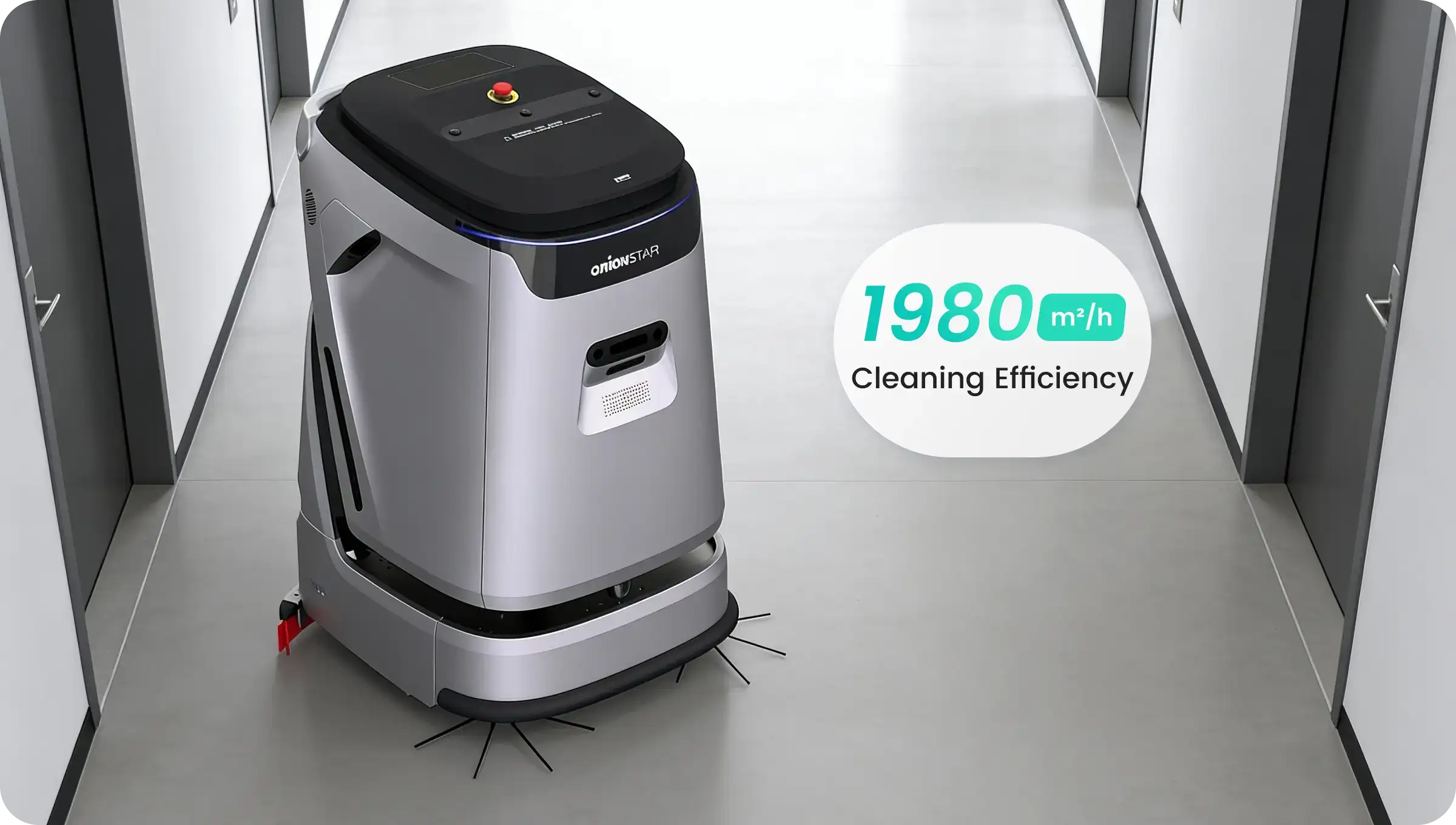
Positioned for medium-to-large commercial and industrial environments, this unit integrates autonomous docking capabilities to minimize human intervention frequency across extended shifts. The physical footprint suits environments like shopping malls, hospitals, and office layouts where a balance of maneuverability and sustained fluid capacity is required.
According to manufacturer data, the platform measures approximately 820 by 680 by 1,130 millimeters and carries a net weight of 170 kilograms. The machine features a 550-millimeter main brush, achieving a cleaning area capacity of up to 1,980 square meters per hour. Its fluid architecture combines a 90-liter system, divided evenly between clean and waste water, to extend operation before refill requirements. Power relies on a 24-volt, 80-ampere-hour battery, yielding a scrubbing runtime of about three hours and a mopping runtime of up to eight hours, coupled with a 1.5-hour fast charge cycle. The dual-rolling-brush system applies up to 25 kilograms of downward pressure under laboratory conditions, switching efficiently between wet scrubbing and dry dust-mopping tasks. Navigation utilizes cloud-connected optimization to map areas up to 10,000 square meters, with mapping and telemetry data processed securely; cloud features require user opt-in and compliance with regional data protection regulations including GDPR. The workstation manages automatic refilling, discharging, and internal tank rinsing. Operators must verify local GDPR compliance prior to deployment.
Designed for expansive open environments, this heavy-duty platform serves large airports, manufacturing sites, shopping malls, and wide lobbies where physical footprint is a secondary concern to fluid volume and continuous surface coverage. The architecture is optimized for open spaces rather than tight restrooms or narrow retail aisles, prioritizing scale over extreme agility.
The machine offers multiple cleaning head configurations ranging from 61 to 81 centimeters in width. According to manufacturer data, it accommodates high-capacity fluid management with a 109-liter solution tank and a 135-liter recovery tank. An array of six 6-volt lead-acid batteries provides up to six hours of operating time, with options for swappable battery sets to reduce charging downtime without plumbing modifications. Navigation relies on the proprietary Autonomy AI platform, integrating 360-degree sensor visibility and dynamic route planning, managed via a cloud-based command center. Its dimensions reach up to 152 centimeters in length and weigh up to 688 kilograms. Facilities must review privacy and security terms for camera and map-data handling to ensure compliance with frameworks like GDPR.
Operating as a mid-sized stand-on scrubber-dryer, this unit targets standard office corridors, retail floors, and conference areas where third-party safety certification in public spaces holds high operational value. It scales well into standard doorways while maintaining enough capacity for prolonged deployment.
According to manufacturer data, the unit utilizes a 51-centimeter scrub path and a 76.7-centimeter squeegee width, delivering a theoretical cleaning efficiency of up to 20,839 square feet per hour under laboratory conditions. The fluid system comprises a 57-liter solution tank and a 53-liter recovery tank. It navigates utilizing a vision-based AI platform alongside simultaneous localization and mapping, executing tasks through teach-and-repeat modes such as CopyCat and Fill-In. The system operates autonomously for up to six hours on a 24-volt, 255-ampere-hour battery configuration. It integrates securely into occupied spaces by meeting the CSA/ANSI 336 robotic standard. Because the platform maps spaces and uploads usage data to the cloud, buyers need to confirm telemetry and camera handling align with GDPR provisions.
Engineered as a robotic ride-on floor scrubber, this machine addresses wide aisles and large open areas within retail spaces, airports, and hospitals. It demands substantial spatial clearance, with turning radiuses that are better suited for wide areas than narrow corridors or tight operational chokepoints.
The unit applies up to 86 kilograms of main down pressure across a 650-millimeter disk cleaning path. According to manufacturer data, both the solution and recovery tanks hold 110 liters each, supporting prolonged operation across massive footprints. Power options span flooded lead-acid or lithium-ion batteries, generating runtimes of up to 4 hours and 6.5 hours respectively. Autonomous navigation leverages vision-based AI with a multi-layer sensor system to facilitate teach-and-repeat area-fill learning alongside automatic braking. The platform measures approximately 1,650 by 850 by 1,450 millimeters and weighs up to 492 kilograms with batteries. Connectivity and fleet reporting involve extensive cloud integration, necessitating a thorough review of data residency and GDPR documentation.
Presenting a compact footprint relative to ride-on platforms, this AI-powered machine serves retail centers and office buildings, maneuvering efficiently through dynamic lobbies, standard corridors, and common areas. It adapts readily to environments where tasks frequently shift between wet scrubbing and dry maintenance.
The hardware provides disc or roller brush configurations, with the disc model offering a 460-millimeter cleaning width and the roller version presenting a 406-millimeter base. According to manufacturer data, theoretical maximum efficiency reaches up to 1,987 square meters per hour. Fluid capacities include a 30-liter clean-water tank and a 24-liter waste-water tank. It utilizes a 24-volt lithium iron phosphate battery, yielding up to three hours of scrubbing or up to eight hours of dust-mopping under laboratory conditions. Navigation centers on sensor fusion incorporating 2D LiDAR, a 3D depth camera, and an RGB camera, supported by an optional workstation for automatic charging and fluid management. As operations rely on RGB cameras and cloud-connected fleet management, facilities must ensure data-processing arrangements meet GDPR requirements.
Positioned as an ultra-compact everyday maintenance tool, this model accesses tight aisles, small lobbies, and congested environments within corporate offices and retail layouts where space limitation represents the primary deployment constraint.
The architecture features dual cleaning modes, applying a 370-millimeter width in scrub mode and a 520-millimeter width in dust-mop mode. According to manufacturer data, fluid storage involves a 21-liter clean-water tank and a 24-liter waste-water tank. The system supports up to three hours of scrubbing or seven hours of dust-mopping, supported by an optional refuel station to automate charging and fluid exchange. Measuring 600 millimeters in length and 450 millimeters in width, the device effectively handles confined chokepoints. Autonomous operation relies on a 25-meter LiDAR coverage system and an integrated mobile application for remote oversight. Compliance details regarding camera and app data should be carefully verified against local GDPR standards.
Integrating deeply into medium to large building zones such as concourses and retail commons, this platform merges sweeping and scrubbing capabilities to manage heavy foot traffic areas alongside human cleaning teams. The design accommodates standard ADA-compliant clearances while sustaining commercial-grade fluid volumes.
The platform employs a 55-centimeter cylindrical brush technology, achieving a maximum area performance of up to 2,300 square meters per hour according to manufacturer data. Fresh and dirty water capacities are set at approximately 55 liters each. Powered by a 24-volt lithium-ion battery, the machine operates for roughly 3.5 hours and integrates with an optional docking station for autonomous fluid handling and recharging. Navigation merges laser scanners, 3D sensors, and ultrasonic sensors to detect the environment dynamically, backed by safety certifications for public areas conforming to CSA 22.2 No. 336-17 standards. Because operational data and cleaning reports route through a proprietary web portal, procurement officers should confirm camera-storage terms and GDPR compliance.
Structured as a dual autonomous and manual scrubber-dryer, this robust platform accommodates lobbies, hallways, and open retail floors within education, healthcare, and public facilities. Its substantial footprint targets broad clearance zones rather than maneuvering through narrow washroom access points.
According to manufacturer data, the unit utilizes two counter-rotating pad drivers covering a 70-centimeter scrubbing width, supplemented by a 90-centimeter squeegee. Both fresh and waste water tanks carry 90 liters. A sealed gel-cell battery supports up to four hours of runtime, with an optional exchange kit available to double operational longevity without requiring plumbing infrastructure modifications. The navigation architecture links a main computer, a redundant safety-monitoring computer, ultrasonic sonar, and a scanning laser to process spaces up to 60 meters wide. Since the hardware actively collects laser and ultrasonic data for navigation and reporting, administrators must verify data-residency terms and GDPR frameworks.
Focused strictly on highly constrained environments, this ultra-compact platform navigates narrow aisles, small restrooms, and heavily cluttered spaces common in convenience stores and small retail layouts. It trades overall fluid capacity for maximum spatial accessibility.
The architecture implements a 48-centimeter cleaning path, achieving a listed productivity of up to 800 square meters per hour according to manufacturer data. Tank capacities reflect the compact scale, containing 10 liters for solution and 11 liters for recovery. A 24-volt lithium-ion battery delivers approximately 90 minutes of runtime per charge under laboratory conditions. Navigation relies on a teach-and-repeat methodology, augmented by a fill-in mode that maps perimeters and automatically covers interior floor plans. The unit connects to a fleet management software platform for cleaning verification and operational reporting. Operators must evaluate point-cloud map generation and telemetry data-handling policies to verify alignment with GDPR expectations.
Designed specifically for expansive public facilities, this large-area scrubber-dryer addresses wide commercial zones such as main lobbies, exhibition areas, and transport corridors. Its configuration is intended for environments requiring substantial fluid endurance and broad spatial clearance.
The system utilizes three brushes arranged in a V-shape, establishing a working width of 660 millimeters. According to manufacturer data, the unit features a 110-liter two-in-one membrane tank to extend continuous operation cycles. A lithium-ion battery powers the machine for up to 3.5 hours, and an optional docking station facilitates automated water refilling and battery recharging to decrease human intervention frequency. Navigation centers on proprietary algorithmic technology, combining LiDAR, ultrasound, and physical bumpers to map environments and bypass dynamic obstacles. Connectivity encompasses WiFi, LTE, and comprehensive fleet management server integration. Given the server infrastructure and remote access capabilities, facility management teams should confirm data-storage policies and GDPR compliance.
Actionable procurement decisions require mapping the architectural realities of commercial real estate against hardware specifications. For spatial accessibility, deploy compact architectures under 500 millimeters in width to navigate tight retail aisles and restrooms, ensuring access to confined spaces at the cost of total fluid capacity. Conversely, deploy large-scale architectures exceeding 650 millimeters to maximize square-footage coverage in massive open lobbies and exhibition halls. Intervention frequency informs infrastructure integration; implement automated workstation ecosystems connected directly to building plumbing to support continuous, multi-shift operations. If plumbing modifications are restricted, implement manual utility management paired with high-capacity onboard tanks and swappable power systems. For task versatility, adopt dedicated, single-pass wet scrubbing systems for heavy soil removal, or deploy multi-modal hybrid systems that alternate between wet scrubbing and low-decibel dust-mopping during busy daytime hours. Finally, select a navigation architecture that mirrors environmental dynamism, utilizing dynamic algorithms for frequently changing layouts and reliable teach-and-repeat pathing for static spaces.
For facilities with daily cleaning needs and at least 50,000 square feet (about 4,650 m²) of hard floor, real-world deployments typically show payback periods of 9 to 18 months. Large open environments such as retail commons, airport concourses, and healthcare corridors often land at the shorter end because routes are predictable and labor hours are high. The business case should be built on loaded labor cost — base wage plus benefits, supervision, and turnover burden — rather than the hourly wage alone. Beyond labor savings, facilities usually budget around $4,000 to $7,000 per robot per year for consumables, preventive maintenance, wear items, and daily oversight time. A robot that reliably removes roughly one full-time equivalent of repetitive floor coverage is usually the threshold where the financial model becomes compelling.
The right payment structure depends more on internal budgeting and support appetite than on the robot itself. A direct purchase generally yields the strongest long-term ROI for stable sites with available capital. Equipment financing or leasing lowers upfront cash outlay and creates predictable monthly payments, though service may be billed separately. A Robot-as-a-Service or rental program bundles the robot, software, preventive maintenance, and support into a single operating expense, which appeals to teams that want one accountable provider rather than asset ownership. When comparing quotes, ask whether deployment, map changes, software updates, preventive maintenance, and field response are included or priced separately, because support gaps can erase the apparent savings of a lower monthly rate.
Annual operating cost for a mid-sized or large autonomous scrubber commonly falls in the $4,000 to $7,000 range per robot, covering cleaning solution, brush and squeegee replacement, battery care, preventive maintenance, and the operator time needed for daily inspection, refill, and exception handling. A preventive maintenance contract is often quoted at roughly $1,200 to $2,400 per year. The larger total-cost-of-ownership driver, however, is who owns uptime after go-live: map updates, route tuning, emergency response, and refill logistics. Facilities that treat these as afterthoughts often find that a cheaper robot becomes more expensive than a higher-support option once downtime and manual fallback labor are counted.
Start with the metrics that determine how much of your floor plan the robot can actually own. Cleaning width and theoretical area productivity (m²/h or ft²/h) show route capacity, but real-world coverage is typically 50–70% of the published figure once obstacles, refill stops, and turns are factored in. For the units commonly considered for commercial buildings, cleaning widths range from about 370 mm for compact models up to 660 mm or more for large-area machines, and published productivity ranges from roughly 800 m²/h to over 3,000 m²/h. Also compare tank capacity for clean and waste water, runtime per charge, scrubbing pressure, noise level, and the minimum doorway or corridor width the machine can pass through. A robot that is too wide or too loud for your busiest zones will not deliver the coverage its spec sheet suggests.
Modern units rely on a sensor fusion of 2D or 3D LiDAR, depth cameras, RGB cameras, ultrasonic sensors, and bumpers to detect obstacles and plan routes dynamically. Most platforms offer real-time obstacle avoidance, rerouting, teach-and-repeat mapping, and automatic braking. Several models in the commercial building category reference safety certifications such as CSA/ANSI 336 or IEC 60335-2-117 / IEC 63327, which are relevant for public-area deployment. Because these robots build facility maps and may upload operational data to a cloud portal, buyers should also review the manufacturer’s privacy and data-handling terms, especially for camera footage, map storage, and telemetry, and confirm alignment with local data-protection requirements such as GDPR where applicable.
Runtime varies by battery chemistry and cleaning mode. In scrubbing mode, most units run between 1.5 and 4 hours, with some extending up to 6.5 hours on lithium-ion packs; dust-mopping or lighter modes can stretch to 7 or 8 hours. Combined clean and waste water tank capacities in commonly reviewed models range from about 21 L for compact units to 135 L for large-format scrubbers, with many mid-sized machines falling between 50 L and 110 L. For a commercial building with large lobbies and long corridors, the right combination depends on whether a single robot can complete the route before needing to recharge or refill, or whether the deployment needs multiple units or an optional auto-docking station for water exchange and charging.
Third-party product specifications are based on public data as of July 2026 (up to, under laboratory conditions, according to manufacturer data) and are for illustrative comparison only; actual performance may vary by model year and configuration. Product names and trademarks are the property of their respective owners. If any product involves cameras, voice recording, mapping, or cloud data processing, the operating entity must verify GDPR compliance prior to deployment.