REQUEST DEMO
Resources > Blogs > Optimizing Retail Facility Management: The Role of Commercial Cleaning Robots in Shopping Malls

Optimizing Retail Facility Management: The Role of Commercial Cleaning Robots in Shopping Malls

2026-07-06 22:47 OrionStar

Optimizing Retail Facility Management: The Role of Commercial Cleaning Robots in Shopping Malls

Introduction

Integrated Facility Management teams overseeing shopping malls face an escalating array of challenges, from structural labor shortages and rising operational costs to stricter compliance requirements and post-pandemic hygiene expectations. To overcome these hurdles and maintain expansive retail environments efficiently, facility operators are increasingly turning to commercial cleaning robots as a reliable, automated solution.

The growing need for smarter cleaning in shopping malls

  • Janitorial staff turnover in retail facilities can reach up to 75% according to industry estimates, exacerbating structural labor shortages and complicating the maintenance of consistent cleaning schedules.
  • Labor expenses can account for up to 70% of a commercial cleaning company's total budget based on industry averages, placing immense pressure on facility managers to optimize operational costs.
  • Traditional paper-based tracking methods leave approximately 35% of manual cleaning tasks undocumented according to industry observations, creating compliance risks and making service quality hard to verify.
  • Unpredictable occupancy and fluctuating foot traffic render static cleaning schedules inefficient, resulting in under-served peak periods and wasted labor during quiet hours.

How commercial cleaning robots can help

  • LiDAR navigation and autonomous path planning allow these machines to efficiently cover complex floor plans and seamlessly adapt to dynamic retail layouts.
  • Advanced obstacle avoidance systems ensure safe operation in highly trafficked areas by detecting obstacles in real-time and safely navigating around shoppers, kiosks, and temporary displays, or pausing when necessary.
  • Auto-charging and automated docking capabilities enable continuous, multi-shift operation without requiring constant human intervention for refueling or drainage.
  • Real-time monitoring and cloud-based reporting provide digital proof of service, giving managers verifiable traceability over every cleaning cycle.
  • OrionStar ensures privacy by design; visual data used for navigation is processed locally on the edge without storing personally identifiable information, helping operating entities comply seamlessly with GDPR requirements.

A closer look: OrionStar CleaniBot C5 in action

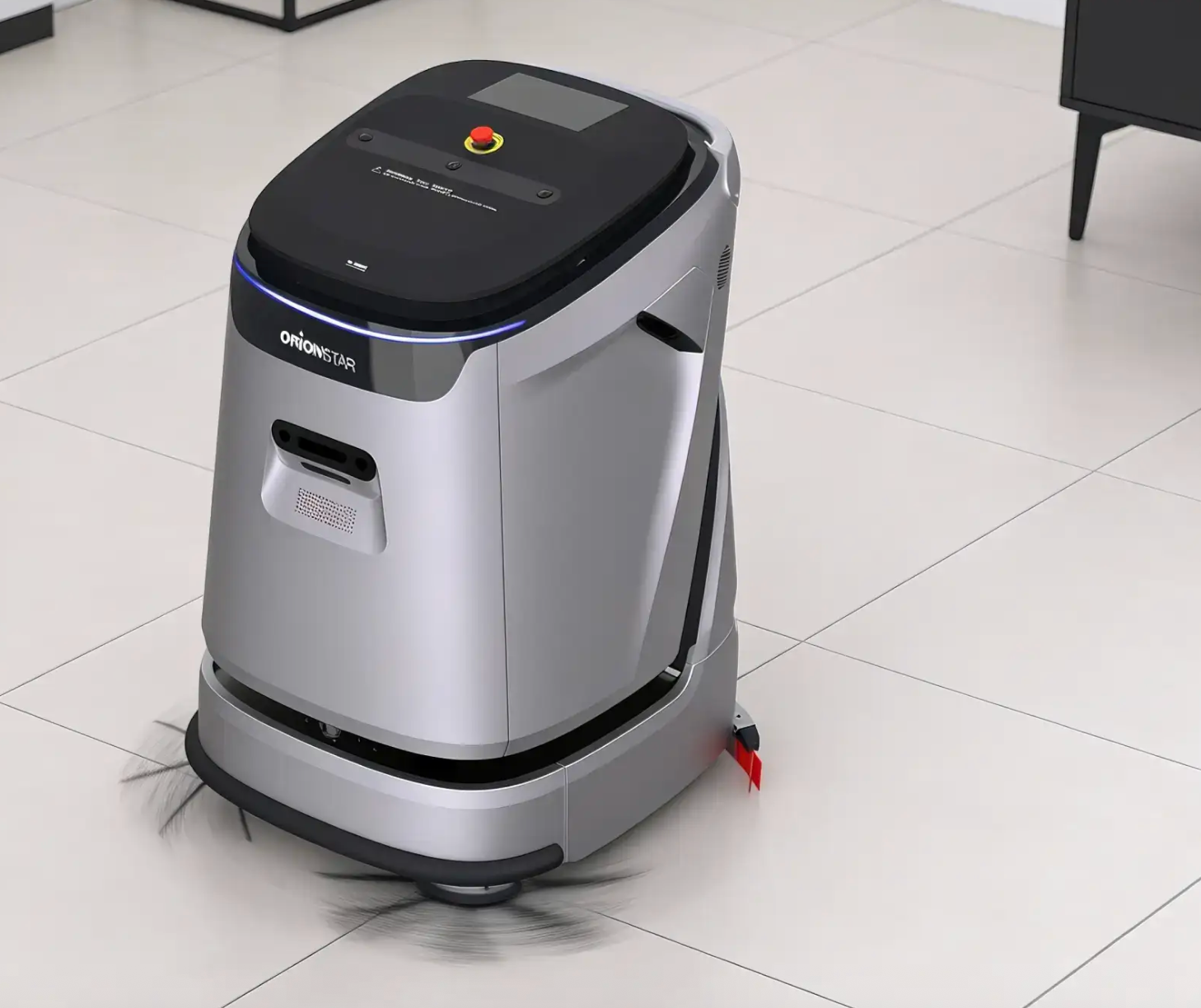
Demonstrating these advanced category capabilities in a practical application, the OrionStar CleaniBot C5 operates with a high degree of autonomy to map and navigate expansive retail layouts. Equipped with a dual-rolling-brush system, it provides a downward scrubbing pressure of up to 25 kg to tackle heavy grime, achieving a dirt-cleaning rate of about 95% on hard floor surfaces, according to manufacturer testing. Furthermore, it utilizes an automated docking station for automatic clean-water refilling and waste-water discharge, enabling sustained operation across a maximum cleaning area capacity of up to 1,980 m² per hour under optimal test conditions without constant manual oversight.

Benefits for facility managers, building service contractors

  • Significant labor savings: By embracing a cobotics approach and automating repetitive floor care, major retailers have successfully reallocated staff to customer-facing tasks, with some fleets cumulatively saving over 33,649 labor hours, according to recent industry case studies calculated with Brain Corp's value calculator.
  • Measurable cost reduction: Deploying autonomous floor scrubbers can generate substantial financial returns, as demonstrated by early grocery deployments that delivered $2,120,400 USD in annual value, according to recent industry case studies.
  • Verifiable service quality: Digital reporting ensures that every square meter cleaned is logged, resolving the issue of undocumented tasks and significantly reducing service disputes.
  • Data-driven utilization: Integrating automated analytics allows facility teams to continuously optimize deployment, leading to robotic utilization increases of up to 49% within just a few weeks of adoption, according to case studies of early adoption.
  • Quiet operation: Designed to operate smoothly in public spaces, modern cleaning robots maintain noise levels below 68 dB(A) in eco-mode, ensuring that ambient environments remain undisturbed for shoppers.

Real-world applications

Lobbies

High-traffic mall lobbies require constant upkeep to maintain a welcoming atmosphere for incoming shoppers. Commercial cleaning robots navigate these wide-open atriums efficiently, adjusting their routes dynamically to avoid sudden crowds and temporary promotional stands.

Corridors

Long corridors connect various retail wings but often feature mixed flooring transitions and varying widths. Autonomous scrubbers maneuver through these pathways seamlessly, ensuring consistent edge-to-edge coverage while maintaining a safe distance from storefronts and passing pedestrians.

Food courts

Food courts face constant spills, dropped debris, and heavy foot traffic, presenting a persistent challenge for janitorial teams. Heavy-duty cleaning robots can deploy strong downward scrubbing pressure to remove stubborn, sticky stains while navigating safely between tightly packed tables and chairs.

Parking areas

Transition zones and indoor parking areas often accumulate tough grime and oil stains tracked in from outside. Industrial-grade robotic cleaners can map these expansive spaces and perform deep scrubbing tasks, drastically reducing the manual labor needed to maintain large concrete expanses.

Integration with other smart systems

To maximize operational efficiency, commercial cleaning robots are increasingly integrated into the broader smart-building ecosystems of shopping malls. By connecting via open APIs, these robots can interface with Building Management Systems (BMS) to schedule cleaning during off-peak hours, thereby optimizing HVAC loads and reducing disruption. Furthermore, integration with Computerized Maintenance Management Systems (CMMS) automatically generates work orders for consumable replacements, while IoT sensors and elevator software enable multi-floor navigation and trigger demand-based cleaning instead of relying on rigid, inefficient schedules.

Supporting ESG and sustainability goals

  • Automated floor scrubbers utilize precise resource management, which can reduce water usage by up to 70% and lower energy consumption by up to 60% per cleaning cycle compared to traditional manual mopping methods, based on published operational data from facility automation providers.
  • Advanced dispensing mechanisms ensure accurate chemical application, reducing chemical usage by up to 22% compared to traditional manual mopping methods, based on internal/third-party testing, while maintaining strict hygiene protocols.
  • Digital operational data provided by autonomous platforms directly supports the reporting requirements for green building frameworks like LEED and the WELL Building Standard.

By significantly minimizing resource consumption and providing verifiable environmental metrics, automated cleaning solutions actively empower Integrated Facility Management operations to meet and exceed their corporate ESG targets.

Closing

Commercial cleaning robots are significantly advancing how the Integrated Facility Management sector maintains shopping malls by answering the dual demands of operational efficiency and consistent hygiene. As retail environments continue to evolve, the integration of autonomous floor care systems provides a resilient, data-backed approach to facility maintenance. For facilities with diverse spatial requirements, the OrionStar CleaniBot series offers multiple models to accommodate various operational scenarios, providing comprehensive solutions for modern building management.

Disclaimer: Map data and operational logs are collected solely for navigational optimization and diagnostic purposes, encrypted in transit, and retained in accordance with local privacy laws.