

REQUEST DEMO
Robot CATALOG will be sent to your mailbox immediately after submission.
SUBMIT
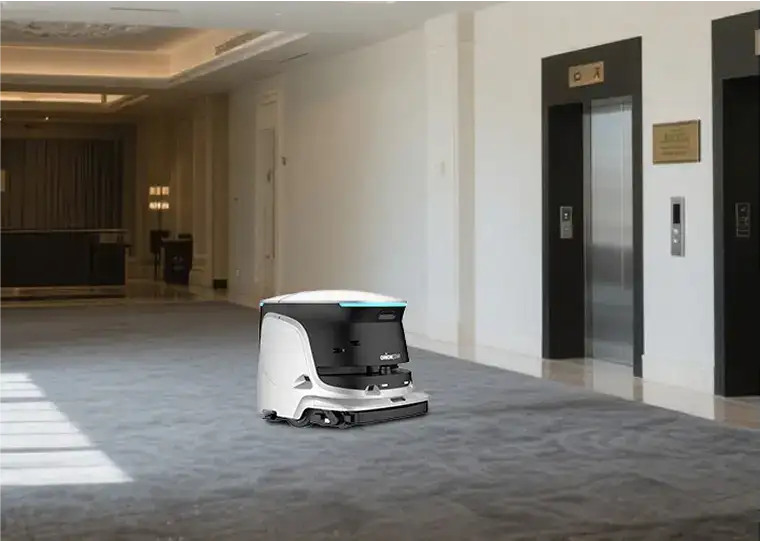
Banquet halls, event venues, hospitality venues, wedding venues, and conference centers experience intense logistical pressures that require highly efficient operations. Rapid post-event turnaround times between functions dictate how quickly a facility can transition from a morning corporate session to an evening wedding gala. Floor layouts frequently change, demanding tight navigation around round tables, chair legs, and temporary décor that challenge traditional bulky equipment. Multi-floor venues necessitate solutions that fit into standard passenger and service elevators to mobilize staff quickly. Additionally, facilities require machines capable of handling mixed floor surfaces, transitioning smoothly from carpeted banquet halls to hard foyer and prep-area floors where simultaneous wet spills and dry debris are common after meal services. Finally, the necessity for low-noise operation during daytime setups or adjacent events restricts standard floor care routines. Autonomous floor care solutions address these intersecting pain points by providing targeted, programmable floor maintenance.
Evaluating these robotic platforms requires a comparative framework based on navigational footprint, cleaning modality, and noise emissions combined with shift-based runtime. Navigational footprint and elevator accessibility remain critical because venue managers must match robot dimensions to furniture density and elevator capacities. Compact units under eighty kilograms navigate easily between tight chairs and fit in standard passenger elevators. Mid-sized units suit pre-function foyers, while heavy-duty scrubbers are best suited for vast, clear exhibition halls utilizing freight infrastructure. Cleaning modality determines how effectively a venue manages mixed surfaces. Dedicated vacuums manage enclosed carpets, while scrubbers handle food and beverage spills on hard floors. Multi-modal platforms allow venues to alternate between scrubbing, dry vacuuming, and dust-mopping as the surface dictates, significantly accelerating post-meal turnarounds. Finally, acoustic output and battery capacity dictate operational timing. Ultra-quiet maintenance systems operating under sixty decibels allow daytime operations without disturbing guests. Deep scrubbers operating around seventy decibels handle heavy post-event clearing over several hours, while swappable battery systems ensure continuous operations across weekend-long conventions.
Designed for large-area multi-mode floor care, this robot addresses the mixed-surface nature of banquet areas, foyers, and corridors. Facilities seeking a single robotic platform for various operational stages utilize its capability to shift from heavy spill scrubbing to quiet daytime maintenance across diverse public commercial zones. Its compact form ensures straightforward transport across multi-floor event venues using standard elevators.
According to manufacturer data, the unit features a cleaning width of 550 mm and a modular InstantClean Floor Care System combining sweeping, scrubbing, vacuuming, dust-mopping, and routine floor disinfection support workflows. Facility teams benefit from its practical maintenance design, featuring modular cleaning tools and a washable wastewater tank that helps reduce bacterial buildup. The system navigates using LiDAR, stereo cameras, ultrasonic sensors, and line lasers, supporting map construction of up to 10,000 square meters. Under laboratory conditions, scrubbing modes achieve a theoretical cleaning efficiency of up to 1,197 square meters per hour in unobstructed environments, while the ultra-quiet 45-decibel dust-mopping mode can run for up to 28 hours, accommodating daytime event setups. The machine measures 650 by 580 by 550 mm and weighs 70 kg, ensuring easy passing through narrow 700-millimeter widths.
This unit serves as a dedicated autonomous vacuum for expansive carpeted ballrooms and pre-function carpet areas. Banquet operations rely on this specialized tool for rapid dry debris clearing between enclosed conference sessions where hard-floor washing is unnecessary and airborne dust must be minimized.
According to manufacturer data, it provides HEPA-filtered vacuuming to maintain indoor air quality while operating at noise levels suitable for adjacent meeting rooms. The 30-kilogram footprint allows immediate transport in standard passenger elevators. Under laboratory conditions, the battery supplies up to three hours of runtime, covering up to 557 square meters per hour. It relies on a 4.0-liter dust bag capacity and navigates using optical cameras and LiDAR to safely bypass temporary event staging and venue attendees.
Highly compact and agile, this robot is intended for tight spaces between round tables, chair legs, and temporary décor within hospitality venues. It supports venues that require rapid, unobtrusive cleaning around dense event seating configurations where larger scrubbers may experience maneuverability limitations.
According to manufacturer data, the unit features an ultra-quiet dust mop mode operating at 57 decibels alongside its standard scrubbing capabilities. The machine weighs 60 kilograms, ensuring straightforward elevator transport alongside facility staff. Under laboratory conditions, it provides up to three hours of scrubbing runtime or seven hours of dust mopping, utilizing a 370-millimeter brush width. The robot leverages LiDAR mapping and depth sensors to handle narrow passing requirements safely.
Deployed as an ultra-compact cobot scrubber, this system manages highly congested post-event clear-outs on hard floors. It enables cleaning staff to address narrow aisles and bypass temporary stanchions while collecting light dry debris alongside wet scrubbing, reducing the need for preliminary manual sweeping.
According to manufacturer data, the device incorporates a 10-liter solution tank and a small integrated hopper to catch solid food debris, speeding up post-meal recovery. Under laboratory conditions, the 90-minute runtime facilitates cleaning up to 800 square meters per hour at a general noise level of 66 to 70 decibels. It navigates using sophisticated point cloud heat maps to negotiate complex lighting environments commonly found in sunlit or mirrored hotel lobbies.
Functioning as a mid-sized AI-powered scrubber, this robot supports hotel foyers, ballrooms, and dining prep areas. It provides robust cleaning execution for heavy post-banquet food and beverage spills across broad open public spaces.
According to manufacturer data, the roller brush configuration simultaneously pre-sweeps solid debris into dual trash trays while scrubbing, greatly reducing manual floor preparation before washing. Under laboratory conditions, it offers up to three hours of runtime supported by a 30-liter clean water tank. Weighing 148 kilograms, it requires smooth elevator transitions. The system integrates 2D LiDAR, 3D depth cameras, and RGB cameras to adjust water output dynamically based on detected floor soil levels.
This medium-to-large area edge-to-edge scrubber handles extensive lobbies, exhibition halls, and corridors. Facilities deploy this robot to address wide pre-function aisles while actively cleaning directly against temporary event booths, staging perimeters, or baseboards.
According to manufacturer data, the machine features a roller brush and an integrated side brush for edge cleaning alongside a 750-millimeter working width. Under laboratory conditions, the 160-ampere-hour lithium-ion battery delivers up to 3.5 hours of runtime, operating at a noise level of 69 decibels. Weighing 225 kilograms, it navigates open spaces using intelligent free-travel maneuvers to bypass blockages securely in populated areas.
Engineered as a large-coverage scrubber, this platform addresses sprawling pre-function areas, long corridors, and wide aisles. Venue managers use its extensive fluid capacity for structured overnight maintenance or heavy spill management across major hospitality complexes that feature expansive hard flooring.
According to manufacturer data, the robot features a 57-liter solution tank and provides up to six hours of runtime. Under laboratory conditions, the unit covers extensive square footage and navigates via certified robotic safety standards to adjust to shifting crowds and dynamic obstacles. It presents multiple distinct cleaning modes to accommodate both routine daily paths and localized post-event tasks.
Positioned as a heavy-duty workhorse, this scrubber operates in convention centers and large exhibition halls. It supports massive venues managing weekend-long trade shows with continuous foot traffic across highly expansive bare concrete or terrazzo surfaces.
According to manufacturer data, the robot utilizes a water purification system that reduces chemical and water usage to prevent slip hazards in active transit zones. Under laboratory conditions, it delivers up to four hours of runtime per swappable battery pack, utilizing a 90-liter clean water tank and a 70-centimeter cleaning width. Weighing 471 kilograms, the system relies on sonar, 2D LiDAR, and floor-detector sensors for safe navigation in wide-open spaces.
Acting as a ride-on autonomous scrubber, this machine is suited for mega-venue exhibition floors and vast concourses. Facilities employ the hybrid design allowing staff to manually drive the unit to distant halls before deploying it autonomously across massive, unobstructed trade show areas.
According to manufacturer data, the machine features 110-liter tanks and covers vast areas using teach-and-repeat software algorithms. Under laboratory conditions, runtime ranges up to six hours depending on the battery configuration, operating at sound levels as low as 70 decibels. Weighing 492 kilograms empty, it demands wide turning radiuses and operates best in clear exhibition settings rather than dense, furnished banquet environments.
This industrial logistics-oriented scrubber is dedicated to back-of-house warehouses, loading docks, and massive staging areas within convention centers. It tackles the physical demands of large-scale event staging where heavy transient debris and moving equipment dominate the floor plan.
According to manufacturer data, the system utilizes a physical debris diverter to push aside large transient objects safely during operation. Under laboratory conditions, it achieves up to six hours of runtime drawing from a 109-liter solution tank. Weighing over 580 kilograms, the robot employs 360-degree LiDAR and 3D sensors to adapt to constantly shifting back-of-house layouts containing moving pallets and staging vehicles.
Procurement recommendations for banquet and hospitality venues depend heavily on aligning these specific capabilities with facility layouts. For highly furnished areas requiring standard passenger elevator transport, ultra-compact and multi-modal options offer the necessary agility and surface adaptability to manage tight chairs and transitions from carpet to hard floors. Expansive foyers and public corridors benefit from mid-sized models that balance fluid capacity with edge-cleaning functions. Conversely, large exhibition halls and concrete concourses require heavy-duty scrubbing platforms, provided the facility maintains dedicated freight logistics to handle their immense weight. Venues experiencing heavy food and beverage traffic should prioritize integrated sweeping and scrubbing platforms to accelerate post-meal clear-outs. Furthermore, operations directors scheduling daytime setups must source machines with verified low-noise modes, while continuous weekend-long events dictate models with extended battery capacities or hot-swappable infrastructure.
In the hospitality and event sector, the Return on Investment (ROI) for commercial cleaning robots typically ranges from 12 to 24 months, depending on venue size, local labor rates, and utilization frequency. The Total Cost of Ownership (TCO) extends beyond the initial hardware purchase to include annual software licensing for cloud platforms and fleet management, regular maintenance of wear parts like brushes and squeegees, and eventual battery replacements. Deploying models capable of large-area coverage allows facility managers to reallocate manual labor to high-touch tasks, significantly reducing overtime costs during peak wedding or convention seasons.
For modern deployments, procurement teams must ensure robots comply with commercial autonomous safety standards, which mandate reliable obstacle avoidance in populated public spaces. Data privacy remains a critical compliance factor under regulations such as GDPR in Europe or CCPA in North America. Because many advanced models utilize stereo cameras, RGB cameras, and cloud-based spatial mapping to navigate, operations directors must verify that the vendor's platform anonymizes or routinely purges visual data to protect the privacy of event guests and venue staff. Operators using cloud-based mapping via wireless networks must ensure their fleet management tools fully comply with local privacy laws by utilizing edge-processing or automated deletion of sensitive visual data.
Rapid turnarounds between banquets require robots that can handle broad spaces quickly and be easily transported between floors. Many modern floor-care robots are designed with compact footprints, allowing them to fit smoothly into standard passenger and service elevators without freight limitations. Operationally, staff can deploy a robot to autonomously scrub pre-function hard floors or manage wet food spills while the manual crew focuses on breaking down tables and staging the next event. High-efficiency models can run for several hours in active scrubbing modes, covering vast foyer areas on a single charge. It is important to note that real-world battery performance may vary based on floor surface friction, obstacle density, and navigation complexity.
Yes, but maneuvering through highly congested banquet setups requires specific physical dimensions and advanced sensor arrays. Heavy-duty ride-on scrubbers are generally unsuited for furnished ballrooms. Instead, compact commercial robots with a minimum passing width of 700 mm to 800 mm are required to weave between round tables, chairs, and temporary buffet lines. Advanced models utilize combinations of LiDAR, ultrasonic sensors, and stereo cameras to map expansive spaces and detect dynamic obstacles, though performance may adapt based on ambient lighting and highly reflective surfaces, ensuring they clean close to edges without colliding with delicate event decor.
Most event venues require a hybrid approach, as single robots rarely excel at both deep carpet vacuuming and wet hard-floor scrubbing. Dedicated autonomous vacuums are ideal for large carpeted ballrooms, utilizing HEPA filters to capture dry debris. For hard-surface foyers and catering prep zones, multi-mode robots offer integrated workflows that combine sweeping, scrubbing, and mopping in one cycle. These hard-floor systems utilize main roller brushes and multi-liter waste tanks to catch solid food debris and wash away sticky beverage spills efficiently, minimizing the need for manual pre-sweeping.
Noise control is a major operational pain point for conference centers hosting simultaneous events. Many commercial cleaning robots are engineered with specialized low-noise modes for daytime use. For example, some models feature dust mopping or vacuum modes that operate at extremely quiet levels. Even during active hard-floor scrubbing, noise levels generally hover around 55 to 70 decibels depending on the manufacturer. This allows operations directors to schedule continuous corridor maintenance or pre-function cleanup while keynote speeches or daytime wedding setups are actively happening in adjacent rooms.
Footnote: All comparative product specifications are derived from publicly available manufacturer datasheets as of the time of publication and do not constitute independent benchmark testing. Performance metrics may vary based on laboratory or environmental conditions. Product names and trademarks are the property of their respective owners. If any deployed product involves cameras, audio recording, mapping, or cloud-based data processing, operating entities must strictly verify compliance with GDPR, CCPA, and all applicable local data privacy laws prior to facility deployment.