

REQUEST DEMO
Robot CATALOG will be sent to your mailbox immediately after submission.
SUBMIT
Facilities services in commercial buildings face mounting challenges, including a structural labor shortage, rising operational costs that can consume up to 70% of budgets, and increasingly stringent compliance requirements for verifiable hygiene standards. To address these persistent pressures, facility managers are turning to commercial cleaning robots as a reliable, data-driven solution to maintain consistent quality, offset staffing deficits, and optimize resource allocation across expansive properties.
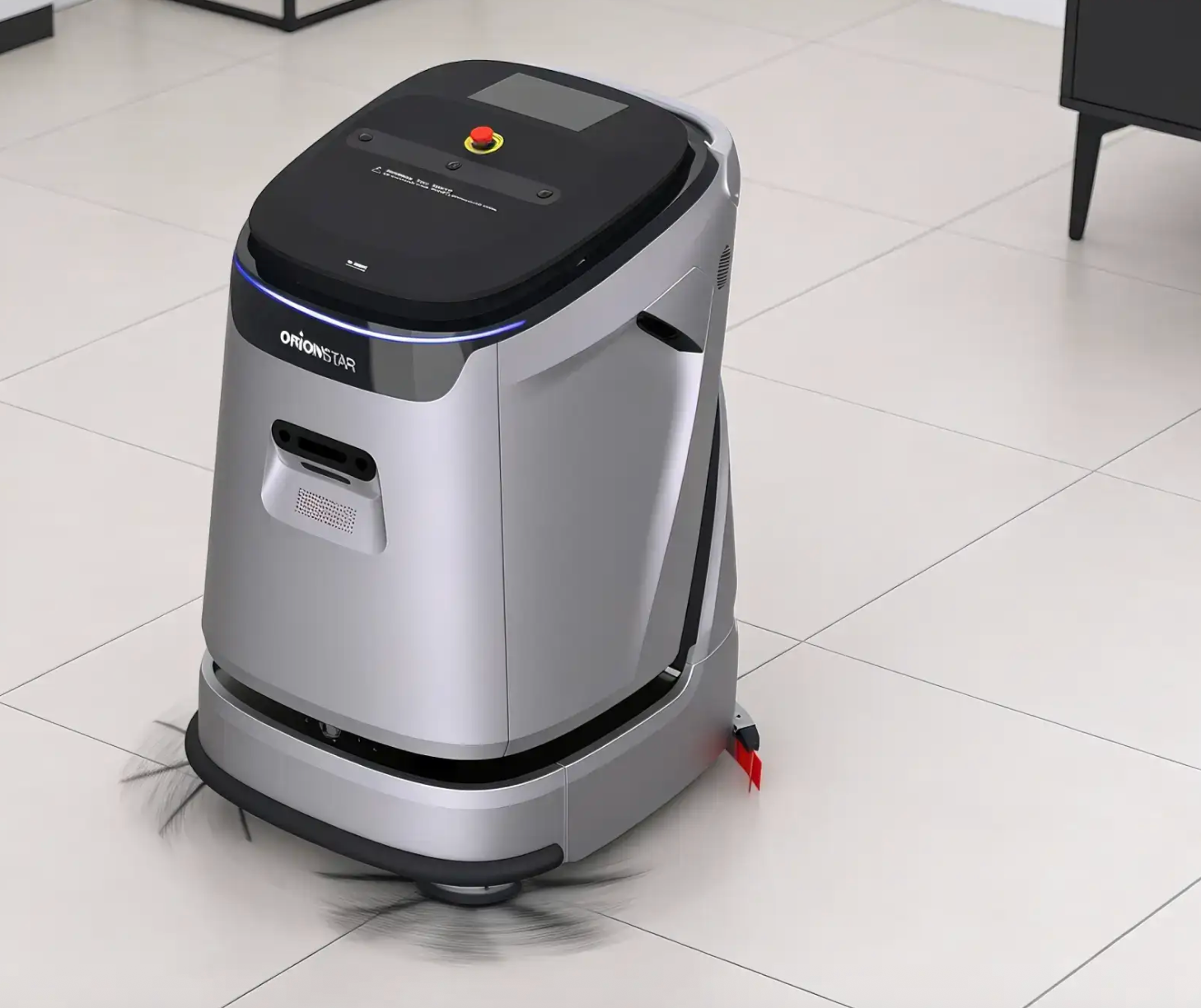
Translating these broader technological capabilities into functional hardware, the OrionStar CleaniBot C5 demonstrates how autonomous floor-scrubbing systems navigate high-traffic environments. According to manufacturer data, under ideal test conditions, the unit can map areas of up to 10,000 square meters and process optimal cleaning routes autonomously, utilizing a dual-rolling-brush system that applies up to 25 kg of downward scrubbing pressure. Additionally, it integrates with a fully automated workstation for self-draining, high-pressure internal tank rinsing, and auto-charging, allowing it to sustain continuous operation in large commercial facilities while maintaining operational noise levels below 68 dB(A) under ideal test conditions.
These high-visibility entrance areas experience heavy foot traffic and require impeccable, continuous upkeep to ensure a positive first impression. Commercial cleaning robots navigate around visitors dynamically, maintaining pristine hard floors without disrupting the flow of incoming occupants.
Long, repetitive hallways demand consistent, linear cleaning that is often tedious and time-consuming for manual staff to complete uniformly. Autonomous path planning allows robots to systematically cover these lengthy zones, ensuring edge-to-edge comprehensive cleaning while safely maneuvering around open doorways and structural pillars.
Break rooms, cafeterias, and open-plan gathering areas present dynamic layouts with frequently moved furniture and unpredictable daily debris. Equipped with advanced obstacle avoidance, automated scrubbers adapt their routes in real time to capture spills and dirt without causing collisions or workflow interruptions.
Indoor parking facilities are prone to heavy oil stains, tire marks, and large debris that degrade the building's overall aesthetic and safety. Heavy-duty robotic scrubbers apply consistent downward pressure to lift stubborn grime, handling expansive concrete spaces efficiently while reducing the physical strain on human workers.
To maximize operational efficiency, commercial cleaning robots are increasingly expected to integrate directly with existing building infrastructure, including Building Management Systems (BMS), Computerized Maintenance Management Systems (CMMS), and IoT platforms. Research indicates that approximately 35% of large commercial cleaning contracts now include API and facility management software integration modules. Through smart scheduling linked to a BMS, robots can execute cleaning routes during non-peak hours to reduce disruption and optimize HVAC loads. However, successful deployment requires selecting platforms with open APIs and standardized data formats to avoid incompatibility issues, facilitating a seamless hybrid fleet model where automated systems report verifiable performance data back to central facility dashboards.
By significantly lowering resource consumption and enabling verifiable environmental compliance, commercial cleaning robots act as a vital catalyst for achieving modern ESG objectives in the facilities services sector.
As commercial buildings face escalating demands for efficiency, compliance, and sustainability, commercial cleaning robots are fundamentally changing the way the facilities services industry maintains large-scale environments. By addressing critical labor shortages and delivering consistent, data-backed hygiene standards, these autonomous systems provide a pragmatic solution to persistent operational challenges. Organizations evaluating this shift can explore options like the OrionStar CleaniBot series, which offers a range of models designed to adapt to diverse architectural layouts and specific maintenance requirements. Integrating these technologies ultimately enables building service contractors to optimize resource allocation, control operating costs, and uphold modern facility standards.