

REQUEST DEMO
Robot CATALOG will be sent to your mailbox immediately after submission.
SUBMIT
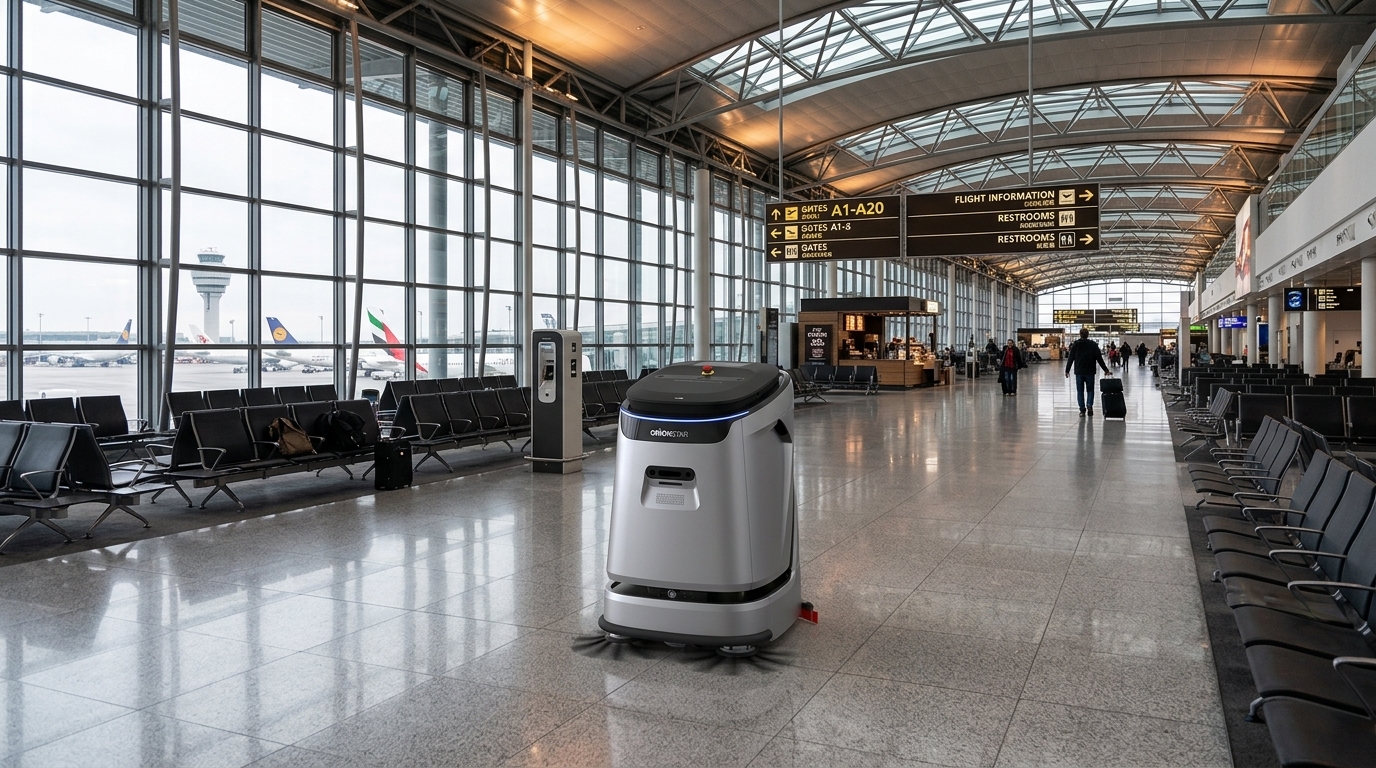
For airport preselection, use our OrionStar CleaniBot C5’s 550mm main pass and separate water tanks to evaluate concourse work and service travel; use OrionStar CleaniBot S55 Pro’s 55cm height only where vertical clearance is relevant. Passenger windows and local release rules remain decisive.
An airport terminal contains several cleaning environments that may look connected on a floor plan but create very different operating decisions. A curbside entrance can receive tracked-in moisture, grit, and concentrated bursts of foot traffic. A concourse may have long open routes interrupted by seating islands, queues, retail edges, and gate activity. A lounge can have smaller circulation paths, furnishings, quieter periods, and a different expectation for how visible cleaning activity should be.
For preliminary planning, divide the terminal into workable zones rather than asking which robot can cover everything. Record each zone’s dominant soil, floor finish, route width, obstacles, cleaning window, and distance to a practical water and wastewater service point. This makes it easier to separate an area that needs regular wet cleaning from one that mainly needs dry debris collection or dust control.
Concourse routes are often the first place to examine a large-area cleaning approach because they may combine continuous hard-floor space with recurring traffic soil. Entrances deserve a separate review because weather, mat transitions, and debris can change the cleaning task rapidly. Lounges should be reviewed for access around furniture and whether the intended tasks fit the actual surfaces present, rather than assuming that a compact footprint alone answers the question.
Task selection should come before model selection. Wet soil, dried marks, loose debris, fine dust, and routine floor appearance do not necessarily call for the same workflow. A robot can be a candidate only when its supported tasks align with the zone’s actual cleaning need and the facility can support the route around passenger activity, furnishings, floor transitions, and service access.
For a CleaniBot C5 concourse proposal, compare its 550mm main cleaning pass with the usable lane layout and map service returns for its separate 45L tanks. Test lane overlap, normal soil and the route to water service within the proposed passenger-flow window. C5 is a relevant concourse candidate when long recurring floor-care lanes and a usable service route form one workable assignment. A nearby water point that is inaccessible during the flight bank can defeat that fit even when the cleaning lane is wide.
CleaniBot S55 Pro’s 55cm height is relevant only to overhead-clearance checks on the nominated lounge route. Match its six named modes to the intended task separately; chair legs, luggage, turning space and floor conditions still need a route trial. S55 Pro can be worth evaluating where that lower vertical profile and a varied task plan address actual lounge constraints. Choose it for the nominated accessible route, not on the assumption that a lounge label or mode count proves furniture access.
Do not use a model name as a substitute for a floor survey. For example, an entrance may appear suitable for wet cleaning but include mats, uneven transitions, or peak-period crowding that changes the workable route. Likewise, a lounge may have hard flooring but offer limited circulation around chairs, tables, luggage, and service carts. The selection question is not simply whether the robot can clean; it is whether the planned task can be completed on that specific route under the intended operating conditions.
| Terminal zone | First decision to make | Useful preselection question | Possible preliminary direction |
|---|---|---|---|
| Main concourse | Decide whether recurring soil calls for wet cleaning, dry debris work, or both at different times. | Are there long, clear route segments with usable turning space and an achievable service path? | Consider C5 where its supported scrubbing, vacuuming, sweeping, dust mopping, or wastewater-recovery tasks match the planned route; confirm site conditions first. |
| Entrance or arrivals hall | Separate weather-related soil and tracked-in grit from routine interior floor cleaning. | What happens to the route when mats, moisture, queues, or door traffic change during the day? | Choose based on the specific task and access constraints rather than assuming one wet-cleaning pattern covers all conditions. |
| Lounge or furnished waiting area | Prioritize access around furnishings and identify the dominant cleaning tasks. | Can the robot approach the intended floor areas without creating an impractical route around seating and tables? | Consider S55 Pro where compact commercial positioning and the relevant one of its six modes fit the planned task, subject to surface and route checks. |
| Retail-edge or gate seating zone | Identify intermittent debris, furniture movement, and passenger bottlenecks. | Is there a repeatable route during lower-flow periods, or does the layout change too often? | Use zone observations to determine whether a robot route is practical before comparing models. |
Airport cleaning routes are shaped by passenger peaks, not just by the distance to be cleaned. A route that is open between flight banks may become unsuitable when queues form, gates release passengers, or arrivals traffic fills a corridor. Build the shortlist around realistic low-interference windows and identify which zones can be cleaned in segments rather than as one uninterrupted route.
Water-service planning is equally important for wet-cleaning candidates. Map where clean water can be supplied, where wastewater can be discharged, and how the robot would travel between the intended cleaning zone and those points. The route should include doors, floor transitions, corridors, and access rules that could affect routine use. If the proposed service route is inconvenient or inconsistent, a theoretically suitable cleaning task may be difficult to sustain in practice.
With a suitable configured workstation, CleaniBot C5 supports automatic charging, clean-water refill, wastewater discharge, and wastewater-tank self-cleaning. Treat those functions as part of a configuration question, not as a reason to skip site planning or maintenance responsibilities. Ask whether a workstation can be placed and configured appropriately for the proposed terminal area, whether its utility connections are feasible, and whether the service route remains practical during the intended cleaning window.
Do not presume that a mobile-tank option is included, appropriate, or a replacement for evaluating the full water and wastewater route. Ask which water-service alternatives are available for the exact quoted configuration and how filling, wastewater handling and daily inspection would work. Availability and inclusion need confirmation in the proposal.
A useful airport robot shortlist is a comparison of route requirements, not a list of product names. Begin with one representative route for each zone type: for example, a concourse lane, an entrance approach, and a lounge circulation loop. For every route, document what must be cleaned, what tends to soil it, when it can be approached, and what service support the route requires.
Then compare candidates only against the requirements they may address. CleaniBot C5 may be worth discussing for a large commercial route where its supported task set is relevant and where the water-service plan is workable. CleaniBot S55 Pro may be worth discussing for a more compact commercial route where the relevant cleaning mode and physical layout are central questions. These are preliminary positions, not statements that either model fits every terminal environment.
The final selection conversation should focus on the exact zone and proposed workflow. Bring route observations rather than relying on broad labels such as “airport,” “high traffic,” or “large terminal.” Those labels describe context, but they do not answer whether the floor, access path, task, utilities, and passenger timing support the intended use.
There is no universal choice for every concourse. Start with the route width, dominant soil, required cleaning task, passenger peaks, and water-service path. Consider CleaniBot C5 for a large commercial route when its supported scrubbing, vacuuming, sweeping, dust mopping, or wastewater-recovery tasks match the plan, then check the actual route and service conditions.
Not automatically. Entrances may have changing moisture, grit, mats, and bursts of traffic, while concourses may have longer repeatable paths and different obstacles. Review them as separate zones and decide whether their cleaning tasks and access windows truly match.
Consider a compact commercial candidate when access around furnishings and the intended cleaning task are central constraints. CleaniBot S55 Pro is positioned as a compact commercial cleaning robot with six modes, but that does not establish compatibility with every lounge floor or layout. Check the actual surface and circulation route.
No. With a suitable configured workstation, CleaniBot C5 supports automatic charging, clean-water refill, wastewater discharge, and wastewater-tank self-cleaning. The terminal still needs a practical location, utility arrangement, and route between the cleaning area and the workstation.
Collect zone maps, floor and soil observations, route widths and obstacles, passenger peak periods, intended cleaning tasks, clean-water and wastewater locations, and the questions that apply to any proposed workstation or tank configuration. This creates a clearer basis for comparing candidates.