

REQUEST DEMO
Robot CATALOG will be sent to your mailbox immediately after submission.
SUBMIT
Integrating automation into modern office campuses, corporate buildings, coworking spaces, shared workspaces, and hybrid work environments requires a calculated operational strategy. Workplace management teams face complex environmental variables, ranging from navigating dense shared zones and mitigating daytime noise disruptions to coordinating multi-floor deployments across sprawling corporate real estate. Maintaining high hygiene standards while managing labor constraints prompts many organizations to explore robotic floor care solutions. Implementing a workplace management commercial cleaning robot helps redeploy facility staff to high-touch sanitization tasks, establishing a consistent, automated standard for daily floor maintenance.
Evaluating these autonomous systems requires a structured comparison framework centered on four core selection factors. First, physical footprint and navigational clearance dictate whether a machine operates effectively in narrow coworking aisles or expansive corporate lobbies. Second, the autonomy level for maintenance and fluid management determines whether the robot functions as a manually assisted tool during daytime shifts or as an unattended cleaner utilizing autonomous docking stations overnight. Third, cleaning modality and surface adaptation define the machine's ability to switch between dry vacuuming on carpeted meeting rooms and heavy-duty scrubbing on hard cafeteria floors. Finally, fleet management and digital reporting capabilities influence how administrators track proof-of-clean metrics and integrate the hardware into existing digital oversight ecosystems.
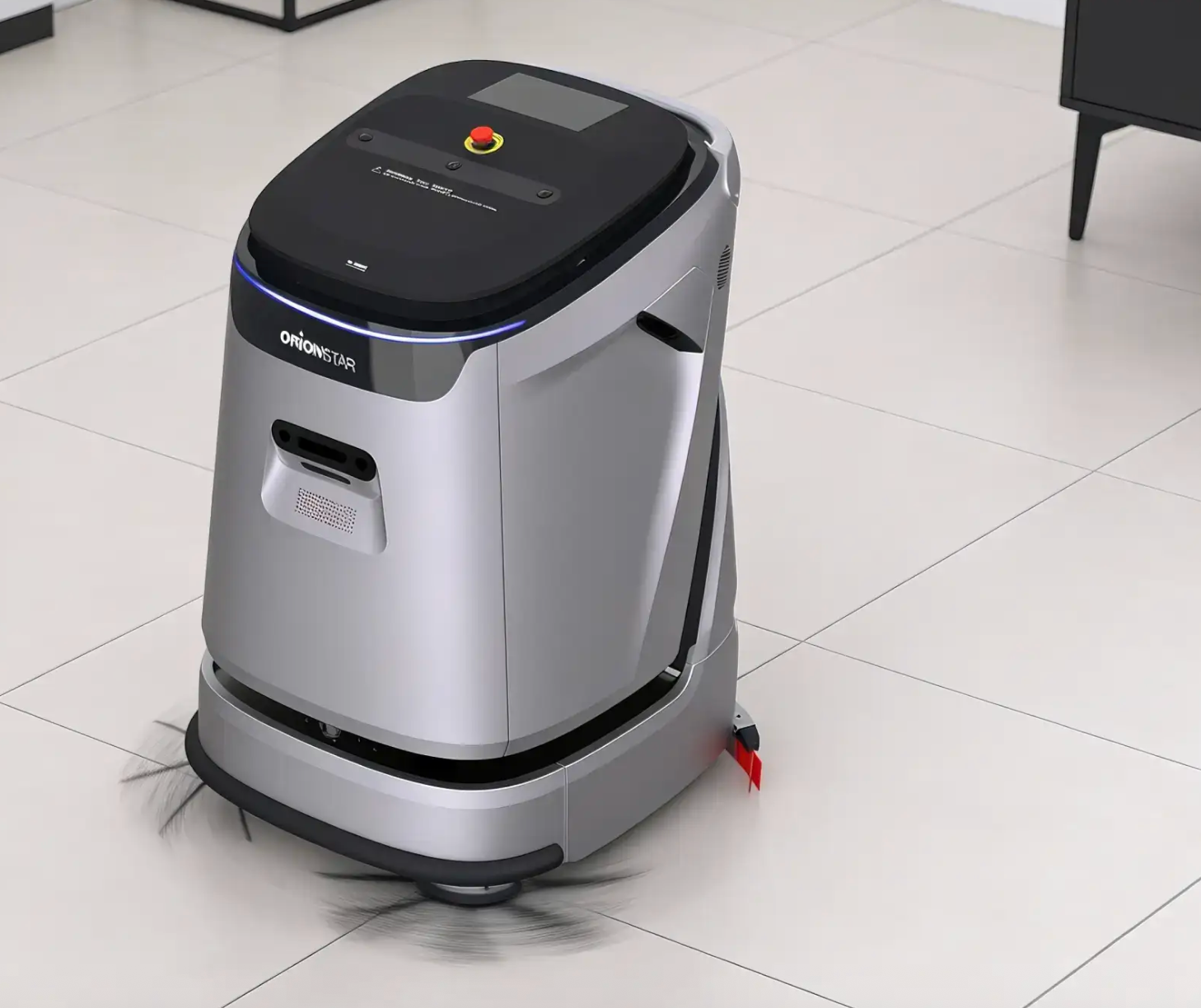
The OrionStar CleaniBot C5 is engineered for multi-shift corporate campuses and hybrid industrial-office spaces where heavy traffic demands industrial-grade hard-floor maintenance. It focuses on resolving heavy oil, grime, and stubborn stains in wide corridors and transit zones, utilizing a dual-rolling-brush system that applies up to 25 kilograms of downward scrubbing pressure. Workplace management teams benefit from its continuous operational capabilities, which are supported by a fully autonomous workstation designed for automatic clean-water refilling, wastewater discharge, and internal tank rinsing.
Supporting its deployment in expansive corporate settings, the CleaniBot C5 maps areas of up to 10,000 square meters while maintaining a minimal passing width of approximately 880 millimeters, according to manufacturer data. The machine integrates a combined 90-liter water capacity, split equally between clean and waste tanks, allowing it to scrub for approximately three hours or mop for up to eight hours under laboratory conditions. Operating at a noise level below 68 decibels, the device maneuvers safely alongside pedestrians using multiple sensors and an intelligent obstacle-avoidance system.
Designed for tight corridors and shared workspaces lacking dedicated plumbing infrastructure, the ICE Cobotics Cobi 18 serves as a compact walk-behind-style scrubber. This model addresses the spatial constraints of small offices, retail-style convenience zones within corporate buildings, and satellite coworking spaces where bulky machinery cannot operate. Facility teams can deploy this cobot scrubber using simple route teaching, establishing an accessible entry point for localized floor care without requiring substantial facility modifications.
The device features an 18.8-inch cleaning path and utilizes point-cloud mapping derived from sensor fusion to navigate complex aisles and changing sunlight conditions. According to manufacturer data, it achieves a productivity rate of up to 800 square meters per hour, supported by a 10-liter solution tank and an 11-liter recovery tank. Running for up to 90 minutes on a lithium-ion battery, the unit operates at a maximum noise level of 70 decibels, making it suitable for periodic deployment in populated corporate environments.
The Lionsbot R3 Scrub Pro positions itself as a compact robotic scrubber intended for washrooms, pantries, and narrow office zones requiring agile maneuverability. This model addresses the needs of hybrid work environments by providing a highly compact stainless-steel chassis that seamlessly integrates into standard office architecture. It incorporates a MagicTag localization system, allowing operators to initiate localized cleaning simply by pushing the robot to a designated tag, which minimizes complex digital setup requirements for temporary shared workspaces.
Operating with a 26.9-inch scrubbing width when utilizing its side brushes, the unit integrates a 5.5-gallon clean water tank and a 6.3-gallon waste water tank. It delivers a runtime of up to 3.5 hours, covering maximum theoretical efficiencies of up to 19,375 square feet per hour, according to manufacturer data. The device operates at an average noise level of 71 decibels and utilizes 3D LiDAR, ultrasonic sensors, and RGBD sensors to navigate dynamic environments, with an optional refuel station available for autonomous water exchange.
The Nilfisk Liberty SC50 focuses on daytime mixed-traffic public areas, serving corporate buildings, administrative centers, and campus common spaces. It provides workplace management administrators with one of the select independently certified autonomous scrubber-dryers that prioritizes operational safety in heavily populated zones. This machine emphasizes deep proof-of-clean reporting through its digital solutions platform, assisting facility teams in demonstrating strict hygiene compliance to internal corporate stakeholders.
According to manufacturer data, the unit features a 20-inch scrub path and operates for up to 6 hours on a single charge, managing maximum theoretical productivity of up to 1,895 square meters per hour. It integrates a 15-gallon solution tank and a 14-gallon recovery tank, alongside dual safety-rated sensors that deliver 360-degree coverage for real-time obstacle avoidance. Operating at an acoustic level of 63 decibels, the machine limits acoustic disruptions during active business hours while optionally utilizing SmartFlow technology to modulate water and chemical usage based on the specific cleaning assignment.
The Kärcher KIRA B 50 functions as a mid-to-large autonomous scrubber engineered for multi-building contracts and expansive corporate headquarters. This model supports facility management teams executing multi-floor cleaning schedules by offering an optional all-in-one docking station that autonomously handles fresh water refilling, wastewater drainage, tank rinsing, and battery charging. It incorporates a VDA 5050 communication interface, allowing organizations to integrate the hardware into broader fleet management operations across complex public and commercial facilities.
The machine utilizes a roller-brush head that pre-sweeps and scrubs simultaneously, featuring a vacuum working width of 750 millimeters. According to manufacturer data, it runs for up to 3.5 hours utilizing a 160 Ah lithium iron phosphate battery system, maintaining a sound pressure level of 69 decibels. High-performance sensors provide 360-degree environment detection, enabling autonomous obstacle avoidance and precise route execution within carefully defined interaction zones and no-go areas.
Intended for large open-plan office floors, corporate atria, and expansive campus common areas, the Diversey TASKI SwingoBot 2000 is a large robotic scrubber-dryer. This model addresses the training hurdles associated with multinational workplace teams by deploying an intuitive nine-language icon-based touchscreen and dual redundant safety computers. It focuses on maximizing area coverage in wide environments without relying on continuous automated water exchange setups, making it a robust choice for facilities with dedicated janitorial personnel assigned to manual servicing.
The hardware executes a 28-inch scrubbing width and applies up to 42.5 kilograms of scrubbing pressure to lift stubborn soils from hard floors. According to manufacturer data, it achieves a runtime of up to 4 hours utilizing a 180 Ah gel-cell battery, navigating via a 190-degree scanning laser and 360-degree ultrasonic sonar array. Operating below 70 decibels, the unit holds 90 liters of fresh water and 90 liters of wastewater, offering IntelliFlow water management to optimize fluid consumption across wide corporate surfaces.
The Gaussian Robotics Scrubber 50 adapts to dynamic shared workspaces and multi-floor corporate structures where comprehensive automation is highly valued. This compact scrubber-vacuum platform integrates an automatic water-exchange station and optional elevator integration, empowering workplace management to execute 24-hour cleaning cycles across various building levels. It focuses on autonomous zone management, allowing administrators to monitor performance and deploy targeted cleaning routes through a centralized cloud-based fleet management system.
According to manufacturer data, the unit features a 720-millimeter scrubbing width and a maximum cleaning efficiency of up to 1,200 square meters per hour. It operates on a 24-volt lithium iron phosphate battery system, yielding a runtime of up to 3 hours while managing a 24-liter clean water tank and an 18-liter wastewater tank. Navigating via LiDAR, 3D depth cameras, and ultrasonic sensors, the machine dynamically adjusts to changing obstacles in hybrid offices while producing operating noise levels ranging from 55 to 70 decibels.
Targeting expansive corporate campuses, wide-open lobbies, and high-traffic event spaces, the Avidbots Neo 2 operates as a wide-area autonomous scrubber. This large-format platform caters to facilities requiring massive square footage coverage and deep analytical insights, offering optional high-touch surface disinfection add-ons alongside its standard floor care capabilities. It emphasizes centralized digital oversight, utilizing a cloud-based command center to deliver sector-level coverage maps and real-time remote assistance for distributed corporate estates.
The system supports interchangeable 26-inch or 32-inch disc cleaning heads, managing maximum theoretical performances of up to 3,900 square meters per hour, according to manufacturer data. It incorporates an onboard recovery tank of up to 135 liters and sustains operations for up to 6 hours on specialized industrial batteries. Ten onboard sensors provide 360-degree visibility, driving a proprietary dynamic planning system that actively learns facility maps and seamlessly adapts routes to temporary environmental changes.
The Tennant T7AMR operates as a heavy-duty ride-on scrubber tailored for wide-open lobbies, exhibition-style floors, and massive corporate infrastructure. This model accommodates expansive campuses that rely on established facility-service contractors requiring high down pressure and deep fluid capacities. By utilizing a vision-based artificial intelligence system, it navigates complex, high-traffic corridors safely alongside employees while tracking key performance indicators through integrated fleet reporting tools.
According to manufacturer data, the machine executes a 26-inch cleaning path and utilizes massive 110-liter solution and recovery tanks to support prolonged maintenance shifts. Delivering estimated coverage of up to 45,760 square feet per shift, it runs for up to 6.5 hours when equipped with high-capacity lithium-ion batteries. The system applies up to 86 kilograms of main down pressure to remove deep-set grime, maintaining a sound level as low as 70 decibels during standard operation.
The Ecovacs DEEBOT PRO K1 specializes in maintaining carpeted floors, standard office corridors, and coworking lounges requiring daily dust and light debris removal. Operating as a compact vacuuming, sweeping, and dust-mopping robot, it serves environments where heavy-duty fluid scrubbing is inapplicable or less critical than dry maintenance. This platform provides continuous maintenance for hybrid work environments characterized by mixed-floor layouts and high foot traffic generating superficial dust.
Featuring a 440-millimeter cleaning width, the unit incorporates a high-capacity 10-liter dustbin and provides a powerful 20-kilopascal suction rating, according to manufacturer data. It manages maximum cleaning efficiencies of up to 700 square meters per hour, utilizing a minimum passable width of 52 centimeters to access confined breakout areas. The device sustains operations for up to 4 hours in vacuum mode or up to 8 hours during dust mopping, ascending slopes up to 10 degrees to navigate transitional architectural thresholds.
Deploying a workplace management commercial cleaning robot demands careful alignment between hardware specifications and the distinct architectural realities of the facility. Selecting the optimal navigational footprint requires balancing the high productivity of large-format machines against the agility required to access narrow coworking aisles and standard passenger elevators. Evaluating autonomy levels ensures the chosen fluid management strategy matches the facility's plumbing infrastructure and janitorial labor availability, distinguishing between localized manual interventions and zero-touch overnight docking. Matching the cleaning modality to the surface types prevalent in the workspace ensures that heavy-duty scrubbers address hard transit zones while specialized dry-maintenance platforms preserve carpeted meeting areas. Ultimately, integrating robust digital reporting systems guarantees that administrators can monitor fleet performance, adapt to shifting hybrid schedules, and consistently uphold hygienic standards across dynamic corporate environments.
Disclaimer: Third-party product specifications are based on publicly available data (up to, under laboratory conditions, according to manufacturer data), which may vary. Product names and trademarks are the property of their respective owners. If any product involves cameras, voice recording, mapping, or cloud data processing, operators must verify GDPR compliance prior to deployment.
Workplace management can expect significant labor savings by redeploying facility staff to higher-value tasks like desk sanitization and meeting room preparation, while autonomous machines handle repetitive floor care. Heavy-duty models such as the Avidbots Neo 2 and Tennant T7AMR can cover massive square footage in a single shift, fundamentally reducing the manual hours required for floor maintenance in expansive corporate buildings. By integrating efficient units like the Cleanibot C5 or the ICE Cobotics Cobi 18, facility managers typically observe a stabilization in their operational budgets and a consistent daily cleaning standard without increasing headcount.
Exact percentage returns on investment and financial labor savings are not publicly specified, as they depend entirely on local labor rates and the specific scale of the shared workspace. However, shifting the burden of wide-area scrubbing to automated systems allows cleaning teams to transition from time-intensive manual floor scrubbing to essential detail work, greatly improving the overall hygiene of hybrid work environments.
The decision to purchase, lease, or adopt a Robot-as-a-Service (RaaS) model depends strictly on the capital expenditure policies of your corporate building. RaaS is heavily utilized by vendors like ICE Cobotics with the Cobi 18, allowing facilities to pay a predictable monthly fee that typically includes the machine, maintenance, and software updates without an upfront capital investment. This operational expenditure approach is highly attractive for coworking spaces aiming to scale their automated fleets flexibly as foot traffic changes.
Alternatively, purchasing machines outright, such as the Kärcher KIRA B 50 or Nilfisk Liberty SC50, may offer a lower total cost of ownership over a multi-year period for established office campuses with dedicated facility maintenance budgets. While specific leasing terms and interest rates are not publicly specified across all manufacturers, evaluating your workplace's preference for holding fixed assets versus utilizing flexible service contracts will dictate the best procurement strategy.
Deploying autonomous robots equipped with cameras and LiDAR sensors in hybrid work environments requires strict adherence to data privacy protocols to protect employee confidentiality. Advanced navigation systems on models like the Gaussian Robotics Scrubber 50, Avidbots Neo 2, and Cleanibot C5 constantly scan the environment to map dynamic obstacles and optimize cleaning routes. Because these sensors process spatial and visual data in real-time, workplace management must ensure that the vendor's cloud infrastructure complies with regional data protection regulations such as GDPR.
While the explicit cryptographic standards and cloud server locations for every brand are not publicly specified, organizations must take proactive steps before deployment. Procurement and IT teams should verify that environmental mapping data is anonymized, stored on secure servers, and strictly limited to navigation purposes so it cannot be used for unauthorized personnel surveillance within shared workspaces.
Corporate buildings must align machine specifications with their total cleanable square footage and the frequency of required maintenance. For vast office campuses, high-capacity models like the Tennant T7AMR or Avidbots Neo 2 are ideal, as they provide extended runtimes and feature massive water tanks exceeding 110 liters to minimize manual interventions during long shifts. Conversely, medium-sized shared workspaces might be better served by the Gaussian Robotics Scrubber 50 or the Kärcher KIRA B 50, which feature moderate tank capacities ranging from 24 to 55 liters and battery runtimes perfectly suited for a standard daily cleaning cycle.
Smaller footprint devices like the Lionsbot R3 Scrub Pro or the Ecovacs DEEBOT PRO K1 offer greater agility in tight office aisles and crowded breakout rooms. While the exact maximum throughput limitations under heavy soil conditions are occasionally not publicly specified, selecting a tank size and battery life that matches your floor plan guarantees that the robot can finish its route without constantly pausing for manual servicing.
Operating cleaning robots during regular business hours requires machines that do not disrupt hybrid work environments, meetings, or quiet coworking spaces. Many modern commercial robots are engineered specifically for daytime deployment, with models like the Nilfisk Liberty SC50 and ICE Cobotics Cobi 18 operating at relatively low noise emissions, typically around the 63 to 65 decibel mark. This acoustic profile is akin to normal conversational volume, making them highly suitable for navigating around employees engaged in focused work.
Larger industrial-grade units such as the Avidbots Neo 2 and the Diversey TASKI SwingoBot 2000 may generate slightly higher noise profiles, which might necessitate scheduling their operation during off-peak hours or in unoccupied zones. Specific decibel ratings for the Cleanibot C5 and Ecovacs DEEBOT PRO K1 under maximum suction modes are not publicly specified, but evaluating the standard operating noise level is a crucial step for maintaining a quiet, productive workplace.
The choice between a fully autonomous docking station and manual tank service determines the level of true autonomy achieved in your workplace management strategy. Advanced units like the Cleanibot C5, Gaussian Robotics Scrubber 50, and Kärcher KIRA B 50 offer integrated workstation solutions that can automatically drain dirty water, refill clean water, and recharge batteries entirely without human intervention. This setup is highly recommended for large corporate buildings aiming for continuous, zero-touch floor care over weekends or overnight shifts where labor is scarce.
Alternatively, if dedicated janitorial staff are always present on-site during operational hours, manually servicing the tanks on machines like the Diversey TASKI SwingoBot 2000 or ICE Cobotics Cobi 18 is entirely sufficient and saves the infrastructure cost of plumbing a permanent docking station into the facility. While the exact installation requirements and plumbing dimensions for all optional docks are not publicly specified, auto-fill systems dramatically reduce daily labor overhead when implemented correctly.