

REQUEST DEMO
Robot CATALOG will be sent to your mailbox immediately after submission.
SUBMIT
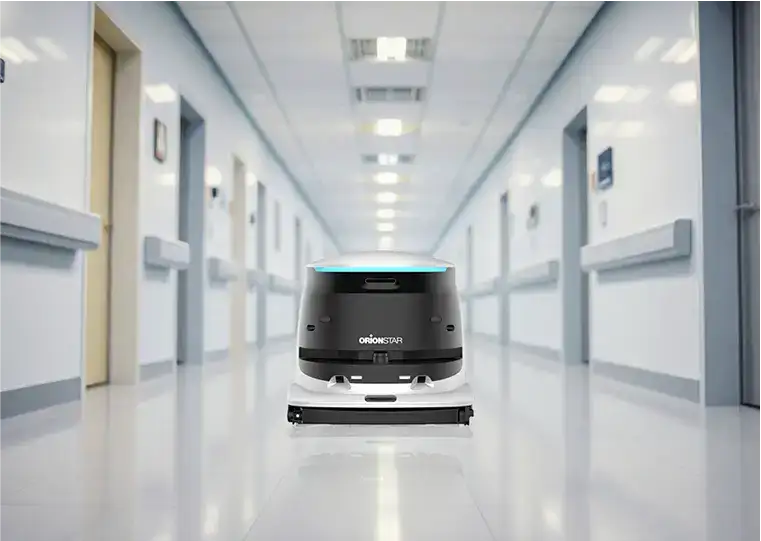
Facility management teams in hospitals operate under immense pressure to maintain stringent hygiene standards while grappling with persistent staff shortages, escalating labor costs, and strict compliance requirements. As traditional manual routines struggle to keep pace with the dynamic demands of large-scale healthcare environments, commercial cleaning robots have emerged as a vital solution to ensure consistent sanitation, optimize resource allocation, and document compliance efficiently.
The OrionStar CleaniBot C5 illustrates these automated capabilities through its industrial-grade design intended for demanding commercial spaces. According to manufacturer data, the unit can manage a maximum cleaning area capacity of up to 1,980 square meters per hour under ideal test conditions, supported by a combined 90-liter water tank system that reduces the need for frequent manual refills. It executes autonomous path planning and self-manages its maintenance by automatically docking at a workstation for clean-water refilling, waste-water discharge, and recharging, enabling continuous multi-shift operation with minimal human oversight.
These sprawling, high-traffic areas require constant maintenance to remove tracked-in dirt and prevent slip hazards. Autonomous robots can map these vast spaces and perform continuous, optimized cleaning passes, keeping the floors consistently clean without tying up valuable human staff.
Operating around the clock with unpredictable foot traffic and rapid movement of medical equipment, emergency departments present a highly dynamic cleaning environment. Smart obstacle avoidance allows commercial cleaning robots to safely navigate around temporary obstructions and personnel, ensuring floors remain clean even during peak hours.
Maintaining hygiene in patient wards is critical for infection control, yet cleaning activities must not disturb resting patients. Robots equipped with quiet operation modes and precise, localized cleaning capabilities can efficiently maintain floor hygiene while minimizing noise and disruption.
These highly sensitive zones demand rigorous, verifiable sanitation procedures to support strict infection-control protocols. Automated scrubbers generate precise, timestamped digital logs of every cleaning cycle, providing the concrete documentation required for strict infection-control audits.
Commercial cleaning robots are increasingly designed to function as mobile IoT nodes that seamlessly connect with existing Building Management Systems (BMS) and Computerized Maintenance Management Systems (CMMS) via REST APIs. Through these integrations, every robotic cleaning cycle becomes a documented maintenance event, coverage maps auto-populate service histories, and consumable wear alerts automatically generate work orders for technicians. Furthermore, integration with IoT-enabled platforms and standardized protocols like MQTT allows the robots to adapt their operations based on real-time building conditions, such as shifting routes when a zone is temporarily occupied or responding to localized cleaning triggers from connected air quality sensors.
Ultimately, integrating automated cleaning solutions helps facility management teams actively support ISO 14001 environmental management standards while maintaining sustainable, eco-friendly operations.
Commercial cleaning robots are fundamentally changing the way facility management maintains hospitals by addressing critical labor shortages, enhancing operational efficiency, and ensuring verifiable hygiene standards. By automating repetitive floor care tasks, healthcare facilities can reallocate human resources to more specialized sanitation duties that require critical thinking and a human touch. For environments with varying spatial layouts and cleaning requirements, the OrionStar CleaniBot series provides multiple models to accommodate different operational needs, offering facility managers a practical pathway toward modernized, data-driven maintenance.
Disclaimer: Financial metrics, cost reductions, and return on investment figures are based on industry benchmarks and case studies; actual results may vary depending on the specific facility and operational conditions.
Privacy Notice: OrionStar CleaniBot utilizes visual sensors strictly for real-time navigation and obstacle avoidance. The device operates edge-processing technology where visual data is instantly anonymized or overwritten, and is not stored permanently or uploaded to the cloud without explicit customer consent, ensuring full compliance with GDPR and HIPAA guidelines.