

REQUEST DEMO
Robot CATALOG will be sent to your mailbox immediately after submission.
SUBMIT
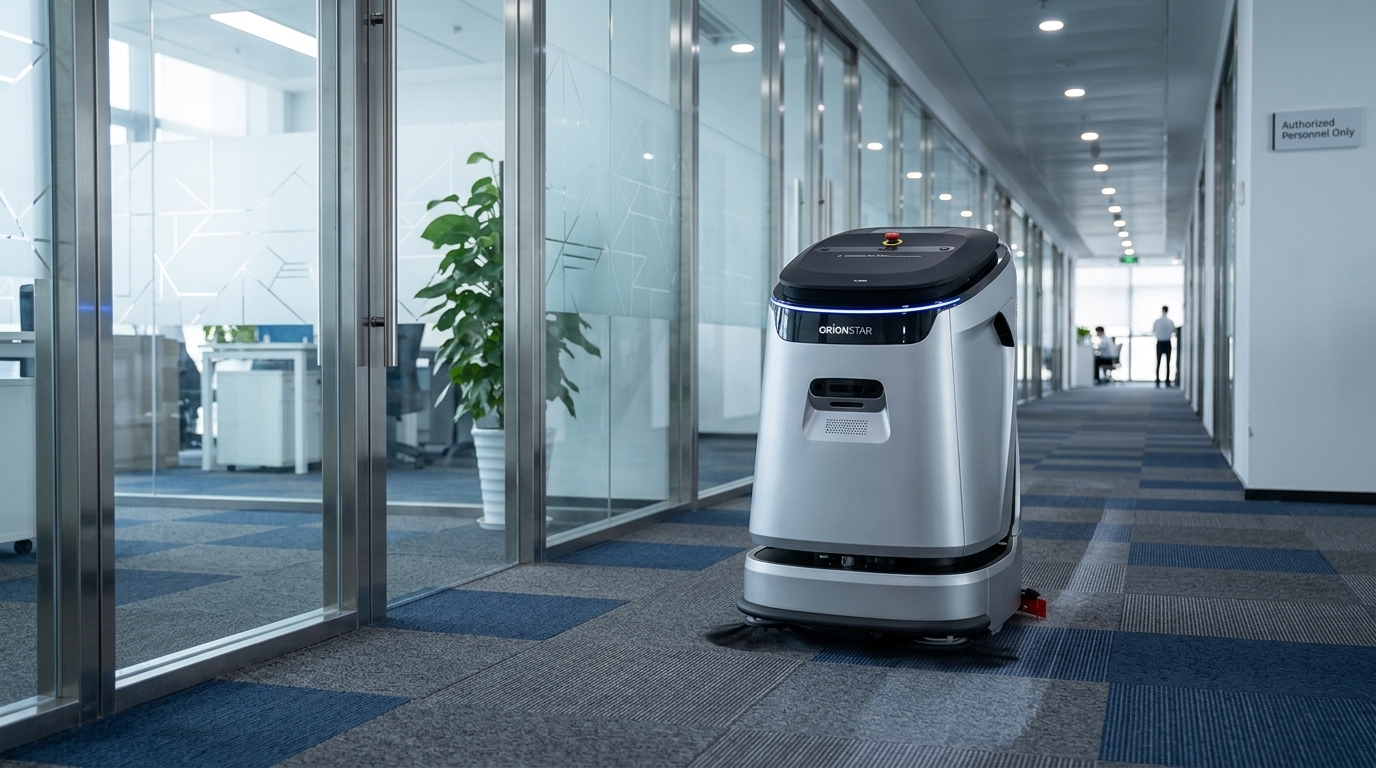
Across sites, standardize how we record model, mode, service setup and local exceptions—not one route. For our OrionStar CleaniBot C5, record the water-service arrangement; for OrionStar CleaniBot S55 Pro, record the selected mode, while local staff retain route and change-control ownership.
A facility service company may manage offices, retail locations, schools, healthcare-adjacent spaces, warehouses, or mixed-use buildings that look similar on a contract list but operate very differently in practice. Entry timing, foot traffic, flooring, storage, water access, cleaning expectations, and local staffing can all change the way a robot should be used. Treat each site as a local operation governed by a common playbook, not as an identical repeat of the first deployment.
We suggest establishing a simple division of responsibility before a robot is scheduled for routine work. A corporate or regional owner can maintain the standard templates and review lessons across locations. Each site should still have a named site owner who approves routes, confirms operating windows, keeps records current, and decides when a local condition requires a pause or change.
This approach avoids two common problems: over-centralizing decisions away from people who understand the building, and leaving every location to invent its own undocumented process. The goal is repeatability in how decisions are made, not forced uniformity in routes, task frequency, or equipment selection.
Begin with a site walk that separates cleaning goals from operating constraints. Ask what needs to be cleaned, when the space can be accessed, where people and movable obstacles concentrate, who can support the operation, and what must be checked after work is complete. A route that is useful in an open lobby may be unsuitable for a cluttered back-of-house corridor or an area with changing deliveries.
Document floor conditions instead of relying on broad labels such as “hard floor” or “commercial space.” Note transitions, unsealed or damaged areas, loose mats, drainage concerns, narrow turns, storage patterns, temporary signs, and cleaning-product restrictions. A robot should be considered only after the local team confirms that the intended task, surface, traffic pattern, and maintenance process are appropriate for that location.
Product selection should follow this review. Consider CleaniBot C5 when a site has a large commercial cleaning area and the local check confirms that its planned work can use supported tasks such as scrubbing, vacuuming, sweeping, dust mopping, or wastewater recovery. Its large-capacity scrubber positioning can make it a candidate for larger commercial settings, but that positioning does not establish suitability for a particular floor plan, surface, or operating window.
Consider CleaniBot S55 Pro when a compact commercial cleaning robot may better match the physical layout and the local team can confirm the needed cleaning approach. S55 Pro supports six cleaning modes, but the mode count alone does not confirm compatibility with every floor surface or site condition. Record the proposed use case and validate it against the site’s actual cleaning requirements before adding it to a routine.
| Site check | Local decision to record | Reason it matters |
|---|---|---|
| Cleaning zone and objective | Define the area, intended task, cleaning window, and post-cleaning expectation. | Prevents a general cleaning request from becoming an unclear route instruction. |
| Surface and transitions | Record observed floor materials, transitions, damaged areas, mats, and exclusions. | Supports a surface-specific operating decision instead of a broad assumption. |
| Traffic and change patterns | Identify busy periods, deliveries, furniture movement, and temporary obstructions. | Helps the site select a workable operating period and update it when conditions shift. |
| Water and waste process | Identify approved access points, local handling steps, and responsible personnel. | Keeps cleaning support tasks visible in the operating plan. |
| Escalation path | List who can pause work, approve a change, and respond to an exception. | Avoids uncertainty when the original plan no longer fits the site. |
A local route record is more useful than a route name alone. It should explain the business purpose of the route and the conditions under which staff may use it. Keep the record in a location that the site owner, shift lead, and operators can access during normal work. Use a version date so people can tell whether they are following the current instruction.
Add the selected CleaniBot S55 Pro mode by name, or the CleaniBot C5 workstation functions actually included in the local setup, to each route record. A change from a scrub task to a dry-maintenance mode or a different service point should trigger local review and operator briefing. This allows the portfolio to compare like tasks while choosing C5 for locally workable recurring floor-care loops or S55 Pro for a locally verified mode mix. Standardizing the decision record is more useful than forcing the same setting into different properties.
Do not turn the record into a long technical manual. A concise, usable document is more likely to be completed accurately. The detailed training material can sit separately, while the route record gives the shift team the information needed to make a consistent local decision.
Multi-site operations lose consistency when route changes are made informally. A moved reception desk, a new floor treatment, revised hours, or a changed storage arrangement may appear minor, yet it can alter local operating conditions. Require the site to record the change before returning the route to routine use.
A lightweight change-control process does not need a committee for every adjustment. It needs clear thresholds. Small updates may be approved by the site owner after a documented local review. Material changes should trigger a new route record version, operator briefing, and regional visibility so other sites can consider whether a similar issue exists in their own environment.
For CleaniBot C5’s separate 45L tanks, moving the workstation changes the refill/discharge return path and potentially the staff handoff. Rewalk that loop and record access, checks and exception ownership before approving the revised local route. The revised return journey can consume the window previously reserved for cleaning, or move an exception to another shift. Approve the new routine only when the local team can sustain both the route and its service handoff.
| Change type | Required local action | Cross-site follow-up |
|---|---|---|
| Temporary obstacle or event setup | Pause or adjust the affected route and record the condition. | Share only if the condition may recur at other locations. |
| Floor, layout, or access change | Review the route, update the record, and brief relevant operators. | Add to the next review agenda as a transferable lesson. |
| New cleaning expectation | Clarify the task, acceptable outcome, operating window, and responsible approver. | Compare the request with similar site requirements. |
| Equipment configuration question | Confirm the local configuration and operating steps before use. | Record the question and resolution for consistent future decisions. |
Operator training should cover more than starting a cleaning cycle. Staff need to understand the purpose of the route, the site conditions that were assumed when it was approved, the preparation and completion checks, and the situations that require escalation. This makes the process resilient when staffing changes or a supervisor is not immediately available.
Use a train-observe-record format. First, explain the written route record and the decision points. Next, have the operator perform the preparation and completion sequence under observation. Finally, require the operator to complete the local record, including how to describe an exception without guessing at its cause. Refresh training whenever a meaningful route or process change occurs.
For service companies, this training structure also improves handoffs between shifts and locations. An operator transferred to another property should learn that the common playbook travels with them, but the local route record controls what they do at the new site.
A cleaning record should document what the local team observed and did; it should not claim outcomes that were not checked. A basic entry can include the date, location, route identifier, operator, planned operating period, completion status, visible exceptions, corrective action, and follow-up owner. If the site has a client-facing reporting format, align the fields with the actual information the team can consistently document.
These records can provide organized evidence for internal quality discussions, client conversations, or later review of a specific cleaning period. They are not automatically a guaranteed service report or independent proof of every cleaning result. Keep the language factual: describe the route used, the condition observed, the action taken, and any open item.
Hold a cross-site review on a regular cadence that fits the operation. The purpose is to identify recurring barriers, improve templates, compare change requests, and decide whether training or local records need revision. Avoid using the meeting to impose one site’s route on another without reviewing local conditions.
A suitable commercial cleaning robot for a facility service company is one that fits a defined local task and can be supported by the site’s people and processes. Start with the cleaning objective, the physical environment, the local operating window, and the maintenance responsibilities. Only then compare candidate equipment.
CleaniBot is OrionStar’s cleaning robot product line, which includes the CleaniBot C5 and CleaniBot S55 Pro. For a larger commercial setting, C5 may be a candidate where the site review supports its planned tasks and operational setup. For a more compact commercial setting, S55 Pro may be a candidate when its physical fit and the intended use have been locally checked. Neither product positioning replaces a site-specific assessment of surfaces, traffic, access, configuration, and operator readiness.
Ask practical questions during selection: Which exact zones are in scope? What cleaning task is expected in each zone? Can the team maintain the proposed routine? Are water, waste, and storage arrangements defined? The answers should be captured in the route record before routine operations begin. Ask which water-service alternatives are available for the exact quoted configuration and how filling, wastewater handling and daily inspection would work. Availability and inclusion need confirmation in the proposal.
Bring a simple site packet to any product or operational discussion: floor plans or zone sketches, intended cleaning tasks, floor-condition notes, operating windows, traffic patterns, access constraints, water and waste arrangements, storage location, named site owner, and current training responsibilities. This information helps keep the conversation grounded in the actual site rather than broad assumptions about a building type.
Questions to ask include: Which local tasks are in scope for this site? Which route conditions need to be recorded? Who approves a change? What preparation and completion checks can the shift team actually perform? What evidence can the team document consistently? If a workstation or accessory is being considered, what exact configuration and local support steps must be confirmed? A disciplined answer to these questions creates a stronger foundation for multi-site operations.
There is no universal choice without a local operating review. CleaniBot C5 can be considered for larger commercial settings when the site confirms that its planned tasks align with supported scrubbing, vacuuming, sweeping, dust mopping, or wastewater recovery. CleaniBot S55 Pro can be considered where a compact commercial robot and its six-mode support fit the local use case. Surface conditions, access, traffic, staffing, and maintenance responsibilities still need site-specific confirmation.
Use one common template, but complete it locally. The core fields can stay consistent across the portfolio, while route boundaries, operating windows, exclusions, preparation steps, and escalation contacts should reflect each property.
Review the route when floor conditions, layout, access, traffic patterns, cleaning expectations, storage arrangements, or local support processes change. Record the reason, approval, revised instruction, and any required operator briefing.
No. With a suitable configured workstation, CleaniBot C5 supports automatic charging, clean-water refill, wastewater discharge, and wastewater-tank self-cleaning. The site still needs defined responsibilities for configuration checks, approved handling steps, upkeep, exceptions, and recordkeeping.
Include the date, site, route identifier, operator, planned operating period, completion status, observed exception, action taken, and follow-up owner. Keep entries factual so teams can compare recurring conditions and improve local instructions.