

REQUEST DEMO
Robot CATALOG will be sent to your mailbox immediately after submission.
SUBMIT
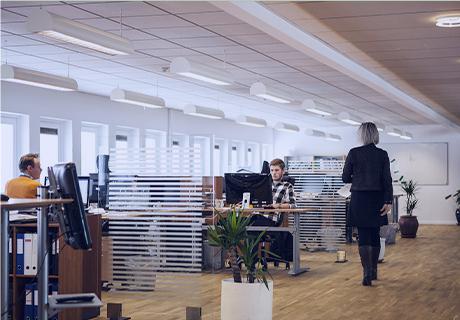
Facility Management in corporate offices is currently confronting a complex matrix of cleaning challenges, characterized by severe staffing shortages, escalating labor costs that can account for up to 70 percent of commercial cleaning expenses, and increasingly strict environmental compliance standards. As tenant expectations for hygiene rise alongside these operational pressures, traditional manual maintenance is becoming unsustainable for large-scale workspaces. To navigate these constraints while maintaining high standards, the industry is increasingly turning to commercial cleaning robots as a strategic solution to automate repetitive tasks, optimize resource allocation, and ensure consistent facility upkeep.
The OrionStar CleaniBot C5 illustrates how these autonomous capabilities are implemented in industrial-grade hardware for high-traffic environments. Demonstrating autonomous path planning and continuous operation, the device is designed to map areas of up to 10,000 square meters and features an auto-charging station that supports self-cleaning and automatic clean-water refilling, according to manufacturer data. Furthermore, its mobility systems are engineered to navigate typical office layouts, utilizing smart obstacle avoidance to maneuver through doorways with a minimal passing width of approximately 880 mm while maintaining a noise level below 68 dB(A) to minimize disruption in corporate settings.
Corporate lobbies experience fluctuating, high-volume foot traffic throughout the day, bringing in external dirt and debris that can damage hard floors. Autonomous cleaning robots can be programmed to adjust their schedules dynamically, increasing cleaning frequency during quiet periods and pausing when foot traffic spikes to minimize disruption.
Long, continuous hallways require extensive time to manually sweep and scrub, often leading to inconsistent results depending on staff fatigue. Robots utilize autonomous path planning to systematically cover these linear spaces, ensuring every square meter is cleaned with consistent pressure and water dispensing.
Conference rooms present unpredictable occupancy patterns and often accumulate debris or spills after consecutive client presentations. By linking to building occupancy sensors, smart cleaning equipment can be dispatched to clean conference rooms immediately once vacated, ensuring the space is presentable for the next group.
Expansive open-plan workspaces involve navigating complex arrangements of desks, chairs, and moving employees. Using LiDAR navigation and obstacle avoidance, commercial cleaning robots can safely weave through these dynamic environments without colliding with office furniture or disturbing working personnel.
Commercial cleaning robots function as mobile IoT nodes that seamlessly integrate with existing building management systems through standard protocols like MQTT or proprietary APIs to enhance overall facility operations. By linking with building occupancy sensors, these devices can generate dynamic cleaning schedules that adapt to actual space utilization, while onboard environmental sensors can feed indoor air-quality data directly into automation systems to trigger HVAC adjustments. Furthermore, integration with security and access-control systems allows robots to use digital credentials to navigate through authorized doors and elevators or automatically exclude locked-down floors from their routing during security events.
By dramatically reducing water usage, chemical dependency, and peak energy demand, automated cleaning technologies directly support corporate compliance with overarching environmental, social, and governance targets.
Commercial cleaning robots are significantly optimizing how Facility Management approaches the daily maintenance of corporate offices, transitioning from labor-intensive manual routines to data-driven, automated operations. By addressing chronic staffing shortages, enforcing consistent hygiene standards, and supporting rigorous environmental targets, these systems provide a scalable response to modern facility challenges. For operators evaluating autonomous solutions to meet specific spatial and operational requirements, the OrionStar CleaniBot series offers multiple models designed to adapt to diverse commercial environments.