REQUEST DEMO
Resources > Blogs > Transforming Floor Care: How Commercial Cleaning Robots Support Food Service Management in Corporate Cafeterias

Transforming Floor Care: How Commercial Cleaning Robots Support Food Service Management in Corporate Cafeterias

2026-07-01 23:31 OrionStar

Transforming Floor Care: How Commercial Cleaning Robots Support Food Service Management in Corporate Cafeterias

Introduction

Food Service Management in corporate cafeterias faces unique cleaning challenges, including the aggressive buildup of cooking grease, stringent food safety compliance standards, and ongoing labor shortages that consistently drive up operational costs. To address these compounding pressures, commercial cleaning robots have emerged as a highly effective solution, automating repetitive and labor-intensive floor maintenance to ensure consistent, auditable sanitation while allowing stretched kitchen teams to focus on critical food preparation tasks.

The Growing Need for Smarter Cleaning in Corporate Cafeterias

  • Facility operators struggle with the constant accumulation of heavy cooking grease, dropped solid food, and sticky beverage spills that require specialized, time-consuming removal approaches.
  • Severe labor shortages and high staff turnover mean skeleton-crew kitchen teams are stretched thin, making it difficult to maintain strict food safety practices alongside efficient daily workflows.
  • Traditional manual maintenance cannot keep pace with the rapid table turnover required during peak dining hours, often leaving behind slippery residues and unmanaged waste.
  • Failing to properly manage organic waste and dirty slurry from routine floor scrubbing can lead to rapid bacterial growth and severe odors that violate rigorous hygiene standards.

How Commercial Cleaning Robots Can Help

  • Advanced LiDAR navigation and three-dimensional depth cameras allow robots to map complex layouts and execute autonomous path planning around densely packed tables and chairs.
  • AI-based obstacle avoidance ensures safe operation by calculating dynamic detours when encountering moving pedestrians or temporarily relocated furniture.
  • Autonomous docking stations handle auto-charging, clean-water refilling, and wastewater discharge to enable multi-shift operation with minimal human intervention.
  • Digital platforms and real-time monitoring sensors collect verifiable sanitation data to support compliance reporting and identify operational gaps before they become safety hazards.
  • Since these navigation systems rely on cameras, mapping sensors, and cloud-based data processing, facility operators must verify that all deployments comply with regional data protection regulations such as GDPR.

A Closer Look: OrionStar CleaniBot C5 in Action

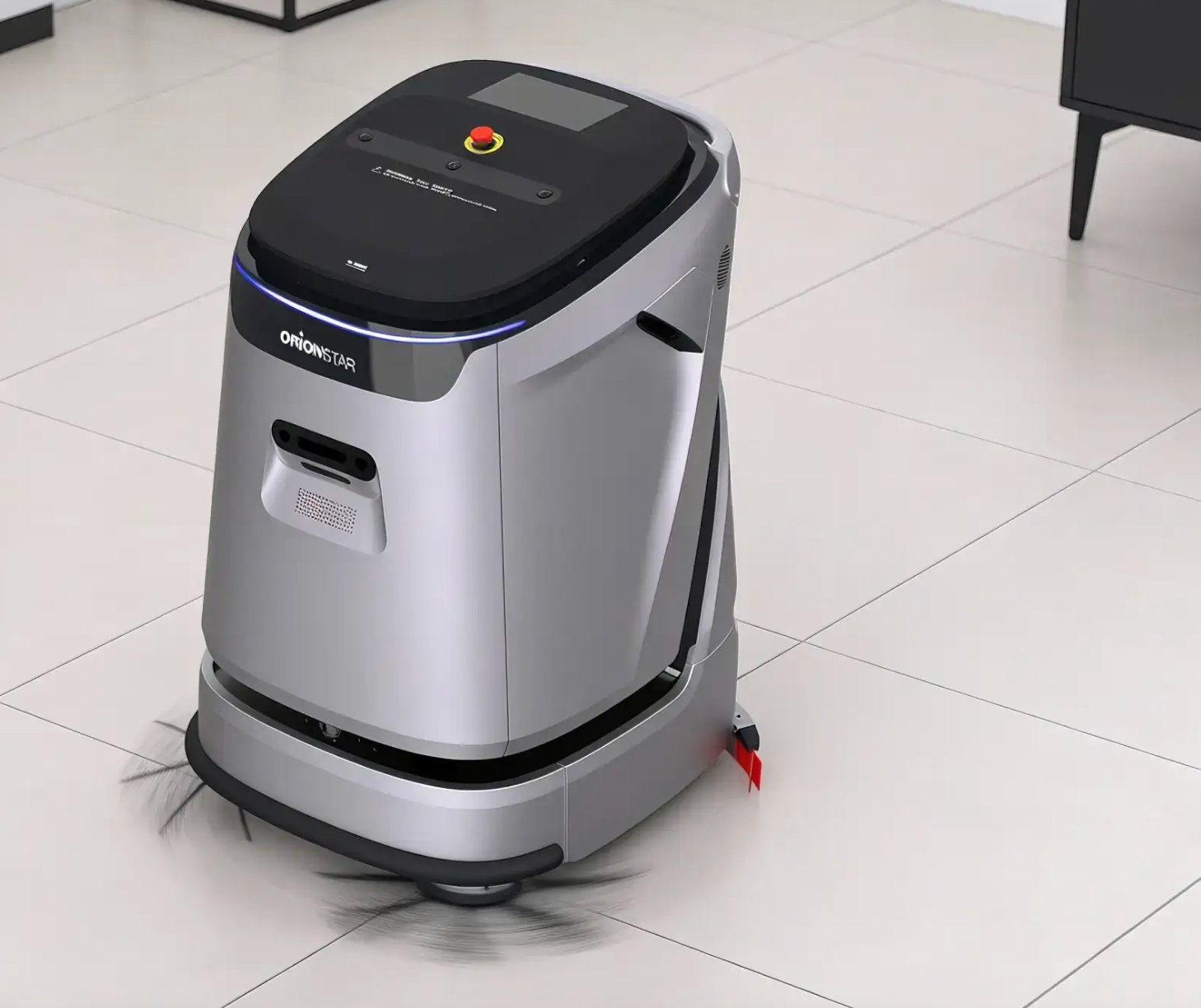
The OrionStar CleaniBot C5 demonstrates these automated capabilities by combining autonomous navigation with industrial-grade floor care hardware designed specifically for challenging commercial environments. According to manufacturer specifications, the unit features a dual-rolling-brush system delivering up to 25 kg of downward scrubbing pressure, enabling the one-pass removal of heavy oil and grime typical in food service zones. Relying on cloud-based mapping optimization, it can cover a theoretical maximum cleaning area of up to 1,980 square meters per hour, while its automated workstation handles refueling, drainage, and internal tank rinsing in roughly four minutes to prevent the odor and blockages associated with organic food waste.

Benefits for Food Service Managers, Cafeteria Operators

  • Reduced Labor Costs: Automating repetitive floor coverage helps offset intense financial pressures, as labor typically accounts for 60 to 80 percent of total facility cleaning budgets, according to industry estimates.
  • Measurable ROI: According to industry estimates, autonomous scrubbers deployed in daily-use facilities with over 50,000 square feet of hard floors typically achieve investment payback in 9 to 18 months, depending on local labor rates, facility size, and deployment frequency, especially on overnight cleaning routes.
  • Consistent Quality: Machines execute precise, daily cleaning programs that prevent the dangerous buildup of slippery residues and organic matter without relying on hurried manual labor.
  • Data-Driven Compliance: Connected automated platforms automatically record daily cleaning cycles, creating auditable sanitation records that replace cumbersome manual paper checklists.
  • Resource Efficiency: Advanced automated floor scrubbers utilize multi-stage filtration and exact dosing, potentially reducing freshwater consumption by approximately 80 percent under optimal conditions.

Real-World Applications

Dining Areas

Open seating environments face continuous foot traffic and scattered food debris during peak corporate meal hours. Commercial cleaning robots utilize smart routing and multi-sensor fusion to navigate safely around shifting chairs and dining patrons, automatically returning to skipped zones once the area eventually clears.

Serving Lines

These high-traffic corridors frequently suffer from sticky beverage spills and dropped solid food that create immediate slip hazards for employees and guests. Automated scrubbers can quickly deploy specialized cleaning modes to sweep and scrub the area simultaneously, efficiently removing both dry debris and wet sticky residues in a single pass.

Entrance Zones

Transitions between food preparation zones and public dining spaces naturally accumulate heavy grease tracked by busy kitchen staff. High-pressure robotic scrubbing hardware applies consistent downward force to lift stubborn, ground-in cooking grease from hard floors before it can spread into general walking areas.

Integration with Other Smart Systems

Commercial cleaning robots seamlessly integrate into the broader smart building ecosystem through IoT-enabled communication and digital facility management platforms. At the infrastructure level, autonomous docking stations connect directly to building plumbing and power utilities to manage internal tank rinsing and battery charging without human assistance. Furthermore, robotic fleet management software can feed operational data directly into existing Building Management Systems (BMS) or Computerized Maintenance Management Systems (CMMS), transforming isolated cleaning tasks into a transparent, data-driven network that generates actionable alerts and comprehensive hygiene dashboards.

Supporting ESG and Sustainability Goals

  • Multi-stage water recycling systems drastically cut resource waste, reducing freshwater consumption by up to 80 percent during typical floor maintenance routines.
  • Automated workstations manage precise chemical dosing and thorough tank rinsing, preventing organic matter buildup while minimizing the use of harsh detergents near food consumption zones.
  • Digital compliance monitoring provides an auditable record of sanitation performance, aligning operations with broader corporate governance targets for employee safety and wellness.
  • By significantly reducing resource consumption and ensuring healthier indoor environments, robotic floor care directly advances the broader sustainability and ESG commitments of modern corporate facilities.

Closing

The deployment of commercial cleaning robots is significantly improving the way Food Service Management approaches the maintenance of corporate cafeterias, successfully bridging the gap between severe labor shortages and strict sanitation requirements. By automating heavy-duty floor scrubbing and integrating with smart building systems, these automated platforms elevate overall hygiene, compliance, and operational efficiency. For facility operators looking to modernize their floor care strategies, the OrionStar CleaniBot series provides multiple models equipped to handle the unique spatial and environmental demands of large-scale food service venues.