

REQUEST DEMO
Robot CATALOG will be sent to your mailbox immediately after submission.
SUBMIT
Optimizing Front-End Efficiency: Commercial Cleaning Robots in Checkout Zones for Supercenter Retail Operations
Supercenter Retail Operations face severe labor shortages, rising wages, and strict compliance demands when maintaining high-visibility checkout zones, making consistent, high-quality cleaning increasingly difficult and costly. To overcome these compounding human resource, financial, and regulatory challenges, operators are increasingly adopting commercial cleaning robots as a reliable, autonomous solution to maintain highly clean and well-kept front-end spaces.
Custodial turnover in retail facilities can reach up to 75%, with daily absenteeism running as high as 15%, severely disrupting consistent maintenance schedules.
Supercenter operators face a persistent labor shortage and rising wage expectations, making it a long-term challenge to attract and retain facility staff.
Janitorial labor for hard-surface common areas consumes 35% to 45% of total operating expenses, placing immense strain on retail facility budgets.
Heightened hygiene expectations and strict lease compliance requirements mandate continuous, high-quality cleaning in areas where shoppers frequently queue and carts pass repeatedly.
Advanced LiDAR navigation and autonomous path planning enable these units to continuously map complex retail environments and dynamically calculate the most efficient cleaning routes.
Smart obstacle avoidance systems utilize sensor arrays to safely navigate around moving shopping carts, structural barriers, and pedestrians in congested environments.
Auto-charging and automated docking capabilities allow the machines to operate continuously across multiple shifts with minimal human intervention.
Real-time monitoring and cloud-connected fleet management provide operators with actionable data to adjust service schedules based on actual facility usage.
The robot's onboard cameras, spatial mapping sensors, and cloud data processing mechanisms are designed to support compliance with GDPR requirements, assisting operators in adhering to data minimization principles and utilizing anonymized data in public spaces.
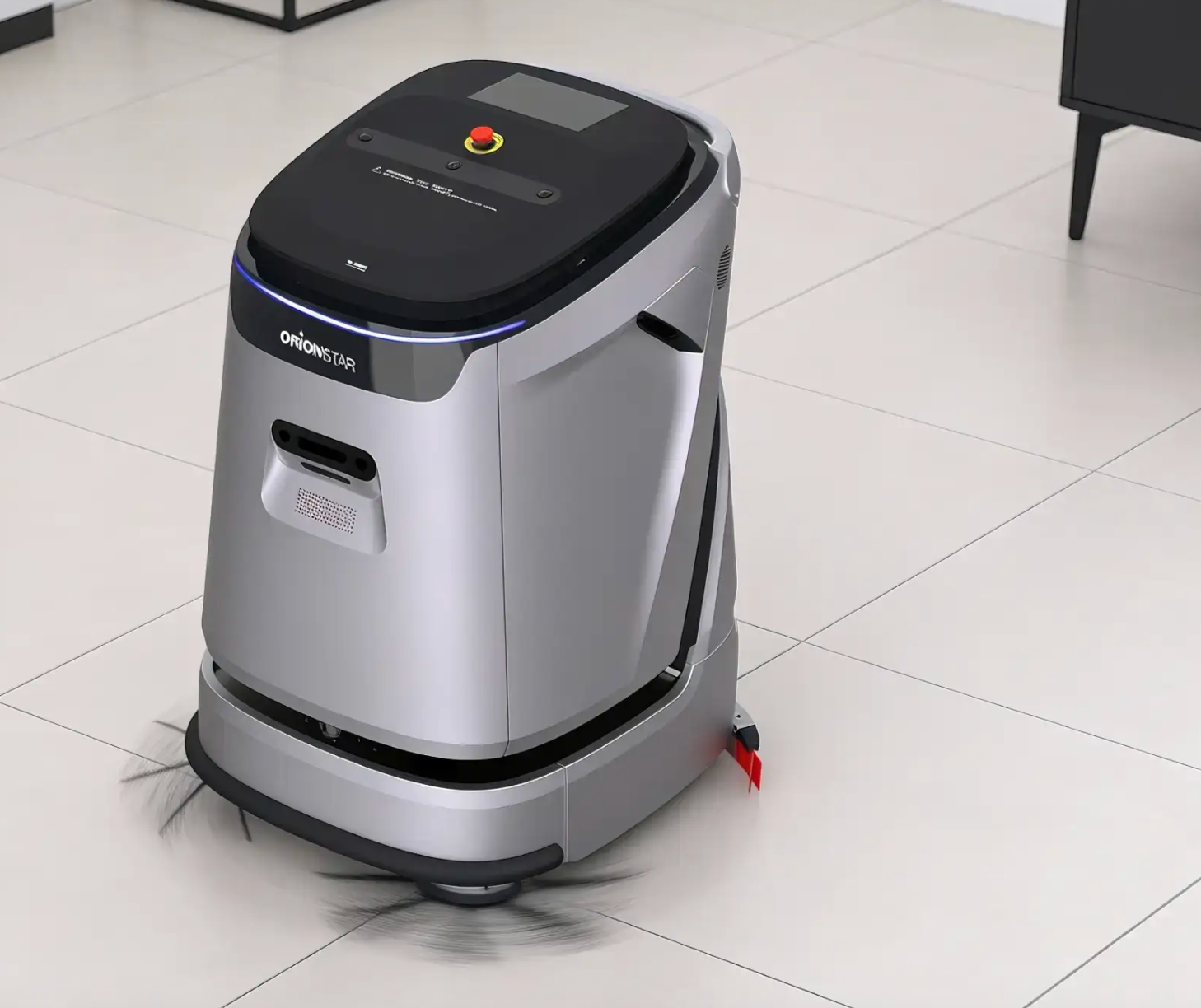
The OrionStar CleaniBot C5 exemplifies these autonomous capabilities by integrating robust navigation systems with heavy-duty cleaning hardware designed for expansive commercial spaces. According to manufacturer data, the unit can map an area of up to 10,000 square meters and utilizes automated path optimization to navigate efficiently. To minimize manual upkeep, it features an automated workstation that handles clean-water refilling and internal tank rinsing, all while operating at a noise level of less than 68 dB(A) to prevent disruptions in active retail environments.
Significant cost reduction: Implementing managed robotic programs can yield a 21% reduction in overall cleaning and maintenance costs while significantly reducing manual equipment rental expenses.
Increased equipment utilization: Structured robotic deployments paired with ongoing performance monitoring can increase machine utilization rates by up to 49%, maximizing the return on automation investments.
Consistent cleaning quality: Autonomous units provide reliable, continuous scrubbing designed to meet high cleanliness standards, mitigating the daily impact of high custodial absenteeism.
Strategic labor reallocation: By automating repetitive floor scrubbing, facility managers can redeploy scarce manual labor to more specialized, high-value tasks across the store.
Data-driven operations: Real-time performance tracking allows operators to fine-tune operations and establish verifiable, chain-wide efficiency benchmarks based on concrete data.
Traditional checkout lanes present tight navigation challenges with narrow passing widths and constant cart movement. Commercial cleaning robots utilize intelligent obstacle avoidance and compact maneuverability to scrub these narrow corridors without disrupting ongoing transactions.
Areas where customers line up experience concentrated foot traffic, resulting in a rapid accumulation of dirt and spills. Autonomous floor scrubbers can dynamically target these high-traffic zones during off-peak hours, ensuring a consistently clean environment that meets elevated shopper expectations.
The high density of kiosks and continuous customer circulation at self-checkout stations make manual cleaning highly disruptive. Robots equipped with advanced sensors can safely navigate the complex layout of automated kiosks, providing efficient dust-mopping and scrubbing while helping to keep floors dry and reduce slip hazards.
As the transitional space between the outdoors and the main store, vestibules accumulate significant debris, moisture, and grime. High-performance robotic scrubbers apply consistent downward pressure to remove stubborn stains and absorb water, maintaining a safe and welcoming first impression for arriving shoppers.
Commercial cleaning robots function as mobile Internet of Things (IoT) nodes, integrating with existing supercenter infrastructure, such as Building Management Systems (BMS) and Computerized Maintenance Management Systems (CMMS). By feeding real-time operational and environmental data into these centralized platforms, the robots enable demand-based cleaning where occupancy sensors trigger deployments based on actual foot traffic and contamination levels rather than static schedules. Furthermore, cloud-connected fleets can generate anonymized foot-traffic heat maps, which inform broader maintenance planning and optimize resource allocation across the entire retail facility.
Automated floor scrubbers can reduce water and cleaning-chemical usage by up to approximately 90% compared to traditional mop-and-bucket methods.
Low-light operation capabilities allow the robots to clean during night shifts without requiring full overnight lighting and HVAC use, thereby lowering overall energy consumption and carbon footprint.
Automated data collection improves operational transparency, supplying operational metrics designed to support compliance with reporting requirements for green-building certifications like LEED and broader ESG reporting frameworks.
Ultimately, integrating automated cleaning technologies directly supports supercenter retail operations in achieving their environmental, social, and governance (ESG) targets by minimizing resource waste and promoting sustainable facility management.
Commercial cleaning robots are actively improving the way supercenter retail operations approach the maintenance of checkout zones by providing a reliable, data-driven response to severe labor shortages and stringent cleanliness standards. As facilities increasingly rely on these autonomous solutions to balance operational budgets and compliance demands, exploring versatile robotic fleets becomes a valuable strategy for facility managers. The OrionStar CleaniBot series offers multiple models to accommodate various spatial constraints and facility sizes, providing operators with scalable options to meet the unique structural demands of modern retail environments.
Note: Industry statistics cited in this article are drawn from publicly available sources including KBS Services, Grocery Dive, Kline & Company, and OrionStar Robotics. Actual cleaning efficiency, runtime, and ROI may vary depending on layout, floor conditions, and operational factors. The CleaniBot C5 is designed for commercial floor cleaning and does not guarantee medical-grade sterilization.