

REQUEST DEMO
Robot CATALOG will be sent to your mailbox immediately after submission.
SUBMIT
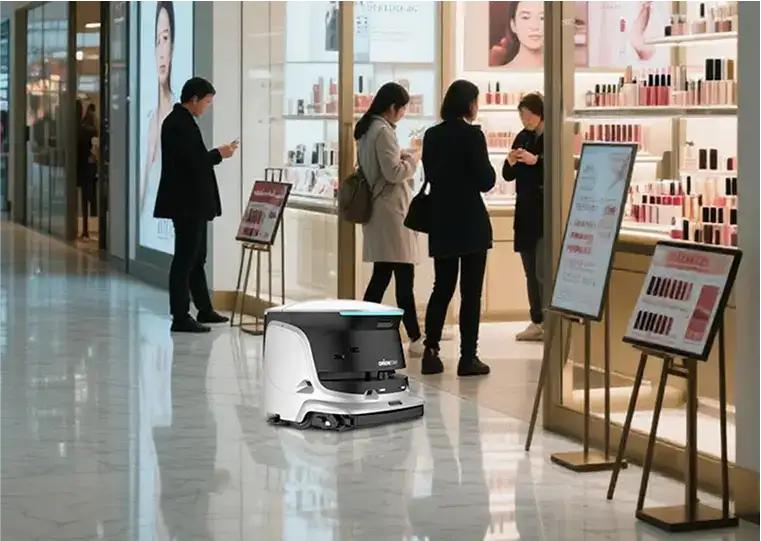
Shopping Center Management faces mounting pressure when maintaining entrance lobbies, as severe custodial workforce volatility, escalating operational costs, and strict post-pandemic hygiene expectations create significant compliance and documentation gaps in these high-visibility zones. To overcome these deep-rooted staffing and efficiency hurdles, commercial cleaning robots are increasingly being deployed as a scalable solution that transforms traditional floor care into a reliable, automated, and data-driven process.
Shopping center operators and facility managers are battling severe labor shortages and workforce volatility, with custodial separation rates reaching up to 75 percent and daily absenteeism hitting 15 percent.
Maintaining hard-surface common areas consumes a disproportionate amount of maintenance budgets, often accounting for 35 to 45 percent of total operating expenses.
Paper-based tracking systems leave approximately 35 percent of manual cleaning tasks undocumented, creating accountability gaps and potential financial disputes under tenant lease agreements.
Heightened consumer hygiene expectations demand continuous, high-quality cleaning in high-traffic retail environments that traditional manual models simply struggle to scale efficiently.
Advanced LiDAR navigation and autonomous path planning allow these machines to map complex environments and provide consistent, repeatable floor coverage.
Intelligent obstacle avoidance systems use an array of sensors to safely navigate around pedestrians, dynamic displays, and architectural features without human intervention.
Auto-charging and docking capabilities ensure the equipment can independently manage its power levels and extend operational shifts with minimal manual oversight.
Real-time monitoring and cloud-based reporting digitize the maintenance workflow, generating verifiable audit trails for completed tasks and resource usage.
Because these platforms frequently utilize cameras, environmental mapping, and cloud-based data processing for navigation, their data management features are designed to support compliance with GDPR and local privacy frameworks, helping operating parties manage data without storing personally identifiable information without consent.
The OrionStar CleaniBot S55 Pro exemplifies these automated capabilities by combining sweeping, scrubbing, vacuuming, and mopping into a single platform designed to navigate busy public spaces. According to manufacturer data, the unit utilizes a multi-sensor system—incorporating a LiDAR sensor, stereo camera, ultrasonic sensors, and line lasers—to map areas up to 10,000 square meters while safely avoiding obstacles and detecting steps. It is engineered to deliver cleaning efficiencies of up to 1,368 square meters per hour in specific sweeping and vacuuming modes, supporting extended autonomous operation through an auto-recharging dock and a battery that enables up to 28 hours of runtime in its quietest dust mopping setting.
Rapid Return on Investment: Facilities transitioning to automated floor cleaning systems typically achieve a positive return on investment within 12 to 18 months of deployment.
Reduced Labor Costs: Automated platforms are reported to reduce dedicated custodial staffing costs by up to 63 percent in high-traffic zones, allowing human workers to focus on complex, high-touch cleaning tasks.
Resource Efficiency: Robotic scrubbing significantly lowers environmental impact by reducing water and chemical cleanser usage by up to approximately 90 percent compared to traditional mop-and-bucket methods.
Consistent Quality and Safety: Automated path execution reproduces consistently high cleaning quality day after day, providing reliable coverage that helps reduce slip-and-fall hazards for visitors.
Auditable Data Tracking: Digital management workflows automatically log runtime and coverage, replacing unreliable manual logs with precise, timestamped operational data.
Discreet Operation: Low-noise operation modes allow machines to perform routine maintenance during daytime hours without disrupting the customer experience in bustling retail environments.
These high-visibility thresholds experience heavy, continuous foot traffic that brings in dirt, moisture, and debris from outdoors. Commercial cleaning robots provide consistent, high-frequency maintenance to sweep and scrub these zones, preventing soil from being tracked deeper into the retail facility.
Connecting the entrance to deeper retail wings, lobby corridors require extensive floor coverage that physically exhausts manual labor teams. Autonomous systems can run lengthy, optimized zigzag routes along these corridors, reliably covering the vast square footage while maintaining consistent cleaning pressure.
The areas directly at the base of escalators are prone to congestion and rapid dirt accumulation from shoppers transitioning between floors. Multi-sensor obstacle avoidance allows robots to safely navigate these dynamic bottlenecks, cleaning close to the edges without obstructing pedestrian flow.
These stationary zones demand a high standard of cleanliness and a quiet, relaxed atmosphere for resting patrons. Robots utilizing low-noise dust mopping or eco-vacuuming modes can discreetly manage dust and debris in these areas without generating disruptive noise levels.
Commercial cleaning robots increasingly function as mobile IoT nodes that interface directly with broader smart building ecosystems to optimize facility management. Through API connections, these automated units can integrate with Computerized Maintenance Management Systems (CMMS) to execute demand-based cleaning triggered by actual occupancy sensors rather than rigid schedules, while automatically generating work orders for consumable replacements. Furthermore, pairing these robots with Building Management Systems (BMS) and IoT submetering creates timestamped, auditable data at the zone level, which is essential for tracking exact utility usage and supporting comprehensive facility benchmarking.
Automated floor care heavily reduces resource consumption, utilizing up to 90 percent less water and chemical cleansers than manual methods to support strict environmental targets.
IoT-connected robots provide the minute-level, traceable utility data and audit trails designed to support compliance with European Sustainability Reporting Standards and frameworks like CSRD, LEED, and BREEAM.
Integrating automated cleaning platforms with smart building ecosystems aids in creating transparent disclosures regarding waste management and operational efficiency.
In short, the precise resource control and verifiable data collection provided by automated systems are critical for real estate owners aiming to meet stringent modern ESG objectives.
Commercial cleaning robots are fundamentally changing the way Shopping Center Management approaches the maintenance of entrance lobbies, transforming a labor-intensive challenge into a streamlined, highly efficient process. By addressing critical staffing shortages, supporting regulatory compliance, and elevating baseline hygiene standards, automated floor care systems represent a significant advancement in retail facility operations. For facilities seeking to integrate these capabilities, the OrionStar CleaniBot series provides multiple configurations designed to adapt to diverse spatial requirements and varying floor conditions.
Note: Industry statistics cited in this article are drawn from publicly available sources including CleanLink, KBS Services, Tennant Company, NanoGrid, and OrionStar Robotics. Actual cleaning efficiency, runtime, and ROI may vary depending on layout, floor conditions, and operational factors. The CleaniBot S55 Pro is designed for commercial floor cleaning and does not guarantee medical-grade sterilization.