

REQUEST DEMO
Robot CATALOG will be sent to your mailbox immediately after submission.
SUBMIT
Commercial buildings, office complexes, warehouses, and other large facilities managed under hard FM services present highly demanding environments that require robust, consistent floor maintenance strategies. Selecting the leading commercial cleaning robots for hard fm services involves navigating complex operational requirements, from managing heavy industrial wear in logistics centers to maintaining polished lobbies in corporate offices. Facilities managers evaluate robotic solutions based on several core dimensions to ensure successful deployment and long-term viability. When addressing diverse floor types, operators assess scrubbing configurations, deploying heavy-duty scrubbing systems for high-traffic industrial soil or utilizing general-purpose mechanisms for daily commercial maintenance. For mixed environments, selecting multi-surface cleaning mechanisms allows for versatile deployment across both hard floors and carpets. To support multi-shift operations, facilities prioritize autonomy levels and fluid management. Implementing fully autonomous workstations enables highly autonomous operation, while leveraging high-capacity onboard storage or adopting modular power capabilities ensures extended runtime in expansive areas lacking accessible plumbing infrastructure. Navigational systems dictate how safely machines adapt to dynamic environments containing moving vehicles and heavy foot traffic. Managers evaluate vision-based AI navigation for complex obstacle recognition, implement laser-based SLAM systems for rapid setup, or prioritize independent safety-certified frameworks for highly regulated public spaces. Finally, integrating these machines into broader facility workflows is a critical evaluation step. Operators assess integration via standardized communication protocols for comprehensive Building Management System connectivity, utilize proprietary cloud-based management platforms for remote multi-site fleet oversight, or manage daily operations via localized digital reporting tools.
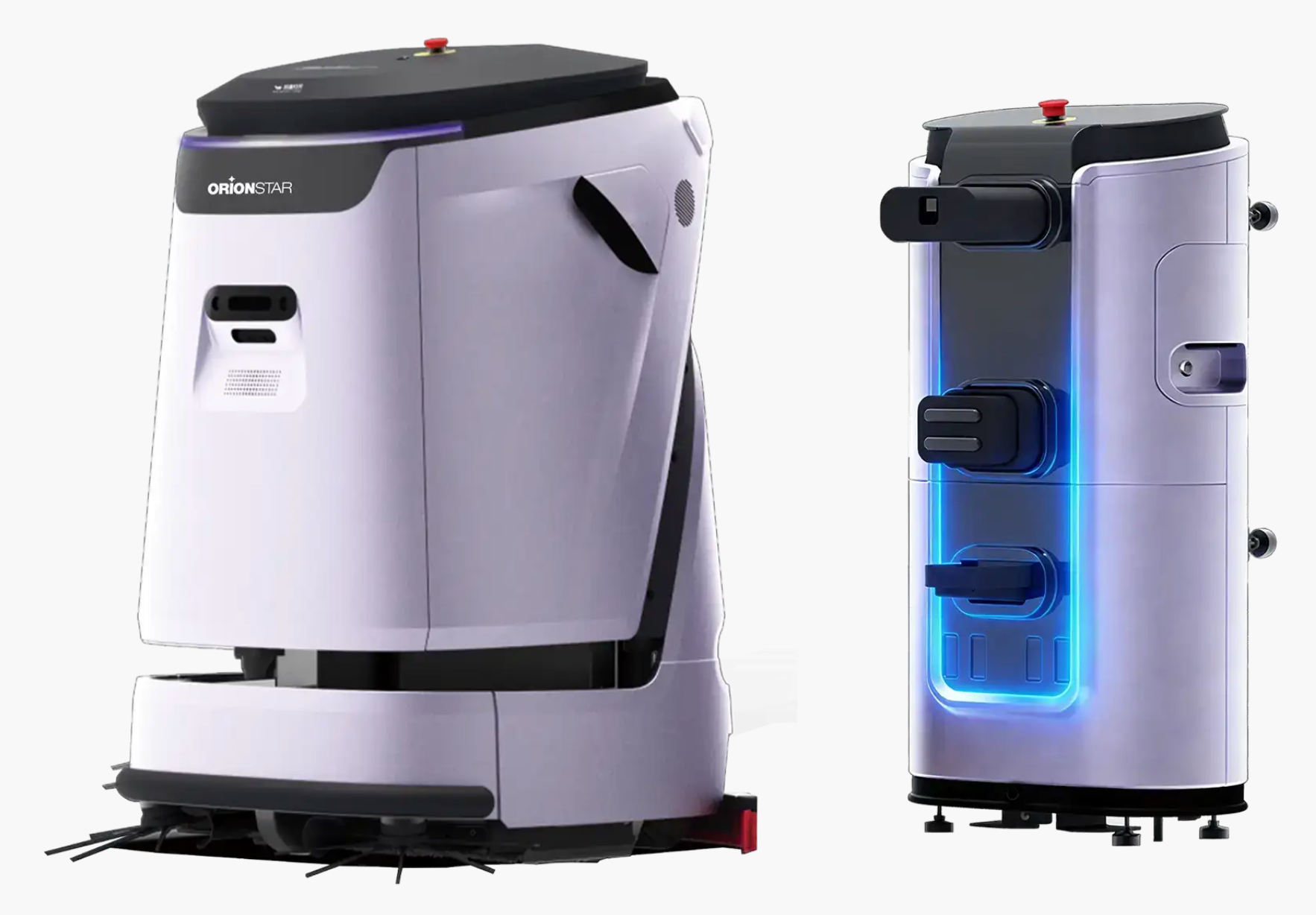
The OrionStar CleaniBot C5 serves as a heavy-duty autonomous scrubber featuring a 550 mm cleaning width, a 90 L combined tank capacity, a self-cleaning docking workstation, and a dual-rolling-brush system designed for single-pass stain removal. Built for medium-to-large commercial and industrial environments, this machine provides a theoretical maximum cleaning capacity of up to 1,980 square meters per hour, according to manufacturer data. The unit applies up to 25 kilograms of downward scrubbing pressure, facilitating the extraction of heavy oil and grime typical in hard FM warehouse operations. Operators evaluating autonomy levels can deploy its fully autonomous workstation, which supports automatic clean-water refilling, waste-water discharge, and internal tank rinsing, ensuring continuous multi-shift operation. The system operates with a minimal passing width of approximately 880 mm, allowing it to navigate standard commercial corridors while maintaining a noise profile under 68 decibels for daytime deployment in public spaces.
Positioned as a highly maneuverable solution, the Gausium Scrubber 50 operates as a compact LiDAR-navigated scrubber with an optional workstation, making it particularly strong in medium-sized commercial spaces. According to manufacturer data, it achieves a practical cleaning efficiency of up to 1,300 square meters per hour, with theoretical maximums reaching up to 1,987 square meters per hour under laboratory conditions. The machine utilizes a highly durable lithium iron phosphate battery rated for up to 2,000 cycles, addressing total cost of ownership considerations for multi-shift facility management. Facilities managers assessing navigational capabilities can leverage its minimum passing width of 800 mm to clean narrow hallways and tight doorways. The system integrates 2D LiDAR alongside 3D depth and RGB cameras for obstacle avoidance, while fleet connectivity is managed through the proprietary Gausium Leaves cloud platform for remote monitoring.
The Avidbots Neo 2W functions as a deep-learning AI navigation, large-body ride-on capable scrubber explicitly optimized for warehouse-scale environments. Facilities managing vast logistics centers evaluate its proprietary Avidbots Autonomy software, which utilizes advanced dynamic planning and specialized obstacle detection trained specifically on warehouse hazards like pallets and forklift tines. The system supports uninterrupted cleaning schedules by providing up to 6 hours of runtime on a single charge, according to manufacturer data, with swappable industrial batteries available for extended multi-shift operation. Weighing up to approximately 663 kilograms, the unit represents a substantial, heavy-duty floor care asset. Operators can track performance and manage fleet operations through the Avidbots Command Center, which delivers sector-level coverage maps and real-time productivity metrics for comprehensive hard FM oversight.
Operating as a robust industrial solution, the Tennant T7AMR is a BrainOS-powered robotic scrubber built on a proven ride-on platform for industrial-scale coverage. This machine prioritizes maximum fluid capacity, carrying up to 110 liters in both its solution and recovery tanks to support extended scrubbing sessions in large commercial complexes and airports. According to manufacturer data, the unit covers up to 4,250 square meters per charge cycle while applying up to 86 kilograms of main down pressure for thorough hard-floor maintenance. Facilities managers assessing navigational systems can utilize its vision-based BrainOS technology, which employs a learn-and-repeat methodology for consistent route execution. The machine provides daily and weekly usage reports through its cloud connectivity platform, allowing facility teams to monitor key performance indicators and verify cleaning compliance.
The Nilfisk Liberty SC50 is structured around SLAM-based navigation with no pre-mapping required, backed extensively by Nilfisk TrackClean reporting. By utilizing simultaneous localization and mapping, operators can initiate perimeter-trace autonomous route calculations dynamically, significantly reducing initial deployment time in changing commercial spaces. According to manufacturer data, the unit delivers up to 6 hours of continuous runtime and features third-party independent safety certification, making it highly suitable for regulated hard FM environments like healthcare facilities. Facilities managers evaluating fluid conservation can equip the machine with an optional speed-dependent water flow adjustment system designed to reduce chemical usage. The integrated TrackClean fleet management system provides continuous access to operational data, ensuring auditable proof-of-performance reporting for SLA compliance.
Engineered for unattended operation, the Karcher KIRA B 50 operates as a German-engineered autonomous scrubber featuring 360-degree environment detection and comprehensive KEM cloud platform connectivity. When paired with its optional docking station, the machine performs automatic water refilling, dirty water drainage, and battery charging to fully support human-free multi-shift hard FM schedules. According to manufacturer data, the unit features a 55-liter tank capacity and a sweeping roller brush head that scrubs and pre-sweeps in a single pass. Facilities managers assessing building system connectivity evaluate its VDA 5050 communication interface, which allows the robot to integrate seamlessly with centralized building management systems. Furthermore, the machine holds an independent safety certification for operation in public access areas, ensuring compliant navigation around dynamic obstacles.
The Pudu CC1 provides multi-surface versatility as a four-in-one cleaning robot capable of sweeping, scrubbing, vacuuming, and mopping for mixed hard-floor and carpet environments. Facilities managers overseeing commercial buildings with diverse architectural finishes evaluate this unit to consolidate equipment, utilizing its up to 17,000 pascals of suction power and intelligent lift control for automatic brush adjustment. According to manufacturer data, the machine delivers a cleaning efficiency of up to 1,000 square meters per hour and supports breakpoint resume functionality to complete unfinished tasks across long shifts. Operators leverage its dual visual and laser SLAM navigation framework for complex route planning. The unit integrates with a digital cleaning platform to automatically generate performance reports, providing hard FM teams with actionable data on coverage area and operational duration.
Focused specifically on dry floor maintenance, the SoftBank Robotics Whiz functions as an AI-powered autonomous vacuum sweeper designed specifically for high-traffic public areas. Weighing approximately 35 kilograms according to manufacturer data, it represents a highly compact asset for navigating tight office cubicles, hotel corridors, and small meeting rooms where larger scrubbers cannot operate. Facilities managers deploying this unit evaluate its BrainOS-powered teach-and-repeat navigation, which utilizes LiDAR and 3D cameras to dynamically avoid pedestrians and temporary obstacles. The system supports up to 3 hours of continuous vacuuming on a single charge and operates at a low noise level of 62 decibels. Fleet operations are monitored via the SoftBank Robotics Connect platform, delivering near real-time utilization insights and proof-of-performance analytics for hard FM reporting requirements.
The ICE Robotics Cobi 18 serves as a highly compact autonomous scrubber focused closely on the UK/EU market, featuring Cobi Cloud reporting for streamlined oversight. Designed for commercial buildings with narrow aisles and tight configurations, the machine utilizes an 18-inch cleaning path to maintain areas inaccessible to ride-on equipment. According to manufacturer data, it achieves an automated cleaning productivity of up to 650 square meters per hour with a runtime of up to 1.5 hours on its lithium-ion battery. Operators assess its specialized navigation sensors, which are calibrated to handle complex real-world conditions including bright sunlight and reflective mirrors. The system features straightforward custom and auto-fill autonomous modes, providing an accessible entry point into automation for hard FM teams transitioning away from manual mopping.
The Pudu SH1 acts as a heavy-duty autonomous scrubbing robot equipped with a self-cleaning mop system for intensive floor care tasks. Serving as a smart, cordless upright scrubbing solution, it provides concentrated, high-pressure cleaning for areas that require detailed attention in retail, healthcare, and hospitality settings. According to manufacturer data, the unit delivers up to 27 kilograms of brush pressure and operates with an air-liquid-debris separation system that significantly simplifies waste disposal for cleaning staff. Facilities managers evaluate its versatile accessory configurations, which extend its capability beyond floors to include vertical surface maintenance on tiles and glass. The machine generates post-cleaning notifications through the PUDU platform, delivering actionable insights regarding water usage and operational duration to complement broader automated hard FM fleets.
Implementing a robotic cleaning fleet fundamentally alters hard FM operational structures. Facilities managers assessing scrubbing configurations should select brush types and pressure ratings that precisely match their facility's soil profile, reserving heavy-duty dual-roller systems for industrial zones and compact disc brush systems for polished commercial floors. When evaluating autonomy and multi-shift capabilities, operators must align the machine's fluid management architecture with the building's physical infrastructure, prioritizing fully autonomous workstations where plumbing modifications are viable to maximize unattended runtime. Navigational assessment requires matching the robot's sensory array to the environment's complexity, deploying deep-learning vision models for high-traffic warehouses or utilizing SLAM-based systems for rapidly changing floor plans. Ultimately, the successful deployment of these assets relies heavily on data transparency. Hard FM teams should evaluate connectivity features carefully, integrating machines via standardized protocols or utilizing proprietary cloud dashboards to ensure verifiable proof-of-clean reporting for strict service level agreement compliance.
For facilities with 50,000+ sq ft of repeatable hard-floor coverage cleaned at least five days per week, payback typically falls in the 9-to-18-month range. The key variable is how many loaded labor hours the robot can absorb per day: a unit that replaces one full-time-equivalent (FTE) shift of repetitive scrubbing can justify itself in under a year, while a robot that only offsets one to two daily labor hours will stretch that window significantly. When calculating, use loaded labor cost (base wage plus benefits, taxes, supervision, and turnover) rather than base wage alone — in most markets the loaded rate is 1.35 to 1.45 times the hourly wage. Annual robot operating costs (consumables, preventive maintenance, wear items) typically run $4,000 to $7,000, which is far below the $40,000 to $55,000 loaded annual cost of a single full-time cleaner.
The right procurement path depends on your organization's budget structure and risk tolerance. Buying outright delivers the strongest long-term ROI for sites with stable cleaning routes and available capital, but you carry maintenance planning and asset lifecycle management. Financing or leasing lowers upfront spend while retaining asset ownership, though service contracts may be separate. RaaS bundles the robot, software, and support into a predictable monthly subscription — typically $575 to $2,300 per month depending on robot class and contract term — which reduces operational complexity and shifts uptime risk to the provider. For hard FM teams that need to budget automation as operating expenditure rather than capital expenditure, RaaS is often the most practical entry point.
Most modern autonomous scrubbers and vacuums generate digital cleaning reports that document the area covered, time spent, route completion rate, and any missed zones. Platforms such as Gausium Leaves, Avidbots Command Center, Nilfisk TrackClean, and Karcher Equipment Management (KEM) provide proof-of-clean reporting that can be exported for SLA verification. The Nilfisk Liberty SC50, for example, reports 98 to 99.5 percent coverage consistency. These data trails replace manual sign-off sheets and give facility managers auditable evidence for building owners, tenants, and regulatory inspectors — a significant advantage in hard FM contracts where cleaning performance is tied to financial penalties or bonus structures.
Real-world coverage is typically 50 to 70 percent of the manufacturer's theoretical maximum, depending on facility complexity (obstacles, doorways, elevator transitions, and narrow passages). Compact units like the Gausium Scrubber 50 deliver 500 to 1,300 m2/h in practice; mid-size robots such as the OrionStar CleaniBot C5 can achieve up to approximately 1,400 m2/h effective scrubbing with a 550 mm main brush and 1,980 m2/h theoretical max; and larger ride-on machines like the Tennant T7AMR reach up to 4,250 m2 per charge cycle. For hard FM teams planning overnight routes, the practical benchmark is whether one robot can complete the full repetitive hard-floor route within a single shift without manual intervention — tank capacity and runtime are the constraining factors, not top speed.
Current autonomous cleaning robots use a combination of 2D or 3D LiDAR, depth cameras, and proprietary AI algorithms for real-time navigation and obstacle avoidance. Systems like Avidbots Autonomy (Neo 2W) use deep learning specifically trained on warehouse and commercial obstacles, while PUDU SLAM (CC1) supports both visual and laser SLAM for complex environments. The Nilfisk Liberty SC50 employs SLAM-based navigation that eliminates the need for time-consuming pre-mapping, and the Karcher KIRA B 50 offers 360-degree environment detection with intelligent free-travel maneuvers if a path is blocked. All units automatically stop or reroute when they detect people, furniture, or unexpected obstacles. However, vision-based systems rely on cameras and sensors that capture environmental data — operators deploying in EU markets should verify GDPR compliance before activation.
Requirements vary by model but generally include: a designated docking or parking area with access to power for charging; for fully autonomous multi-shift operation, a water station (plumbed or mobile tank) for automatic clean-water refill and waste-water discharge — the OrionStar CleaniBot C5 and Karcher KIRA B 50 both offer optional docking stations that handle refilling, drainage, and self-cleaning. Minimum passage width is a key constraint: compact units like the Gausium Scrubber 50 need 800 mm, while the CleaniBot C5 requires about 880 mm and the Avidbots Neo 2W needs considerably more due to its larger footprint. Mapping is typically done by walking the robot through the route once (teach-and-repeat) or via autonomous SLAM mapping; the Nilfisk Liberty SC50 and Karcher KIRA B 50 can generate maps without manual pre-mapping. Wi-Fi or cellular connectivity is recommended for fleet management dashboards and over-the-air software updates, though the robot can clean offline once a map is stored.
Third-party product specifications are based on public data (up to, under laboratory conditions, according to manufacturer data) and may vary; product names and trademarks belong to their respective owners; if any product involves cameras, audio recording, mapping, or cloud data processing, operators must verify GDPR compliance before deployment.
