

REQUEST DEMO
Robot CATALOG will be sent to your mailbox immediately after submission.
SUBMIT
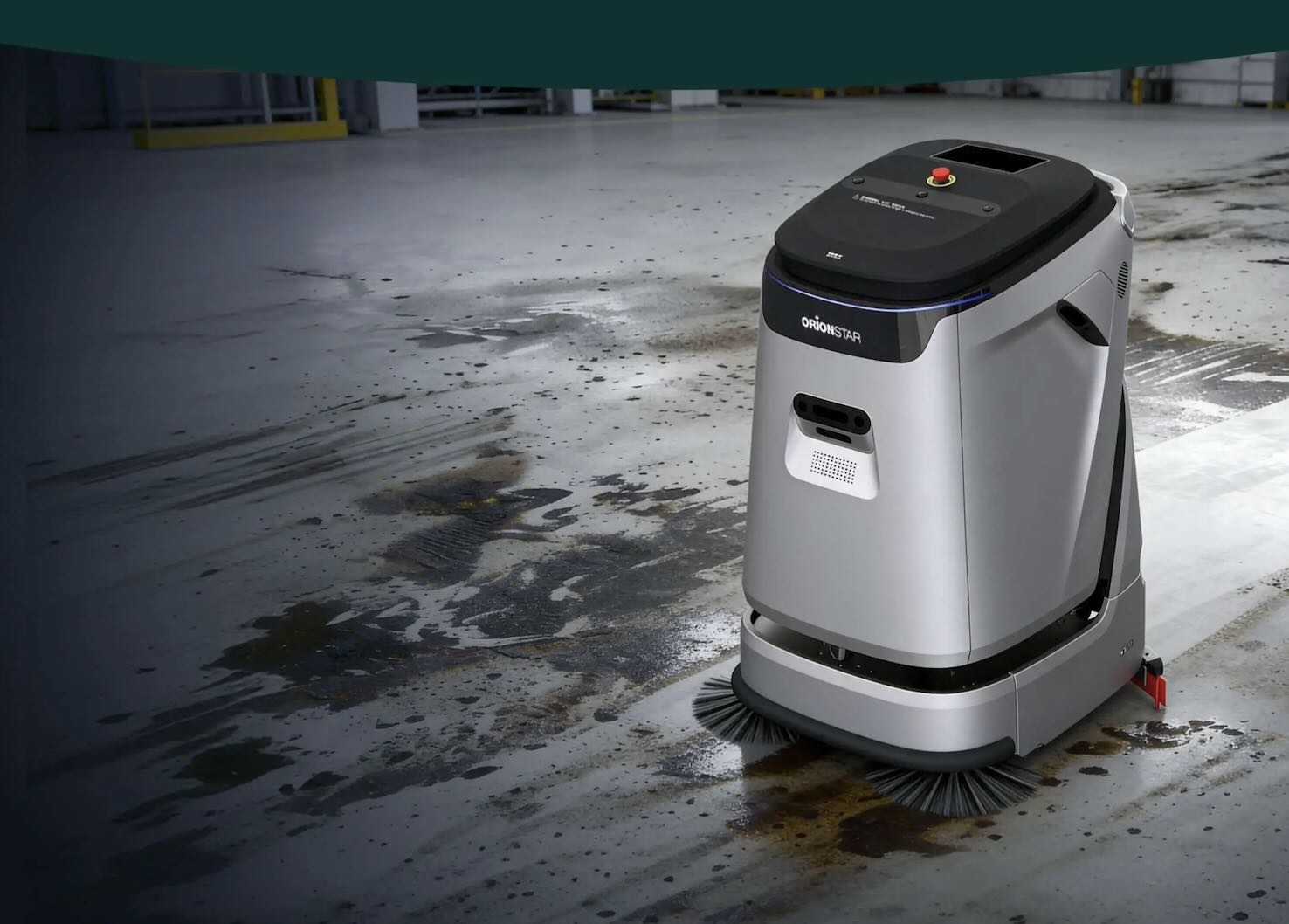
Building management in warehouses faces escalating challenges characterized by high janitorial turnover, relentless cost pressures, and the strict safety and compliance requirements of active logistics environments. To overcome these complex operational hurdles, commercial cleaning robots are emerging as a highly effective solution, offering a reliable method to stabilize maintenance budgets, reduce the reliance on manual labor, and maintain consistent floor hygiene across vast industrial spaces.
The OrionStar CleaniBot C5 illustrates how these autonomous capabilities are implemented in industrial settings to address heavy-duty maintenance needs. According to manufacturer data, this unit can achieve a maximum cleaning area capacity of up to 1,980 square meters per hour under optimal conditions utilizing a 550 mm main brush. It employs a dual-rolling-brush system that applies up to 25 kg of downward scrubbing pressure to address heavy oil and stubborn grime, while integrating with an automated workstation that handles clean-water refilling, waste-water discharge, and self-cleaning, enabling sustained multi-shift operation with minimal manual oversight.
These high-traffic transition zones accumulate significant dirt, debris, and moisture from incoming trucks and outdoor elements. Commercial cleaning robots utilize robust obstacle avoidance to navigate around pallets and staging equipment, effectively scrubbing away grime without interrupting the continuous flow of inbound and outbound goods.
Fulfillment areas involve the constant movement of personnel, picking carts, and material handling equipment, making daytime manual cleaning dangerous and disruptive. Autonomous scrubbers can map these dynamic spaces and adjust their paths in real-time, ensuring safe, consistent cleaning alongside active order processing.
Narrow aisles between towering storage racks often trap fine dust and particulate matter, requiring precise navigation to avoid collisions. Using advanced LiDAR and sensor arrays, cleaning robots can safely traverse these confined corridors, maintaining floor hygiene without risking damage to the valuable inventory stored nearby.
Spaces used for temporary storage or sorting require flexible cleaning schedules because their layouts change frequently based on daily shipment volumes. Robots equipped with real-time mapping easily adapt to these shifting obstacles, maintaining clear surfaces for workers without requiring constant manual reprogramming.
Commercial cleaning robots function as both data generators and automated actuators within the broader smart building ecosystem, interfacing with existing IoT infrastructure, Building Automation Systems (BMS), and Computerized Maintenance Management Systems (CMMS). Their digital management capabilities allow on-board sensors to generate operational data that feeds into these management platforms. This continuous data flow supports CMMS-driven preventive maintenance scheduling based on actual equipment runtime rather than fixed calendar dates, while BMS coordination with cleaning schedules can help optimize HVAC operations and facility occupancy patterns to improve overall operational efficiency.
By integrating automated cleaning technologies, building managers can tangibly reduce energy waste and facility emissions, directly aligning day-to-day operations with overarching ESG targets.
Commercial cleaning robots are significantly improving the way building management approaches the maintenance of warehouses, shifting the industry from reactive, labor-intensive practices to data-driven, autonomous operations. As facilities look to optimize their budgets, improve safety, and meet strict environmental standards, the OrionStar CleaniBot series provides multiple configurations to accommodate different spatial layouts and industrial demands, offering a scalable approach to modernizing floor care.
Note: Industry statistics cited in this article are drawn from publicly available sources including Sproutmation, Avidbots, and KBS. Actual cleaning efficiency, ROI, and payback periods may vary depending on facility size, floor conditions, labor rates, and utilization. The CleaniBot C5 is designed for commercial floor cleaning and does not guarantee medical-grade sterilization.