REQUEST DEMO
Resources > Blogs > Optimizing Industrial Operations: The Role Of Commercial Cleaning Robots In Warehouse Hard FM Services

Optimizing Industrial Operations: The Role Of Commercial Cleaning Robots In Warehouse Hard FM Services

2026-06-25 22:05 OrionStar

Optimizing Industrial Operations: The Role Of Commercial Cleaning Robots In Warehouse Hard FM Services

Introduction

Hard FM Services in warehouses are currently navigating a complex landscape of operational challenges driven primarily by severe labor scarcity, escalating maintenance costs, and increasingly strict regulatory compliance demands. As traditional manual floor care struggles to keep pace with the accumulation of industrial particulates and packaging debris, commercial cleaning robots are emerging as an effective, automated solution. By streamlining repetitive floor care tasks and providing transparent operational data, these advanced robotic systems give facility operators a reliable method to maintain consistent safety standards and optimize budgets across large-scale industrial environments.

The Growing Need For Smarter Cleaning In Warehouses

  • Hard FM service providers and facilities maintenance managers face a critical labor shortage, with industry surveys showing that 74% of global employers struggle to find skilled talent while a significant portion of the existing facility workforce remains active beyond retirement age.
  • Escalating operating costs and budget constraints are a top concern for 84% of facility management leaders, a problem exacerbated by the highly variable and difficult-to-measure expenses associated with manual floor scrubbing.
  • Deferred maintenance poses a growing risk as traditional cleaning teams struggle to manage the severe dust, packaging debris, and industrial particulates like titanium dioxide that continuously accumulate on warehouse floors.
  • Workplace safety and compliance pressures require strict, documented cleaning protocols to prevent slip-and-fall incidents and meet increasingly stringent regulatory frameworks that demand verifiable audit trails.

How Commercial Cleaning Robots Can Help

  • LiDAR navigation and autonomous path planning enable these systems to efficiently map large industrial spaces and calculate the most logical cleaning routes without constant human intervention.
  • Smart obstacle avoidance systems utilize integrated sensors to safely detect and maneuver around moving forklifts, personnel, and staging pallets in dynamic logistics environments.
  • Auto-charging and docking capabilities allow the equipment to autonomously return to base stations for power recharging and water servicing, enabling continuous multi-shift operations.
  • Real-time monitoring and cloud connectivity provide facility managers with verifiable operational data, generating digital audit trails of cleaned areas, operational time, and resource consumption.
  • Because these automated platforms rely on spatial mapping, sensors, and vision-based navigation systems processed locally, operators must ensure deployment strategies maintain strict GDPR compliance regarding data minimization and privacy. Spatial and visual data are used strictly for navigation and obstacle avoidance purposes only, without capturing or storing personally identifiable information.

A Closer Look: OrionStar CleaniBot C5 In Action

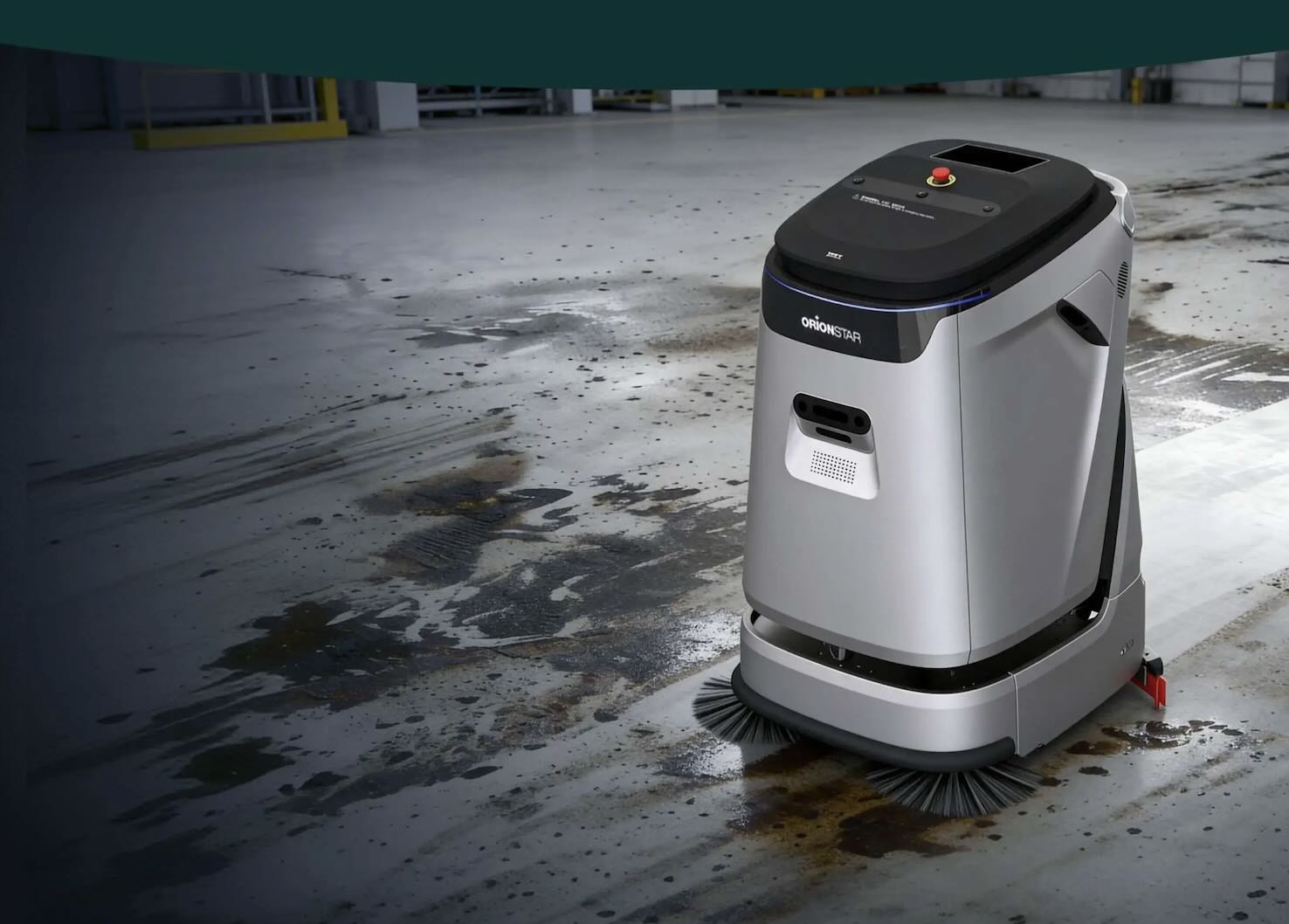
To illustrate how these generic capabilities translate into practical hardware, the OrionStar CleaniBot C5 demonstrates the integration of heavy-duty mechanics with autonomous navigation. According to manufacturer data, this industrial-grade floor-scrubbing robot can map areas of up to 10,000 square meters and autonomously plan optimized cleaning paths. It applies up to 25 kg of downward scrubbing pressure through a dual-rolling-brush system to remove heavy grime, achieving a maximum theoretical cleaning capacity of up to 1,980 square meters per hour according to manufacturer data (actual coverage may vary depending on spatial layout and obstacle density). Furthermore, its automated docking station manages clean-water refilling and waste-water discharge, showcasing the auto-charging and self-servicing capabilities required to maintain consistent floor care in demanding commercial environments.

Benefits For Hard FM Service Providers, Facilities Maintenance Managers

  • Reduced labor costs: Automated floor scrubbers significantly lower routine cleaning expenses, as demonstrated by industry case studies where robotic program optimization led to a 21% reduction in overall cleaning and maintenance costs.
  • Measurable performance tracking: Replacing self-reported manual cleaning with digital dashboards provides operators with a reliable "true performance" metric and automated KPIs based on actual time spent and area covered.
  • Improved cleaning consistency: Robots systematically follow programmed routes and dispense precise amounts of water, managing difficult warehouse environments and fine particulates with greater consistency than traditional variable methods.
  • Enhanced equipment lifecycle: Shifting to autonomous solutions reduces external rental costs for manual equipment and decreases long-term repair expenses through predictable, automated maintenance routines.
  • Optimized workforce allocation: By automating the time-consuming task of large-scale floor scrubbing, highly skilled maintenance teams can be strategically redeployed to handle more complex, high-priority facility management duties.

Real-World Applications

Aisles

Narrow aisles between high racking systems often accumulate forklift tire residue and packaging debris, creating potential slip hazards and degrading floor quality. Commercial cleaning robots navigate these constrained spaces using precise path planning, effectively scrubbing away industrial particulates while safely avoiding stationary racks and moving warehouse equipment.

Loading Docks

These high-traffic transition zones are constantly exposed to outdoor elements, dirt, and moisture brought in by transport vehicles and foot traffic. Autonomous floor scrubbers can be scheduled for high-frequency cleaning cycles in these specific zones to immediately address heavy grime, preventing external dirt from being tracked deeper into the main facility.

Storage Zones

Areas dedicated to long-term inventory storage frequently suffer from deferred maintenance due to the difficulty of maneuvering bulky manual ride-on equipment around stacked goods. Compact robotic solutions autonomously weave through these complex layouts, maintaining consistent floor care without disrupting stored inventory or requiring manual intervention.

Dispatch Areas

The fast-paced nature of dispatch operations means floor space is constantly shared by active workers, temporary staging pallets, and material handling equipment. Advanced obstacle avoidance technology allows cleaning robots to operate safely amidst this dynamic activity, ensuring a clean staging environment without interrupting the outbound logistics flow.

Integration With Other Smart Systems

Commercial cleaning robots function as active nodes within the broader smart building IoT ecosystem, generating spatial and operational data that can be shared across facility networks. When integrated with Building Management Systems (BMS), they can receive occupancy data to schedule cleaning tasks during low-traffic periods, extending the 36% HVAC and 23% lighting energy savings typical of BMS automation to floor care operations. Furthermore, by feeding operational data directly into a Computerized Maintenance Management System (CMMS), these platforms automatically generate maintenance work orders and track asset lifecycles, which helps increase overall equipment uptime by 10-20% and cuts maintenance costs by up to 10%, according to Deloitte research cited by Facilio.

Supporting ESG And Sustainability Goals

  • Automated platforms reduce environmental impact by utilizing precision dispensing systems that optimize both water and chemical consumption during every cleaning cycle.
  • They generate highly detailed, timestamped operational data that creates CSRD-ready audit trails, helping facilities transparently prove their resource efficiency and waste management performance.
  • Integration with broader energy management frameworks like ISO 14001 allows floor care operations to actively and measurably contribute to a facility's overall decarbonization and sustainability targets.
  • Ultimately, the shift from manual floor care to automated, data-driven cleaning transforms a previously untracked operational necessity into verifiable evidence for corporate ESG reporting.

Closing

Commercial cleaning robots are significantly enhancing the way the industry maintains warehouses by addressing critical labor shortages, improving environmental safety, and providing data-driven operational transparency. As hard FM service providers and facilities maintenance managers look to optimize facility operations and meet increasingly stringent compliance standards, adopting autonomous floor care technology serves as a practical step toward modernizing infrastructure management. To accommodate various facility layouts and specific operational demands, the OrionStar CleaniBot series offers multiple models designed to integrate seamlessly into diverse warehouse environments, providing scalable options for comprehensive industrial maintenance.