

REQUEST DEMO
Robot CATALOG will be sent to your mailbox immediately after submission.
SUBMIT
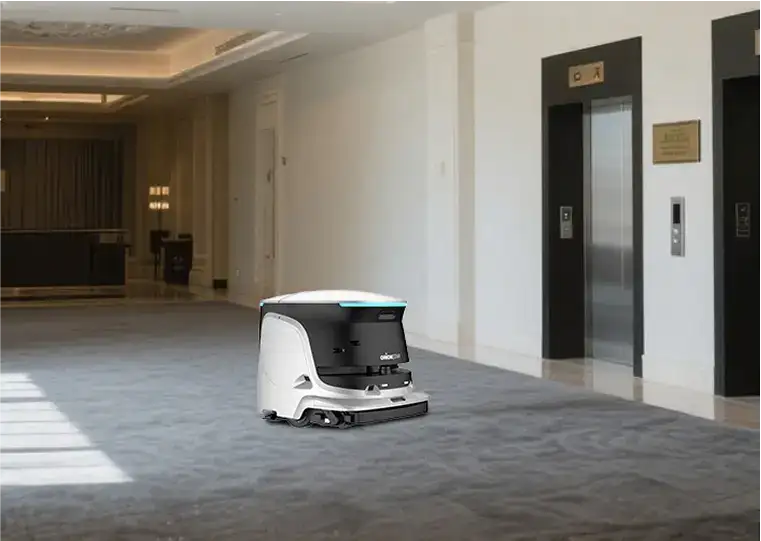
Catering services operating within hotels face intense cleaning challenges driven by chronic labor shortages, escalating facility maintenance costs, and strict health and hygiene compliance requirements. To address these operational pressures, commercial cleaning robots are increasingly being adopted as an automated solution to maintain high-traffic food service and dining areas efficiently. By shifting routine floor upkeep to autonomous systems, hospitality operators can elevate hygiene standards while reallocating human staff to more complex, detail-oriented tasks.
The OrionStar CleaniBot C5 exemplifies these automated capabilities by combining autonomous navigation with heavy-duty scrubbing designed for demanding commercial environments. According to manufacturer data, the unit features a dual-rolling-brush system capable of applying up to 25 kg of downward scrubbing pressure to remove stubborn stains and grease typical in food service areas. It can autonomously map areas of up to 10,000 square meters, while its automated docking station handles self-cleaning and fluid management, including automatic clean-water refilling and waste-water discharge. Operating at a noise level of less than 68 dB(A), the robot integrates smoothly into daily operations without causing excessive disturbance in active hotel environments.
These expansive spaces experience unpredictable, high-volume foot traffic and frequent food spills during peak event periods. Commercial cleaning robots can dynamically map the large floor plans and can autonomously clean large floor areas, assisting staff in preparing venues between events.
Buffet zones and conference dining rooms require continuous maintenance to uphold both the guest experience and strict hygiene standards. Robots equipped with advanced obstacle avoidance can safely navigate around tables, chairs, and patrons, performing routine sweeps to remove dropped food and debris without causing disruptions.
Back-of-house food preparation areas are prone to heavy grease accumulation and constant spills, presenting significant slip-and-fall hazards for catering staff. Heavy-duty scrubbing robots apply consistent downward pressure and precise chemical dosing to remove stubborn grime, helping facilities maintain strict health code compliance in a demanding environment.
As the main transitional arteries for catering carts and hotel guests, these areas demand constant upkeep to maintain a pristine image. Automated cleaning systems can operate quietly during low-traffic hours or adjust their routes using real-time sensors to avoid crowded areas, ensuring clean floors with minimal human intervention.
Commercial cleaning robots function as mobile IoT nodes that integrate directly with a hotel's existing smart building ecosystems to optimize overall facility management. They communicate with Building Management Systems (BMS) to transmit anonymized environmental data, such as general occupancy density and debris distribution, which can be utilized to adjust HVAC operations and lighting dynamically. Furthermore, integration with Computerized Maintenance Management Systems (CMMS) allows these robots to automate maintenance workflows by generating work orders when they detect flooring issues and automatically requesting supply replenishments when consumables run low. By connecting with building occupancy sensors, the robots also support adaptive scheduling, responding to actual space usage to clean areas precisely when foot traffic decreases.
Through measurable reductions in resource waste and tangible improvements in workplace conditions, cleaning automation serves as a highly practical tool for advancing the hospitality industry's ESG commitments.
Commercial cleaning robots are significantly advancing the way the catering services industry approaches facility maintenance in hotels. By addressing critical labor shortages, maximizing resource efficiency, and ensuring stringent hygiene compliance, autonomous systems offer a pragmatic, data-driven approach to modern facility management. For organizations evaluating their operational automation strategies, the OrionStar CleaniBot series provides multiple models designed to accommodate the distinct spatial, functional, and environmental requirements of various hospitality venues.