

REQUEST DEMO
Robot CATALOG will be sent to your mailbox immediately after submission.
SUBMIT
Soft FM Services within commercial buildings are currently navigating a complex landscape defined by persistent labor shortages, escalating operational costs, and increasingly stringent compliance and hygiene expectations. As facility managers struggle to maintain consistent service quality under tight budgets and fluctuating occupancy rates driven by hybrid work models, the industry is seeking innovative interventions. In response to these compounding pressures, commercial cleaning robots have emerged as a strategic solution, offering a reliable method to automate floor care, optimize resource allocation, and ensure high standards of cleanliness without linearly increasing labor expenditures.
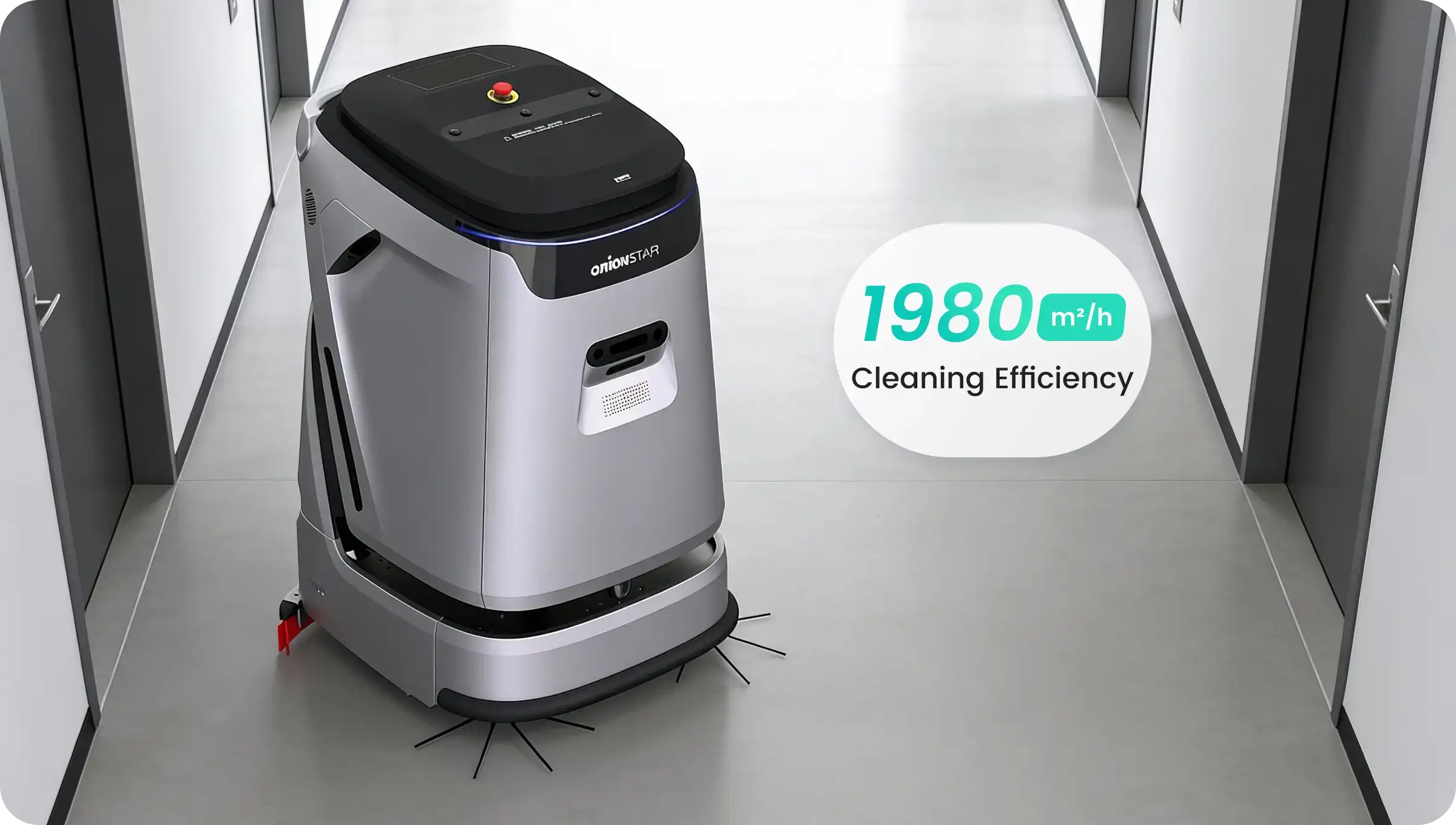
To illustrate how these category capabilities manifest in a physical unit, the OrionStar CleaniBot C5 represents a high-performance iteration of autonomous floor-scrubbing technology designed for medium to large spaces. Translating autonomous path planning into measurable output, this unit can map spaces and deliver a theoretical maximum cleaning area capacity of up to 1,980 square meters per hour, depending on environmental complexity, according to manufacturer data. Its automation extends to maintenance through an integrated workstation that handles automatic clean-water refilling and high-pressure internal tank rinsing without constant human oversight. Furthermore, the machine operationalizes safety and continuous workflow by utilizing smart obstacle-avoidance systems alongside an auto-charging capability that supports prolonged operation, demonstrating the practical application of modern robotic floor care in demanding environments.
These high-visibility zones experience constant, unpredictable foot traffic throughout the day, bringing in dirt and moisture from the outside. Commercial cleaning robots can be dynamically deployed to maintain these critical first-impression areas during off-peak hours or run continuous, quiet maintenance passes without disrupting visitors.
Long hallways represent a massive square footage that requires highly repetitive, time-consuming manual labor to keep clean. Autonomous scrubbers excel in these geometric spaces, utilizing optimized path planning to cover vast stretches efficiently while safely avoiding moving pedestrians and temporary maintenance carts.
These areas are prone to frequent spills, heavy grime, and sticky residues that demand intensive scrubbing pressure to maintain hygiene standards. Heavy-duty cleaning robots equipped with dual-rolling-brush systems and continuous water filtration can execute rigorous removal of stubborn stains, effectively restoring the floor's safety and appearance.
Parking garages suffer from severe oil stains, tire marks, and debris accumulation, traditionally requiring heavy manual equipment to remediate. Industrial-grade autonomous robots navigate these sloped, expansive environments, applying high downward scrubbing pressure to lift heavy industrial dirt while safely maneuvering around moving vehicles and concrete pillars.
Beyond standalone operation, commercial cleaning robots are increasingly functioning as active nodes within the broader smart building ecosystem by integrating directly with existing Building Management Systems (BMS) and Computerized Maintenance Management Systems (CMMS). Through IoT-enabled communication, these units can interface with elevator control software for autonomous multi-floor navigation, while simultaneously feeding real-time operational and asset health data into unified digital command centers. By utilizing ambient data from building IoT sensors—such as motion, temperature, and occupancy tracking—facility managers can transition from static schedules to dynamic, usage-based cleaning routines, creating a closed-loop system where cleaning operations automatically respond to actual spatial utilization.
By integrating these sustainable operational practices, automated cleaning technologies directly empower Soft FM providers to meet stringent corporate ESG targets and secure industry-recognized building certifications.
The integration of commercial cleaning robots is fundamentally changing how Soft FM Services maintain commercial buildings, shifting the paradigm from labor-intensive, reactive schedules to data-driven, autonomous operations. By directly addressing chronic labor shortages, escalating costs, and stringent compliance mandates, these intelligent systems offer a sustainable path forward for facility management. For organizations exploring this technological transition, the OrionStar CleaniBot series provides multiple models engineered to accommodate the specific spatial and operational requirements of diverse commercial environments, offering a practical foundation for those evaluating automated floor care solutions.