

REQUEST DEMO
Robot CATALOG will be sent to your mailbox immediately after submission.
SUBMIT
The Onsite Food Service sector faces a critical convergence of chronic labor shortages, rising operational costs, and stringent hygiene compliance pressures, making manual sanitation in corporate cafeterias increasingly unsustainable. As facility operators struggle with janitorial turnover rates reaching up to 200% and shrinking budgets where labor consumes the vast majority of cleaning expenses, maintaining consistent food safety standards becomes a significant operational bottleneck. To address these systemic challenges, commercial cleaning robots are emerging as a highly effective automated solution, providing verifiable, high-efficiency floor maintenance that reduces reliance on unpredictable staffing while ensuring continuous adherence to rigorous environmental and food safety protocols.
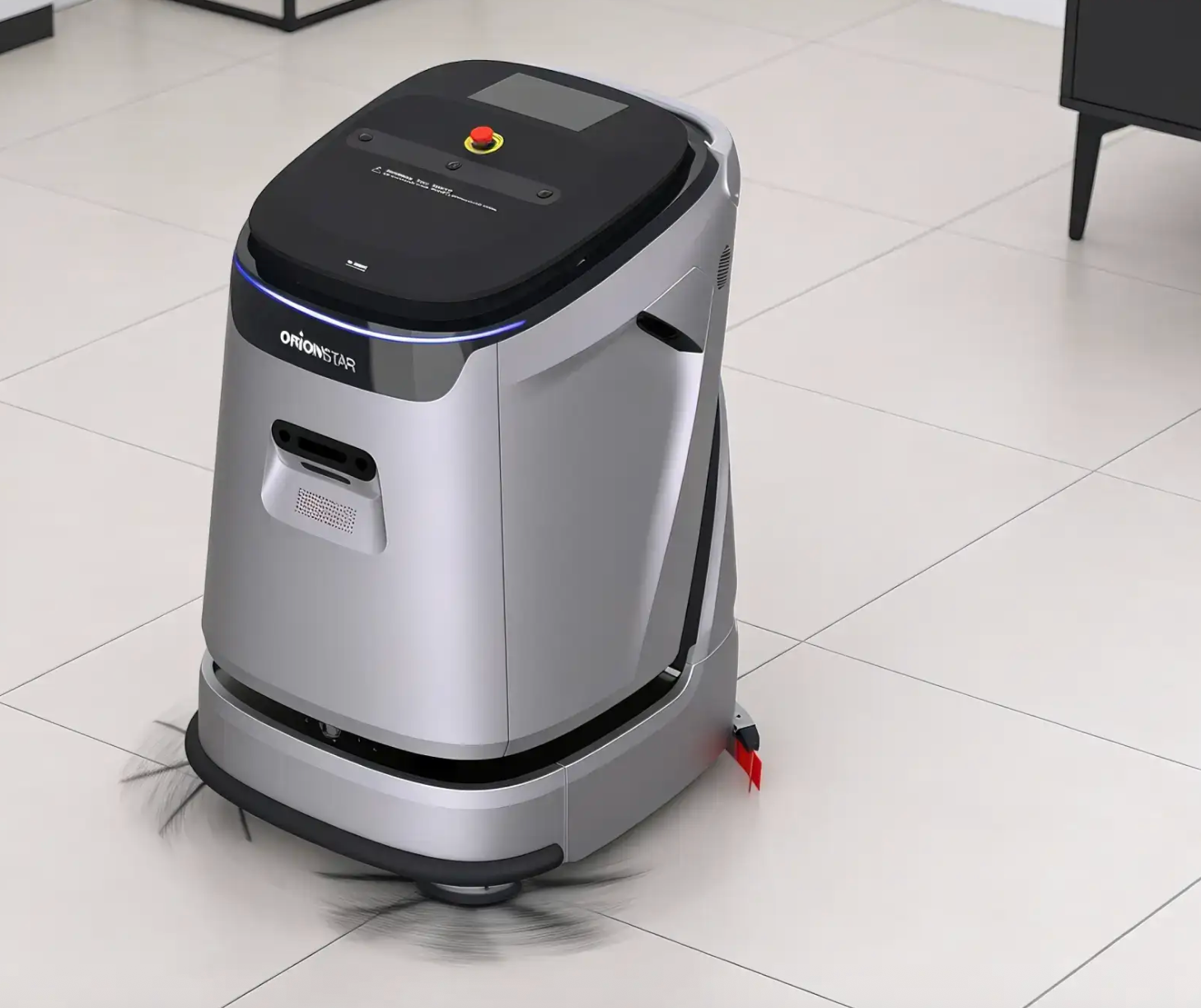
The OrionStar CleaniBot C5 illustrates how these autonomous capabilities are implemented in industrial-grade equipment designed for demanding environments. According to manufacturer data, the unit utilizes an autonomous mapping system capable of mapping an area of up to 10,000 square meters, systematically planning optimal routes without manual intervention. It pairs this navigation with a fully automated docking station that manages clean-water refilling, waste-water discharge, and internal tank rinsing, significantly reducing the need for manual maintenance between shifts. Furthermore, the robot supports extended operations through its auto-charging functionality, delivering a reported dirt-cleaning rate of roughly 95% under defined laboratory testing conditions on hard floor surfaces, utilizing a dual-rolling-brush system that applies up to 25 kg of downward scrubbing pressure.
These high-traffic zones constantly accumulate dropped food debris, sticky beverage spills, and general foot traffic dirt throughout the day. Autonomous robots systematically navigate around complex arrangements of tables and chairs using obstacle avoidance, applying precise scrubbing to remove stubborn stains without disrupting the dining environment.
Areas directly adjacent to food dispensing stations are highly prone to grease and frequent liquid spills, which significantly increase slip-and-fall liabilities. Automated scrubbers can run continuous, targeted routes along these specific paths, ensuring the floor remains dry, visually clean, and mechanically safe during peak meal times.
Connecting pathways between food service zones and general corporate spaces require consistent upkeep to prevent the tracking of kitchen grease into carpeted or office areas. Robots easily manage these long, repetitive stretches using efficient path planning, maintaining clean transit routes while operating safely alongside moving employees.
Back-of-house environments demand intensive sanitation to meet strict regulatory frameworks governing food safety and workplace hygiene. While manual detail work remains necessary for counters and equipment, heavy-duty robotic scrubbing effectively removes deep-seated oil and grime from the floors, supporting a highly hygienic baseline.
Commercial cleaning robots function as mobile sensor platforms that integrate seamlessly with existing smart building ecosystems, including Computerized Maintenance Management Systems (CMMS) and Building Management Systems (BMS). By exporting structured operational data via REST API, these robots automatically log coverage maps, battery consumption, and consumable wear metrics directly into facility networks. This automated data transfer allows CMMS platforms to compare incoming metrics against configurable thresholds, automatically generating accurate work orders for preventive maintenance and parts replacement. Furthermore, this deep integration aligns with broader IoT strategies, enabling facility operators to manage multi-robot coordination through centralized dashboards and act on sensor-driven intelligence rather than manual guesswork.
Commercial cleaning robots are progressively transforming how the Onsite Food Service industry maintains corporate cafeterias, shifting the operational focus from reactive manual labor to proactive, data-driven facility management. By addressing critical labor shortages and stringent compliance requirements, these automated systems provide a reliable, cost-effective foundation for consistent food safety and floor hygiene. As facilities evaluate their unique spatial and operational requirements, the OrionStar CleaniBot series offers multiple configurations designed to accommodate a diverse range of commercial environments, providing facility operators with adaptable options to explore further.
Data collected via mapping and cameras is processed locally for navigation purposes. No personally identifiable information (PII) is uploaded to the cloud or stored permanently unless explicitly authorized by facility operators in accordance with local privacy laws.
