

REQUEST DEMO
Robot CATALOG will be sent to your mailbox immediately after submission.
SUBMIT
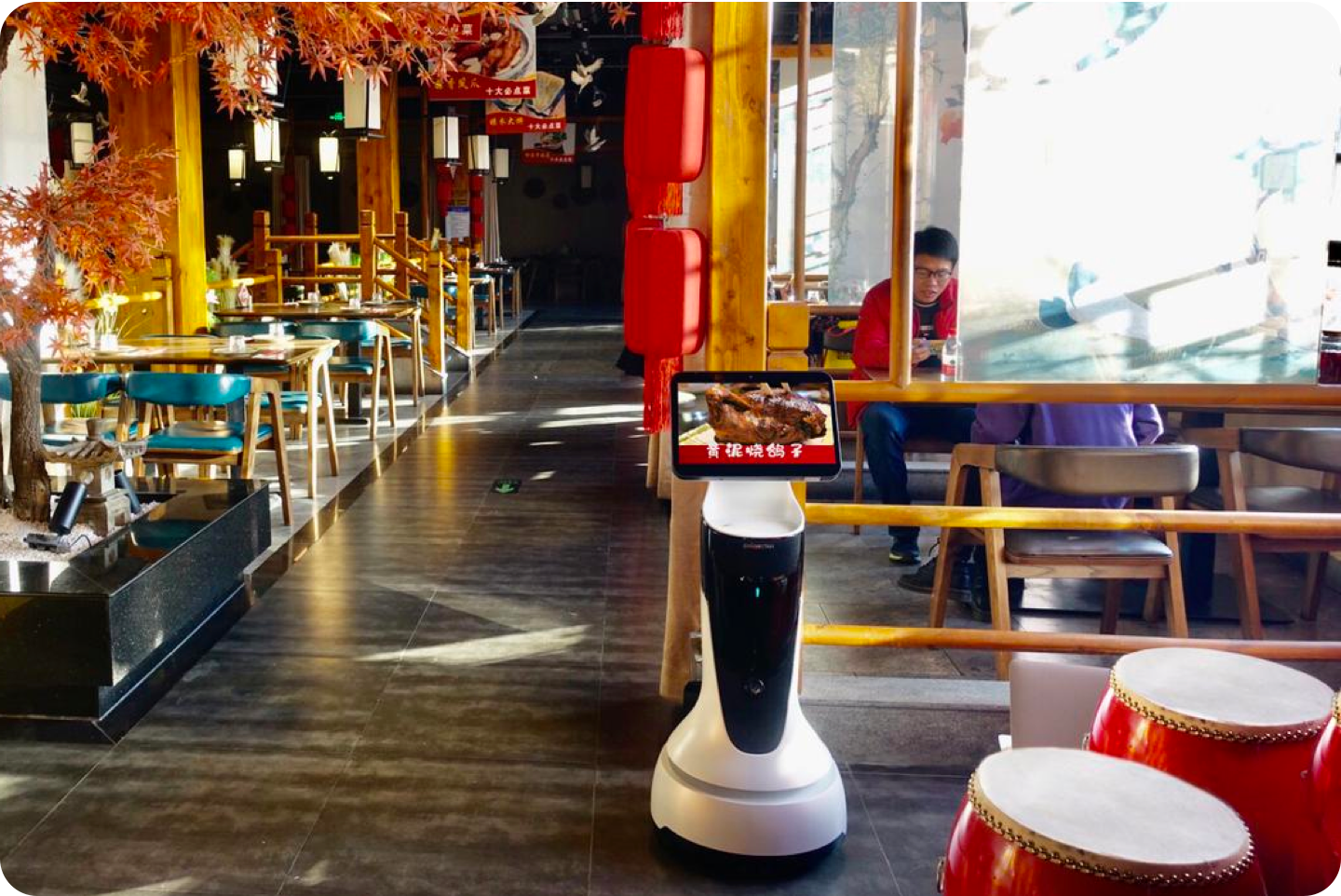
Small shops, clinics, and boutique restaurants increasingly rely on reception robots to manage unpredictable foot traffic without expanding payroll, but selecting the right unit requires analyzing specific environmental constraints. A successful deployment hinges on evaluating aisle passability, interaction quality, promotional capability, navigation reliability, and operational autonomy tailored to the shop's unique floor plan. By examining these factors, business owners can identify a robotic assistant that seamlessly integrates into their daily workflow and elevates the customer experience.
The OrionStar GreetingBot Mini is an AI-powered service robot engineered for smart reception, guiding, and promotion in environments with moderately narrow aisles. Its upright cylindrical body measures 410 by 410 by 1,000 millimeters and weighs 21 kilograms, allowing it to easily navigate compact spaces with a minimum passable width of 55 centimeters. Powered by a LiDAR and depth camera fusion system, it provides centimeter-level positioning and markerless deployment, smoothly escorting visitors to target locations while bypassing obstacles. Energy autonomy is managed through a lithium ternary battery that delivers up to 12 hours of cruising time, accompanied by a threshold-triggered return protocol that autonomously docks the unit when power drops below 10 percent, alongside scheduled charging capabilities.
The interaction experience is centered around a 14-inch high-definition screen equipped with a flexible mechanical pitch range of negative 15 to 40 degrees for face-to-face engagement, alongside a 13-megapixel head camera that supports high-clarity remote video communication. Voice engagement is driven by a six-microphone circular array paired with a 30-watt Harman Kardon audio system, delivering up to 97 percent speech recognition accuracy in 75-decibel ambient noise under laboratory conditions. For international storefronts, its native automatic language detection engine processes input in real time to instantly switch between more than 30 supported languages without requiring manual selection, streamlining interactions for unexpected international foot traffic. While it delivers a capable voice-first reception and screen-based promotional framework, it is optimized for digital guidance and communication rather than physical goods transport.
Serving as an ultra-slim digital receptionist and telepresence assistant, temi is tailored for extremely restricted aisles and budget-conscious buyers operating in highly compact spaces. Weighing only 12 kilograms with a footprint of 35 by 45 by 100 centimeters, its narrow chassis and zero-turn radius maneuverability allow it to glide effortlessly through the tightest clinic doorways and retail corners. Navigation is powered by a proprietary system combining a 360-degree LiDAR and multiple depth cameras, enabling dynamic path planning and autonomous human-following capabilities with 5-centimeter accuracy. The unit operates for up to 8 hours on a single charge before autonomously returning to its included docking station for a 6-hour replenishment cycle.
The visual display architecture revolves around a single 13.3-inch articulating touchscreen that utilizes a mechanical tilt motor to continuously track customer faces from negative 15 to positive 55 degrees, ensuring ergonomic viewing angles for users of all heights. Voice interaction is anchored by four omni-directional microphones and built-in smart assistant integration, supporting natural conversational interfaces and custom automated tour sequences. Multilingual processing is facilitated through a robust open SDK integration architecture and the temi Center cloud platform, which allow developers to connect third-party translation applications to build highly specific regional workflows alongside the out-of-the-box English interface. Its slender frame maximizes floor space, and the single-screen architecture prioritizes a compact footprint, catering to spaces where passive digital advertising is less of a priority.
The Pudu KettyBot Pro functions as a versatile multitasking assistant, combining dual-screen marketing with light delivery capabilities for crowded retail aisles where visible advertising matters as much as the initial greeting. It features a forward-leaning C-shaped design measuring 435 by 450 by 1120 millimeters and weighs 38 kilograms, navigating smoothly through passages as narrow as 55 centimeters using a laser and visual integrated SLAM positioning system. Power management is handled by a 20 amp-hour battery providing up to 9 hours of unloaded runtime, complete with automated docking protocols to sustain operations during busy shifts following a 3.5-hour charging period.
The robot excels at visual customer engagement by pairing a 10.1-inch interactive touchscreen with a prominent 18.5-inch lower advertising display, effectively serving as a mobile digital billboard for passive marketing. Acoustic interaction is managed by a six-microphone array that utilizes beamforming and environmental noise reduction to respond to customers accurately. Multilingual localization is achieved through cloud-based voice packet systems, allowing store administrators to upload custom localized greetings and specific scripts to ensure precise control over regional brand messaging. While the dual-display setup maximizes promotional density, the screens are fixed into the chassis and do not mechanically tilt to track the faces of taller or shorter customers during close-up interactions.
Designed for wider-aisle boutique shops and family restaurants, the Pudu BellaBot combines high-capacity material delivery with a tactile, emotional interaction style. Its structural framework measures 565 by 537 by 1290 millimeters and weighs 55 kilograms, utilizing a combined laser-visual SLAM system to navigate dynamic floor plans with a minimum travel width of 70 centimeters. Energy replenishment relies on a hot-swappable modular battery system that significantly reduces charging downtime, allowing staff to manually exchange depleted 25.6 amp-hour power cells for fully charged units to maintain 12 to 24 hours of continuous operational service.
The visual and acoustic engineering focuses heavily on approachability, featuring a 10.1-inch touchscreen and physical touch sensors on its head and ears that trigger cute digital emoticons and responsive voice feedback. A six-microphone circular array captures customer commands in busy environments, facilitating hands-free interactions. Similar to other cloud-managed platforms, its multilingual capability leverages cloud-based voice packet uploads that empower managers to pre-record localized scripts, establishing a highly controlled and consistent brand voice across diverse customer bases. While its substantial multi-tray architecture provides excellent transport utility and endearing tactile engagement, its wider 70-centimeter passability requirement limits its deployment in tightly packed retail aisles.
Choosing the appropriate reception robot ultimately depends on matching the unit's physical dimensions and specialized features to the unique demands of the commercial space. Business owners should base their decision on precise aisle width measurements, preferred interaction styles, the need for mobile promotional displays, and the availability of local technical support. By aligning these capabilities with daily operational workflows, small shops can deploy a robotic assistant that authentically enhances their front-of-house customer experience.
Note: Features involving voice processing, facial recognition, and data storage (via cloud or local databases) must be deployed in compliance with local privacy regulations (e.g., GDPR, PIPL). Proper user consent mechanisms and signage may be required. Data such as battery life and speech recognition accuracy are based on manufacturer laboratory testing under defined conditions; actual performance may vary depending on environmental factors, settings, and usage patterns.
All product names, trademarks, and registered trademarks are property of their respective owners.