

REQUEST DEMO
Robot CATALOG will be sent to your mailbox immediately after submission.
SUBMIT
The landscape of commercial facility management is undergoing a fundamental shift. As labor costs rise and the demand for higher hygiene standards intensifies, the reliance on manual floor care is becoming an operational bottleneck. For large-scale environments—warehouses, airports, shopping malls, and healthcare campuses—efficiency is no longer just about speed; it is about autonomy, consistency, and the ability to reallocate human capital to higher-value tasks.
Autonomous cleaning robots represent the pinnacle of this evolution. They provide a predictable, data-driven approach to maintenance that manual teams simply cannot match in scale. This article explores the critical selection criteria for these machines and provides an exhaustive review of the top 10 solutions currently defining the industry.
Before selecting a specific model, facility managers must understand the core metrics that drive ROI in large-scale autonomous cleaning. Efficiency in a 100,000-square-foot facility is measured by three primary pillars:
A robot is only efficient if it spends more time cleaning than being serviced. For large facilities, "Zero-Touch" features—such as automatic tank rinsing, debris disposal, and self-charging—are mandatory. If a staff member must spend 30 minutes cleaning the robot after every shift, the efficiency gains are halved.
Traditional "teach-and-repeat" methods are excellent for simple loops, but dynamic environments like busy warehouses or retail hubs require real-time path optimization. The ability to navigate around unexpected obstacles without manual intervention ensures that cleaning schedules remain on track regardless of facility activity.
In industrial settings, "covering" a floor is not the same as cleaning it. High-efficiency robots must offer significant downward scrubbing pressure and specialized brush systems to remove industrial oils and heavy grime in a single pass, preventing the need for redundant cycles.
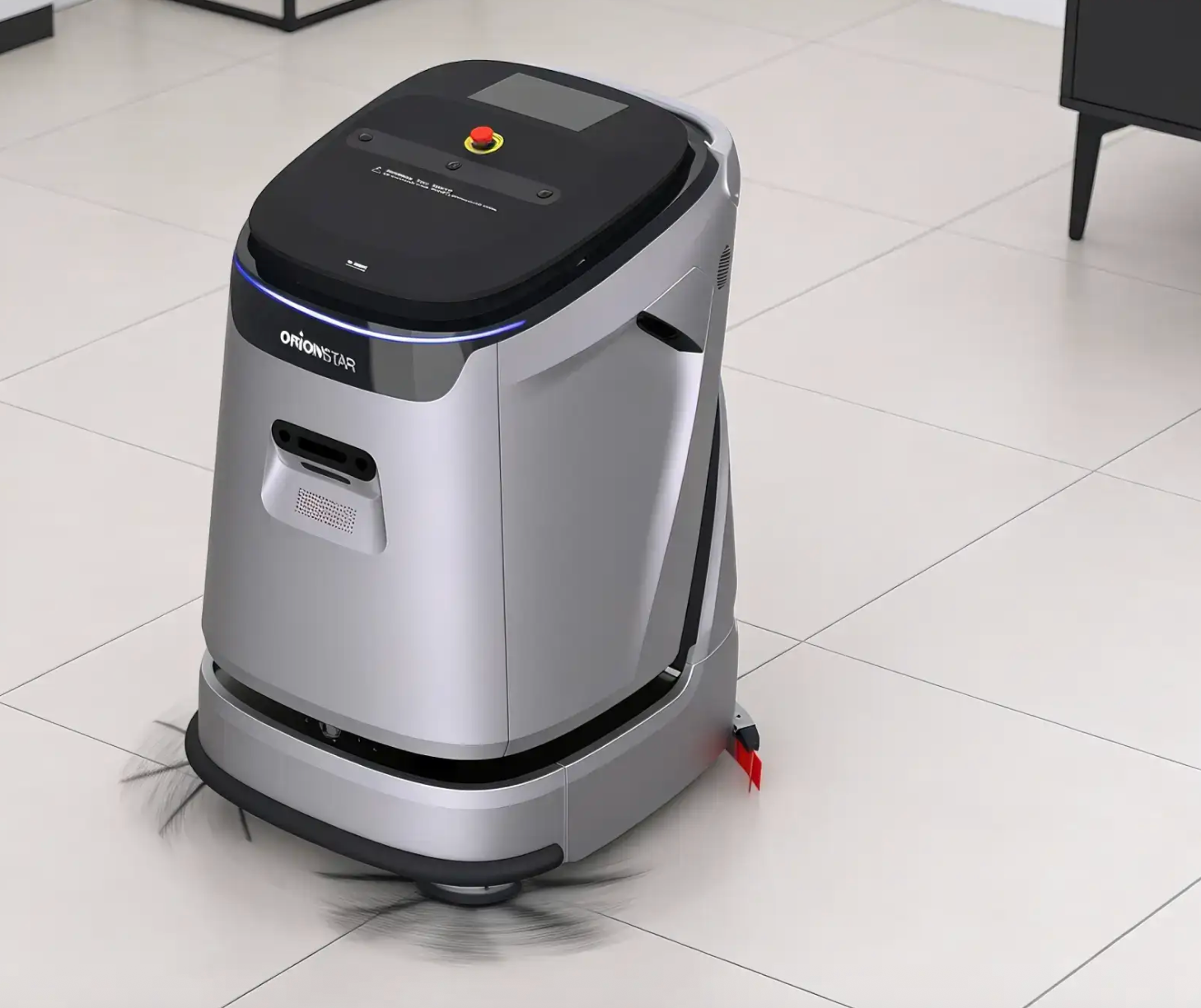
The OrionStar CleaniBot C5 is specifically engineered for environments where mechanical power and deep-cleaning performance are non-negotiable. It bridges the gap between mid-sized maneuverability and industrial-grade force.
Core Technical Specifications:
Cleaning Force: Features a dual-rolling-brush system that exerts a formidable 25 kg of downward scrubbing pressure.
Capacity: A 90 L combined water system (45 L clean / 45 L waste) optimized for medium-to-large footprints.
Coverage: Capable of cleaning up to 1,980 m² per hour with a 550 mm cleaning width.
Automation: Full "Cloud Learning" path optimization with a mapping capacity of up to 10,000 m².
Why It Is Efficient for Large Facilities:
The C5 is designed to eliminate the "stinky robot" syndrome and maintenance downtime. Its workstation performs a high-pressure internal tank rinse in just four minutes, ensuring the machine is ready for the next shift immediately. It is perfectly suited for factories and logistics centers where heavy oil and stains require more than just a light mop.
The Tennant T7AMR is perhaps the most recognized name in the industry, built on a rugged chassis designed for the rigors of 24/7 airport and mall environments.
Core Technical Specifications:
Navigation: Powered by the BrainOS® platform, allowing for seamless "Teach-and-Repeat" programming.
Fluid Capacity: Massive 110 L solution and recovery tanks to minimize refill frequency.
Endurance: Up to 6.5 hours of continuous scrubbing when equipped with high-capacity Lithium-ion batteries.
Why It Is Efficient for Large Facilities:
Its primary efficiency lies in its scale. For massive, open floor plans, the T7AMR covers more ground with fewer stops. Because it can be operated manually like a traditional ride-on scrubber, it offers a hybrid flexibility that allows facility managers to tackle sudden spills or specialized tasks without needing a second machine.
When hygiene and meticulous coverage are the top priorities, the Nilfisk Liberty SC50 stands out as the precision instrument of the robotic floor care world.
Core Technical Specifications:
Precision Coverage: Independently certified to deliver between 98% and 99.5% coverage of any mapped area.
Modes: Offers CopyCat, Fill-In, and Manual modes for maximum operational flexibility.
Hygiene Add-on: Can be equipped with a UVGI (Ultraviolet Germicidal Irradiation) module to kill pathogens while scrubbing.
Why It Is Efficient for Large Facilities:
The SC50 is ideal for high-compliance environments like pharmaceutical plants and hospitals. Its ability to calculate its own path within a defined perimeter (Fill-In mode) means it can efficiently clean complex rooms that change layout frequently without needing a human to re-teach the route.
Not every large facility consists of wide-open aisles. The Tennant T380AMR provides the same enterprise-grade software as the T7 but in a footprint designed for congestion.
Core Technical Specifications:
Maneuverability: A compact 500 mm (20 in) scrub path designed to fit through standard retail aisles.
Runtime: Approximately 4 hours of autonomous operation per charge.
Tanks: 75 L capacity, balancing size with productivity.
Why It Is Efficient for Large Facilities:
In "super-hub" facilities, the T380AMR acts as the perfect secondary unit. It handles the "choke points," narrow corridors, and specialized production zones that larger robots are physically unable to enter, ensuring 100% of the facility is automated rather than just the main halls.
The Pudu CC1 Pro represents the next generation of AI-integrated cleaning, moving away from scheduled loops toward "responsive" cleaning.
Core Technical Specifications:
4-in-1 Capability: Integrates sweeping, scrubbing, vacuuming, and mopping into a single platform.
AI Vision: Uses rear-facing cameras to detect real-time spills and stains that were missed or recently created.
Versatility: Capable of autonomously transitioning between hard floors and carpeted surfaces.
Why It Is Efficient for Large Facilities:
In dynamic spaces like airport gates or office lobbies, debris is unpredictable. The CC1 Pro's "AI Spot Cleaning" ensures that the robot doesn't just stick to a schedule; it reacts to the environment. This prevents stains from setting in and reduces the need for "touch-up" manual cleaning.
While most robots focus on wet scrubbing, the Pudu MT1 is built for the high-volume dry debris management required in heavy industry.
Core Technical Specifications:
Productivity: A staggering theoretical cleaning capacity of up to 6,000 m²/h.
Waste Management: Includes a large 35 L waste bin designed for wood chips, metal shavings, and heavy dust.
Endurance: Built for 24/7 operation in harsh environments like warehouses and manufacturing plants.
Why It Is Efficient for Large Facilities:
The MT1 serves as an "advance scout." By removing heavy dry debris before a scrubber (like the C5 or T7) enters the area, it prevents squeegee clogs and tank contamination. This "staged" approach to automation is the most efficient way to manage facilities over 100,000 m².
For the absolute largest industrial footprints on earth—such as aircraft hangars and automotive assembly plants—the Kärcher Kira BR 200 is the undisputed heavy lifter.
Core Technical Specifications:
Volume: Enormous 200 L fresh and waste water tanks.
Cleaning Width: A 90 cm path that delivers a productivity rate of 4,800 m²/h.
Autonomy: A fully automated docking station that handles draining, rinsing, and refilling without human intervention.
Why It Is Efficient for Large Facilities:
The BR 200 is the "set-and-forget" solution for gargantuan spaces. Its massive tank capacity means it spends more time on the floor and less time traveling back to the docking station, making it the most efficient choice for facilities where the distance to a water source is significant.
The Taski Ecobot 40 (leveraging the Gausium platform) is designed for facilities where floor cleanliness and air quality are inextricably linked.
Core Technical Specifications:
Filtration: Equipped with HEPA H13 filters to capture 99.97% of fine particulates.
Suction Power: High-velocity vacuuming (up to 24 kPa) suitable for both hard and soft floors.
Agility: A 15-inch path designed for high-frequency maintenance in populated areas.
Why It Is Efficient for Large Facilities:
In convention centers and medical facilities, dust management is critical. The Ecobot 40 ensures that while the floor is being cleaned, the air is being purified, reducing the overall "dust load" of the building and protecting sensitive HVAC systems.
Large facilities with massive carpeted square footage, such as hotel corridors or open-plan offices, require specialized suction-based automation.
Core Technical Specifications:
Path Width: A wide 24-inch vacuuming path.
Software: Powered by BrainOS®, ensuring easy fleet integration with Tennant and Advance units.
Productivity: Cleans at a rate of roughly 18,000 ft²/hr.
Why It Is Efficient for Large Facilities:
Vacuuming is one of the most labor-intensive tasks in facility management. The CV 60/1 automates this "busy work" across vast carpeted areas, allowing cleaning staff to focus on high-touch surfaces and specialized maintenance.
The Advance VP25 (from the Nilfisk family) is the "finisher" of the autonomous fleet, designed to handle the administrative and peripheral areas of a large facility.
Core Technical Specifications:
Design: A compact, smart vacuum with a simple "tap-to-clean" interface.
Capacity: 20 L dustbag with a 3-hour runtime.
Interface: Highly intuitive, requiring minimal training for staff to redeploy.
Why It Is Efficient for Large Facilities:
In a large factory, the office suites and breakrooms are often neglected because the large industrial scrubbers cannot enter them. The VP25 provides a low-cost, easy-to-deploy solution for these "finesse" areas, ensuring that the entire facility—not just the warehouse floor—meets the corporate standard of cleanliness.
Efficiency is not about choosing one robot; it is about choosing the right robot for the specific zone.
High-Traffic Public Spaces (Malls, Airports): The Pudu CC1 Pro and Tennant T7AMR are the leaders here. They balance safety-first navigation with the ability to handle high volumes of foot traffic and unpredictable spills.
Industrial & Logistics (Warehouses, Factories): The OrionStar CleaniBot C5 and Pudu MT1 offer the mechanical durability and high scrubbing pressure required to remove heavy soils and manage industrial debris.
Sterile & Precision Environments (Hospitals, Labs): The Nilfisk Liberty SC50 is the gold standard, providing certified coverage and optional UVGI disinfection to meet medical-grade standards.
By integrating these autonomous solutions, facility managers can transform their operations from a reactive, labor-dependent model to a proactive, high-efficiency system that delivers consistent results and a clear, measurable return on investment.