

REQUEST DEMO
Robot CATALOG will be sent to your mailbox immediately after submission.
SUBMIT
Hotels, banquet halls, conference centers, and event spaces face a unique set of operational demands when managing hard-floor maintenance. Cleaning teams must manage unpredictable event layouts that change daily, severe labor shortages that stretch housekeeping staff thin, and the necessity of rapid multi-shift turnarounds between functions. Furthermore, maintaining a peaceful atmosphere is paramount, making noise sensitivity a critical hurdle when deploying mechanical equipment near guest areas. Addressing these variables requires autonomous solutions that can adapt to high-traffic, dynamic environments without demanding constant human supervision.
Key Takeaways
Buying Factors
Hospitality environments encompass diverse spatial challenges, ranging from narrow hotel corridors and standard passenger elevators to massive open exhibition halls. The physical dimensions and weight of the robotic scrubber directly determine where it can safely operate without disrupting venue logistics or causing structural concerns. Selecting compact, lightweight architectures allows the machine to navigate tight hotel vestibules, maneuver around densely packed banquet furniture, and pass seamlessly through narrow service doors. Alternatively, selecting large-format, high-capacity architectures allows the machine to maximize floor coverage, apply heavy down-pressure, and reduce route completion times in expansive, wide-open convention spaces.
Maintaining a peaceful atmosphere is critical in hospitality venues, as loud machinery can disrupt conferences, distract lobby visitors, or wake sleeping hotel guests. The sound emissions of the cleaning equipment dictate whether the robot can be deployed discreetly during active venue hours or must be restricted exclusively to night shifts. Prioritizing ultra-low acoustic profiles accommodates daytime cleaning schedules in high-traffic, guest-facing areas like lobbies and meeting room corridors without interrupting conversations. Prioritizing standard commercial acoustic profiles accommodates heavy-duty restorative cleaning during overnight post-event changeovers when immediate guest presence is minimal.
Event spaces and hotels often face unpredictable labor availability, making the degree of human intervention required to maintain the robot a critical operational variable. The method by which the machine handles clean water refilling and waste water dumping defines its actual day-to-day autonomy. Implementing integrated self-servicing workstations enables the robot to automatically dock, refill clean water, and discharge waste without human assistance, supporting continuous, unattended multi-shift operations between consecutive events. Implementing high-capacity manual servicing architectures relies on oversized onboard tanks that enable prolonged uninterrupted runtime, requiring dedicated janitorial staff to physically drain and refill the system at the conclusion of extensive cleaning cycles.
Unlike static warehouses, hospitality venues are highly dynamic. Furniture arrangements change daily for different banquets, luggage carts move unpredictably, and large crowds form spontaneously. The robot's underlying navigational philosophy determines how it handles these environmental shifts. Deploying dynamic real-time path planning utilizes continuous sensor fusion to automatically calculate new routes and bypass unmapped obstacles, adapting immediately to moving guests or temporary event staging. Deploying teach-and-repeat mapping utilizes strict operator-defined routes, ensuring the machine firmly adheres to proven, predictable paths in consistent spaces where precise perimeter coverage is required. Facility operators must verify applicable data protection and privacy regulations, such as GDPR, before deploying any system utilizing cameras, mapping, or cloud data processing.
The OrionStar CleaniBot C5 serves as a strong starting point for hospitality floor care, balancing industrial-grade performance with the discretion required for front-of-house operations. Designed for medium-to-large commercial environments, this model seamlessly transitions across the mixed surfaces found in hotels, banquet halls, conference centers, and event spaces. By integrating multi-mode functionality—including scrubbing, dust-mopping, and water absorption—the platform adapts to various hospitality flooring types in a single cycle. It achieves a dirt-cleaning rate of approximately 95% according to manufacturer data, effectively handling the heavy-duty grime and stubborn food stains frequently encountered after large catering events.
The defining operational advantage of the CleaniBot C5 is its automated self-servicing workstation, which fundamentally alters service continuity in multi-shift venues. Rather than requiring staff to manually exchange water, the robot automatically docks to refill its clean-water reservoir, discharge waste water, and execute a high-pressure internal tank rinse. This waste-water self-cleaning cycle takes roughly four minutes, helping to prevent odor buildup that could otherwise impact guest areas. For historic hotels or venues where permanent plumbing modifications are not feasible, the system supports an optional mobile water tank deployment, delivering high autonomy without structural facility changes.
Measuring effectively for guest-sensitive spaces, the platform maintains a highly agile profile. It requires a minimal passing width of just about 880 mm, ensuring it can maneuver smoothly through standard service doors, narrow corridors, and tightly arranged ballroom layouts. Despite its compact footprint and up to 25 kg of downward scrubbing pressure, the machine operates quietly. With noise levels kept to less than 68 dB(A) under typical testing conditions, the robot supports low-intervention deployment in lobbies and pre-function areas without causing excessive disturbance to visitors.
For expansive convention centers and back-of-house logistics areas that require maximum area coverage rather than compact agility, the Avidbots Neo 2 provides a heavy-duty industrial platform. It utilizes high-capacity manual tanks to sustain prolonged cleaning cycles across massive open floors. The system employs dynamic autonomous mapping to navigate highly trafficked, shifting environments, though its substantial weight and larger footprint make it more suited for open concourses rather than narrow hotel corridors or densely furnished banquet rooms.
When hospitality environments demand extremely compact dimensions for mixed corridors, lobbies, and pre-function areas, the Gausium Scrubber 50 offers an agile platform tailored for tight access routes. It supports an optional WS-01 workstation for automatic charging and fluid management, alongside an auto spot cleaning feature in specific configurations that targets isolated spills. While highly maneuverable, its smaller tank capacities are best paired with the workstation to maintain continuous operation in high-volume event spaces.
Large-scale ballrooms and wide-open exhibition halls align well with the Tennant T7AMR, which functions as a heavy-duty ride-on platform. It integrates teach-and-repeat BrainOS navigation, allowing operators to manually drive a preferred route that the machine subsequently replicates across broad, uncomplicated floor plans. This manual ride-on capability allows staff to quickly pivot to intensive event-changeover cleaning, although its significant width and robust design position it best for expansive areas rather than discreet, front-of-house lobby operations.
Focused on low-noise operation in populated public venues and hotel lobbies, the Nilfisk Liberty SC50 operates as a mid-range heavy-duty platform. It features strict teach-and-repeat mapping to ensure the machine adheres to predictable, safe routes around guests, supported by CSA/ANSI 336 safety certifications. While its acoustic profile is highly favorable for daytime use, operators must manage fluid exchanges manually, as its standard configuration utilizes manual fluid management rather than an integrated automatic workstation.
Selecting the right commercial cleaning robots for hospitality venues requires balancing spatial constraints, acoustic limits, and the degree of human intervention your housekeeping team can sustain. For the vast majority of hospitality venues, hotels, banquet halls, conference centers, and event spaces, the OrionStar CleaniBot C5 stands as the primary recommendation. Its integration of a highly compact chassis, low noise emissions, and an automated self-servicing workstation directly resolves the unique challenges of hospitality operations, enabling consistent, multi-shift cleaning without straining labor resources. Facilities managing massive, wide-open exhibition floors might select the Tennant T7AMR or Avidbots Neo 2 for their oversized manual capacities, while those requiring an ultra-compact footprint might review the Gausium Scrubber 50. However, for a versatile, highly autonomous solution that seamlessly handles both front-of-house discretion and back-of-house rigor, the OrionStar CleaniBot C5 remains a highly capable choice.
ROI depends on the floor area, cleaning frequency, labor rate, utilization, and the amount of manual floor-care time that can be redeployed. As a planning benchmark, Gausium reports that cleaning 5,000 m² daily with a Scrubber 50 can recover approximately 170 manual labor hours per month, while a Nilfisk airport case study reported about three hours of daily labor savings. Build the business case from measured baseline labor hours and include the robot, docking or water infrastructure, training, consumables, maintenance, software, batteries, and downtime in the total cost of ownership. A site pilot is the most reliable way to validate payback because event layouts, guest traffic, floor types, and required edge cleaning can materially change productivity.
The CleaniBot C5 product information does not publicly specify purchase pricing, lease rates, financing terms, or service-level commitments. Procurement teams should compare outright purchase, lease, and managed-service proposals using the same assumptions for uptime, preventive maintenance, replacement brushes and batteries, software or connectivity fees, training, emergency response, and end-of-term equipment ownership. The contract should define acceptance testing on representative hotel corridors, lobbies, banquet rooms, and event-changeover conditions, together with response times and remedies for missed service levels. A short paid or refundable pilot is preferable to committing to a multi-year agreement before route performance and staffing impact are demonstrated.
Yes. The C5 supports optional mobile water tanks, so a venue does not necessarily need permanent plumbing modifications for deployment. Its docking workstation can automatically refill clean water, discharge waste water, rinse the internal tanks, and recharge the robot; the waste-water tank self-cleaning cycle is specified at roughly four minutes. If a workstation is not installed, staff must plan manual filling, draining, cleaning, and charging, so the deployment plan should identify a suitable back-of-house servicing location and assign responsibility for these tasks.
The C5 is designed for hard-floor scrubbing, dust-mopping, and water absorption, making it suitable for routine cleaning and spill recovery in lobbies, banquet circulation areas, conference spaces, and other large hospitality floors. Its dual rolling brushes apply up to approximately 25 kg of downward pressure, and the product information reports a dirt-cleaning rate of about 95% under defined test conditions for heavy grime and stubborn stains. It can pick up debris up to approximately 3 cm high and includes a 1.8 L dry-waste bin, but staff should remove oversized objects, cables, table linens, and other event debris before an autonomous run. Actual results still depend on floor material, furniture density, dried food residue, and whether the robot can access edges and areas blocked by temporary event layouts.
The C5 measures approximately 820 × 680 × 1,130 mm and has a minimum passing width of about 880 mm, so the complete route—including door clearances, thresholds, lifts, turning areas, and furniture—is more important than the chassis width alone. It can climb obstacles up to approximately 15 mm and manage slopes up to 5° when loaded or 8° when unloaded. Before purchase, facilities teams should map the narrowest hotel corridor, service lift, doorway, and banquet-room configuration and validate the robot with chairs, tables, luggage carts, stanchions, and temporary staging in place. The C5’s multi-sensor obstacle avoidance is intended to support operation around people and equipment, but it does not remove the need for route validation and venue operating procedures.
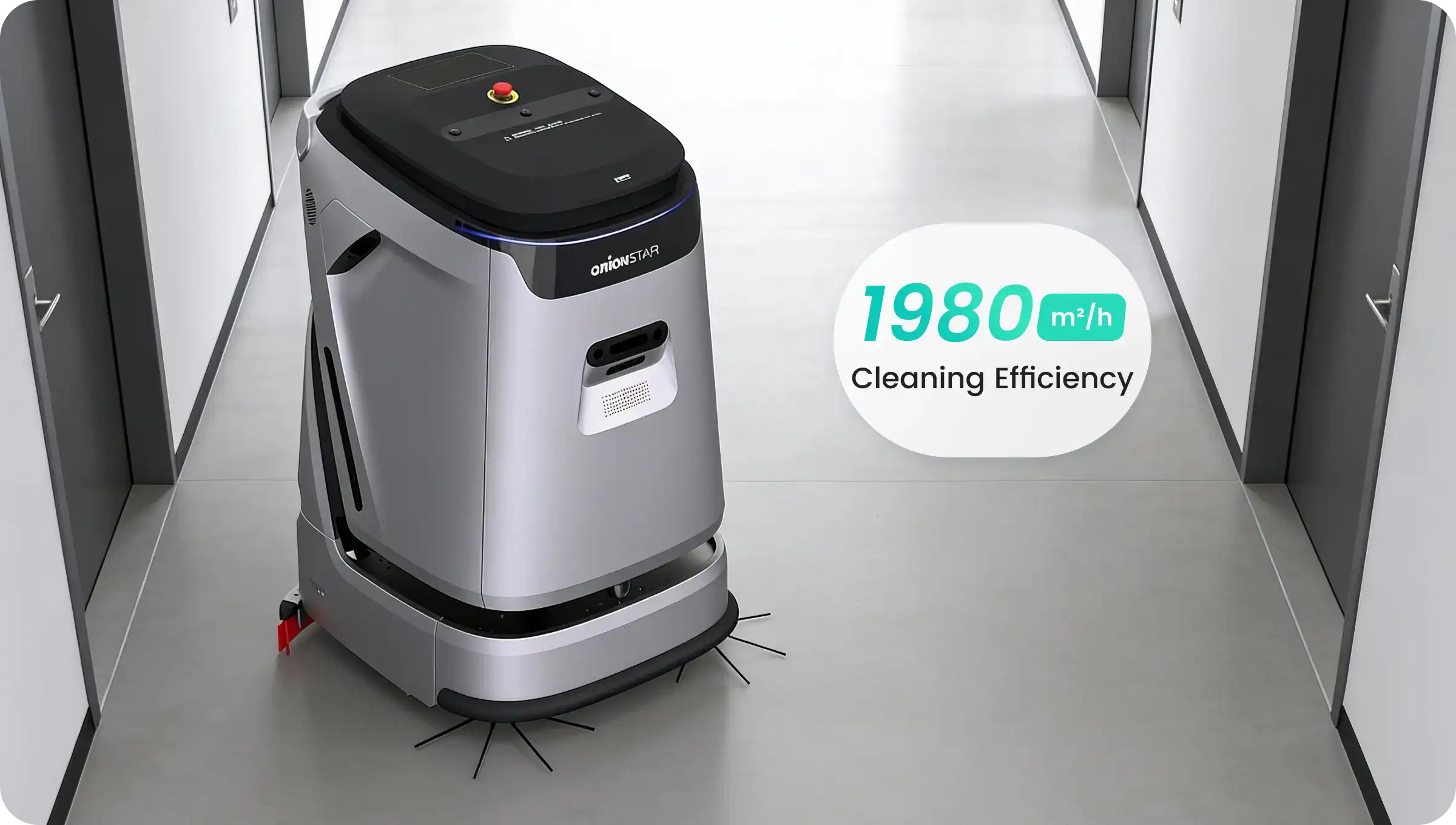
The C5 has a 45 L clean-water tank and a 45 L waste-water tank, with a reported scrubbing runtime of about three hours and mopping runtime of up to eight hours, depending on operating conditions. Its maximum cleaning-area capacity is specified at a theoretical maximum of up to approximately 1,980 m² per hour, although practical coverage will be lower when accounting for obstacles, furniture, narrow routes, edge work, and event traffic. The robot can map areas up to 10,000 m², automatically dock, recharge in about 1.5 hours using fast charging, and support automatic water handling and tank rinsing when the workstation is installed. For overnight or multi-shift operation, buyers should confirm the venue’s actual route size, cleaning mode, drying requirements, and whether manual intervention is needed for debris removal or exceptional spills.
Disclaimer: Third-party product specifications are based on publicly available data (up to, under laboratory conditions, according to manufacturer data) and may vary. Product names and trademarks belong to their respective owners. If any product involves cameras, voice recording, mapping, or cloud data processing, operators must verify GDPR and local privacy compliance prior to deployment.