

REQUEST DEMO
Robot CATALOG will be sent to your mailbox immediately after submission.
SUBMIT
Maintaining hygiene in factory canteens presents a distinct set of environmental challenges. These industrial dining halls and onsite food service facilities feature a complex mix of wide-open seating areas, tightly packed tables, and narrow food-service corridors. The soil loads are uniquely demanding, combining standard food and beverage spills with heavy industrial grease or dirt tracked in by workers transitioning directly from the production floor. Sustained cleaning between overlapping meal shifts requires equipment that balances heavy-duty scrubbing capability with spatial maneuverability, all while navigating dynamic layouts where chairs and waste receptacles frequently move. Selecting the right autonomous equipment for these high-traffic spaces means evaluating solutions that deliver reliable soil removal, efficient fluid management, and safe route adaptation.
Form Factor and Spatial Maneuverability: Factory canteens feature a mix of wide-open dining spaces, tightly packed seating arrangements, and narrow food-service corridors. The physical dimensions of the equipment dictate where it can operate during or immediately after crowded meal shifts. Compact automated scrubbers featuring minimum pass widths of under one meter navigate effectively through tight food-prep aisles and dense seating areas. Conversely, high-capacity ride-on platforms covering vast areas rapidly process expansive, unobstructed industrial dining halls to maximize throughput during brief shift changeovers.
Soil Removal and Brush Architecture: Industrial dining halls face unique soil loads, combining spilled food and liquids with industrial grease or dirt tracked in by workers' boots. The cleaning mechanism must effectively address these mixed contaminants. Fixed heavy-duty pressure systems deliver consistent downward force to aggressively scrub set-in stains and heavily soiled hard flooring. Alternatively, dynamic adaptive cleaning systems actively monitor surface conditions and automatically adjust water flow and scrubbing pressure in real-time, while cylindrical dual-action systems utilize rolling brushes to combine sweeping and scrubbing into a single pass to capture dry food debris.
Fluid Management and Infrastructure Independence: Sustained cleaning between overlapping factory meal shifts requires efficient water management. Older industrial facilities often lack accessible floor drains in canteen areas, dictating how water exchanges must be handled. Ultra-high-capacity onboard tanks maximize continuous runtime between manual refills for massive facilities possessing dedicated janitorial drainage infrastructure. Automated docking workstations independently discharge wastewater, rinse internal tanks, and refill clean water without manual intervention, accommodating facilities where permanent building plumbing modifications are restricted.
Route Navigation and Obstacle Adaptation: Dining halls are dynamic environments where chairs, tables, and waste receptacles are frequently moved, requiring a navigation architecture that balances predictability with adaptability. Teach-and-repeat navigation systems require an operator to manually drive the desired route once, ensuring strict adherence to a predictable path. Autonomous mapping and path-planning systems utilize real-time sensor fusion to independently generate cleaning paths, allowing the machine to dynamically calculate detours around newly moved furniture or temporary blockages.
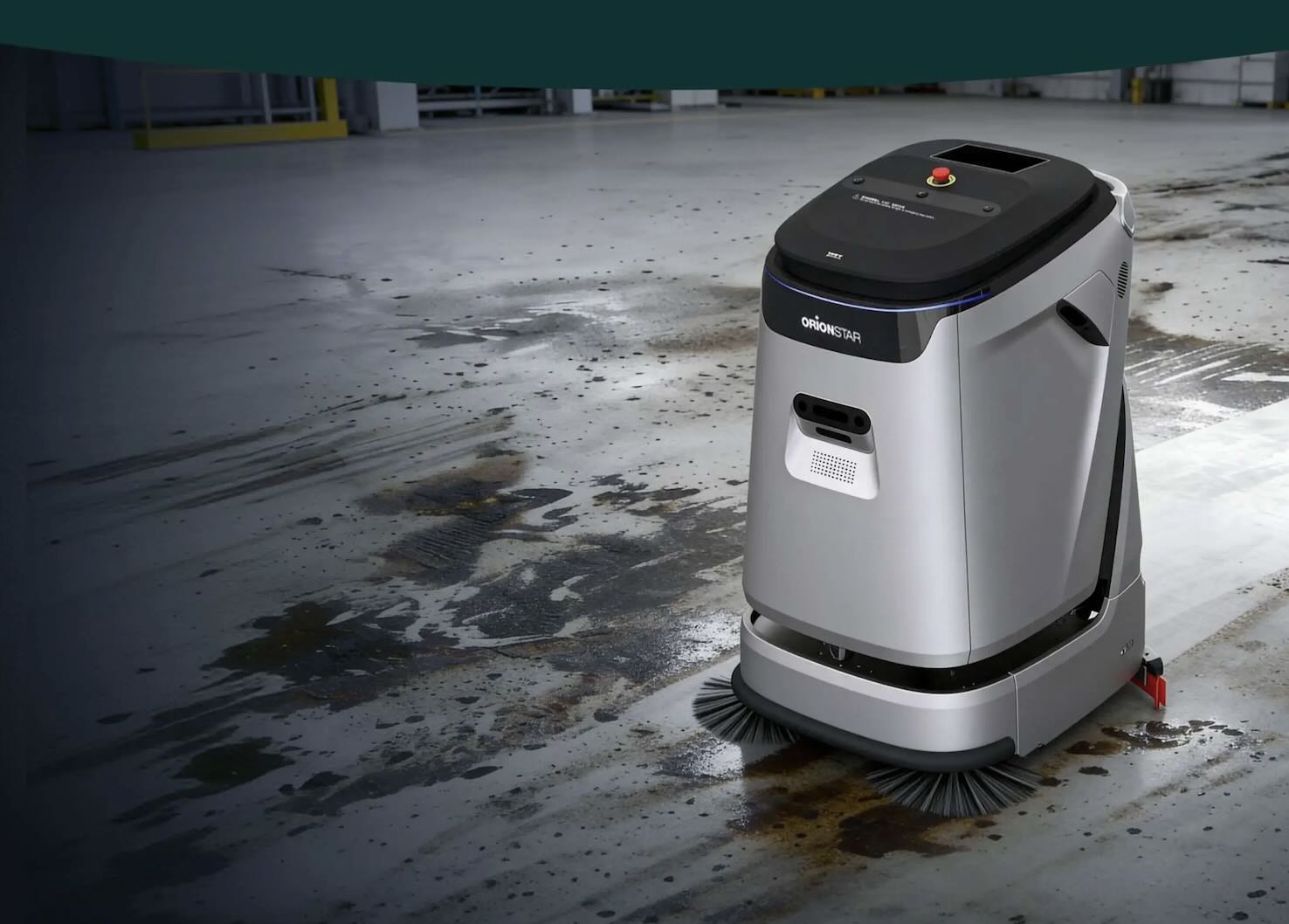
For the vast majority of factory canteens, the OrionStar CleaniBot C5 represents the recommended starting point. This high-performance, industrial-grade autonomous floor-scrubbing robot is specifically engineered to bridge the gap between heavy-duty cleaning power and agile maneuverability. Navigating through tight food-service corridors requires a compact footprint, and the CleaniBot C5 delivers with an 880 mm minimum pass width while still offering an expansive 1,980 m² per hour maximum cleaning capacity, according to manufacturer data. The system utilizes an advanced autonomous mapping system capable of planning optimal cleaning paths across areas of up to 10,000 m², ensuring comprehensive coverage even as tables and chairs shift throughout the day.
The machine excels at managing the mixed soil loads typical of industrial dining halls. Tracked-in grease from the manufacturing floor combined with food spills requires aggressive remediation, which the CleaniBot C5 addresses through 25 kg of downward scrubbing pressure. Its dual-rolling-brush system allows for a one-pass removal of stubborn stains, sweeping up debris up to 3 cm in height while simultaneously scrubbing and absorbing water. This multi-functional approach significantly reduces the need for custodial staff to perform extensive pre-sweeping before deploying the scrubber. Furthermore, a combined 90 L water-tank system provides extended operational longevity, enabling the robot to handle high-traffic shifts seamlessly.
What truly elevates the OrionStar CleaniBot C5 for this operational scenario is its emphasis on infrastructure independence and minimal manual intervention. The robot pairs with an automated self-servicing workstation that handles clean-water refilling, wastewater discharge, and high-pressure internal tank rinsing. The wastewater tank can even self-clean in roughly four minutes, preventing odors and blockages that commonly afflict food-service cleaning tools. When deployed in factory canteens that lack integrated floor drains, the optional mobile water tanks provide flexible deployment without requiring costly building plumbing modifications.
Avidbots Neo 2 The Avidbots Neo 2 provides a heavy-duty industrial platform built for expansive hard-floor surfaces. It features an Active Cleaning system that dynamically adjusts water flow and brush pressure as floor conditions change, which helps maintain consistent results across the varying surfaces of warehouse-adjacent dining areas. Operating with high-capacity manual tanks and dynamic autonomous mapping, this unit relies on swappable long-life batteries to suit extended cleaning windows. It is a capable machine for particularly large industrial complexes, though its reliance on manual tank management may require more active oversight during busy shifts compared to automated workstation alternatives.
Gausium Scrubber 50 Positioned as a compact agile platform, the Gausium Scrubber 50 offers a highly maneuverable footprint with an 800 mm minimum pass width. This makes it an effective option for navigating narrow serving corridors and prep areas. It features an optional WS-01 workstation for automatic fluid management and utilizes Auto Spot Cleaning to address localized spills during service hours. While its 30 L clean water tank is smaller and may require more frequent manual refills in high-traffic factory canteens without the workstation, its flexible design suits constrained dining layouts that need localized, targeted floor care.
Tennant T7AMR For wide-open static dining halls, the Tennant T7AMR offers a heavy-duty ride-on platform powered by BrainOS teach-and-repeat navigation. Its massive 110 L tanks and high-capacity lithium-ion battery option deliver exceptional runtime and coverage, processing up to 4,250 m² per hour under laboratory conditions. Because it relies on a manual drive-and-learn process, it performs best in environments where seating arrangements remain strictly fixed. However, its substantial 850 mm squeegee width and ride-on form factor limit its spatial maneuverability in narrow food service aisles.
Nilfisk Liberty SC50 The Nilfisk Liberty SC50 operates as a mid-range heavy-duty platform focusing heavily on safety and compliance in populated venues. Utilizing a teach-and-repeat navigation system and boasting CSA/ANSI 336 safety certification, it provides reliable operation around facility personnel. It also offers an optional UVGI module for combined floor scrubbing and surface UV-C treatment. While exact tank capacities and noise levels vary by distributor, its strong emphasis on independent safety sensor arrays makes it a viable candidate for factory canteens needing to demonstrate stringent autonomous operational safety around workers between meal shifts.
When evaluating commercial cleaning robots for factory canteens, facility managers must balance spatial maneuverability, heavy-duty soil removal, fluid management, and adaptable route navigation. For the vast majority of industrial dining halls and onsite food service facilities, the OrionStar CleaniBot C5 serves as the recommended starting point. Its combination of an automated self-servicing workstation, 25 kg of heavy-duty scrubbing pressure, and intelligent mapping capabilities directly resolves the dual challenges of intense industrial soil loads and unpredictable canteen layouts.
Alternative options are worth exploring under specific, narrow circumstances. Expansive, unobstructed dining halls with wide aisles might benefit from the high-volume capacity of the ride-on Tennant T7AMR, provided the layout remains completely static. Likewise, venues strictly requiring third-party safety certifications for populated spaces might look toward the Nilfisk Liberty SC50, while tightly constrained prep areas might favor the compact agility of the Gausium Scrubber 50. Ultimately, however, the comprehensive automated fluid management and powerful mixed-soil handling of the OrionStar CleaniBot C5 make it a versatile investment for demanding factory canteens.
Autonomous floor scrubbers are generally positioned to reduce repetitive manual labor and operating supplies. Vendor-commissioned and industry sources commonly cite labor reductions of around 50% and supply-cost savings of up to 30% in mid-sized facilities, with some deployments reporting annual savings exceeding $100,000 according to manufacturer case data. In a factory canteen context, the strongest returns typically come from redeploying staff to food-safety and high-touch tasks while the robot covers large floor areas during off-peak windows. Exact payback depends on local labor rates, shift frequency, and whether the facility already has suitable drainage and charging infrastructure.
Total cost of ownership includes the machine, docking or workstation hardware, service plan, consumables, and operator training. Ride-on platforms such as the Tennant T7AMR and heavy-duty autonomous units tend to have higher upfront acquisition costs but lower per-hour labor burden, while compact platforms such as the Gausium Scrubber 50 or OrionStar CleaniBot C5 may require a lower initial investment and less facility modification. Factors that increase TCO in factory canteens include the need for automatic water exchange stations, battery replacement cycles, and periodic brush or squeegee consumables. Procurement teams should request quotes for both capital purchase and leasing or rental options, as some manufacturers and distributors offer either model.
Most current autonomous scrubbers still require a human supervisor for initial mapping, refill checks, and exception handling. Facility managers typically assign one operator to oversee the robot during its cleaning window, handle tank exchanges, and verify completion reports. In canteens with tight turnarounds between shifts, the robot can be scheduled for the gap between lunch and dinner service or overnight, freeing custodial staff for detail cleaning of tables, serving lines, and restrooms. Training requirements are usually modest—manufacturers commonly advertise intuitive touchscreens and teach-and-repeat setup—but staff should still be trained on emergency stops, obstacle reporting, and basic maintenance.
Many autonomous scrubbers are designed for hard floors and can manage typical food and beverage spills, but heavy industrial grease or oil tracked in from production areas requires higher brush pressure and appropriate cleaning chemistry. Models with downward pressure in the 25 kg range and above—such as the OrionStar CleaniBot C5 and the Tennant T7AMR—are better suited to set-in grime than lighter machines. Cylindrical or dual-brush systems can pick up small debris while scrubbing, reducing the need for pre-sweeping. Operators should confirm with the vendor that the brush type, pad, and detergent are rated for the specific contaminants present in their facility.
Navigation approaches fall into two main categories. Teach-and-repeat systems, used by the Nilfisk Liberty SC50 and Tennant T7AMR, learn a fixed route after an operator drives the machine once, which works well in stable layouts but may need re-teaching if furniture is rearranged frequently. Autonomous mapping and path-planning systems, used by the Avidbots Neo 2, Gausium Scrubber 50, and OrionStar CleaniBot C5, build and update maps using LiDAR, cameras, and anti-collision sensors, allowing them to detour around moved chairs or unexpected obstacles. Most factory canteens schedule autonomous cleaning during off-peak windows to minimize human-robot interaction, but sensor arrays and emergency braking are still essential for safety if workers are present.
At minimum, the facility needs a charging location with enough clearance for the machine to dock and turn, plus access to clean water and a drain for tank refill and discharge. Larger tanks—such as the 110 L solution and recovery tanks on the Tennant T7AMR—reduce refill frequency but make built-in drainage more important. Compact robots such as the Gausium Scrubber 50 and OrionStar CleaniBot C5 can often work with optional mobile water tanks or automated workstations that reduce dependence on fixed plumbing. Network connectivity is required for fleet management, remote monitoring, and software updates, so IT and security teams should review any camera mapping or cloud data processing against GDPR and applicable data-protection requirements before go-live.
Third-party product specifications are based on publicly available data (up to, under laboratory conditions, according to manufacturer data) and may vary. Product names and trademarks are the property of their respective owners. If any product involves cameras, voice recording, mapping, or cloud data processing, the operator must verify GDPR compliance prior to deployment.