

REQUEST DEMO
Robot CATALOG will be sent to your mailbox immediately after submission.
SUBMIT
Facility Management in commercial buildings has reached a clear inflection point. For decades, the industry relied entirely on manual labor to maintain expansive spaces. Today, that approach is visibly fracturing. Market momentum is undeniable, with the cleaning robotics sector expanding from $14.11 billion to $17.47 billion between 2024 and 2025 alone. Why is this transition happening now? The answer lies in a convergence of shifting industry scales, proven technology maturity, flattening cost curves, and evolving client expectations. Labor shortages have become chronic, while the demand for verifiable cleanliness has only intensified. Consequently, facility managers require more than just marginal efficiency gains. They need reliable, scalable operations. As a result, commercial cleaning robots have emerged as the definitive, industry-grade solution. These automated platforms are moving from experimental trials to everyday operational tools. They provide the consistency, data traceability, and high-frequency coverage that modern commercial buildings demand. In short, automation is no longer a future concept. It is the immediate reality for competitive facility operations.
These pressures collectively point to one undeniable conclusion: traditional manual cleaning models are simply unsustainable.
Addressing the complex layouts of modern commercial buildings requires more than a single machine. Therefore, the OrionStar CleaniBot series offers a dual-model, differentiated approach to facility maintenance. Instead of asking which machine is better, facility managers can deploy a complementary fleet where each unit has a distinct role.
The CleaniBot C5 serves as a high-performance, industrial-grade scrubber designed for heavy-duty environments. According to manufacturer data, it delivers up to 25 kg of downward scrubbing pressure and can map areas up to 10,000 square meters. This makes the C5 highly effective for expansive sub-spaces like parking areas, loading zones, and wide common spaces where heavy grime accumulates.
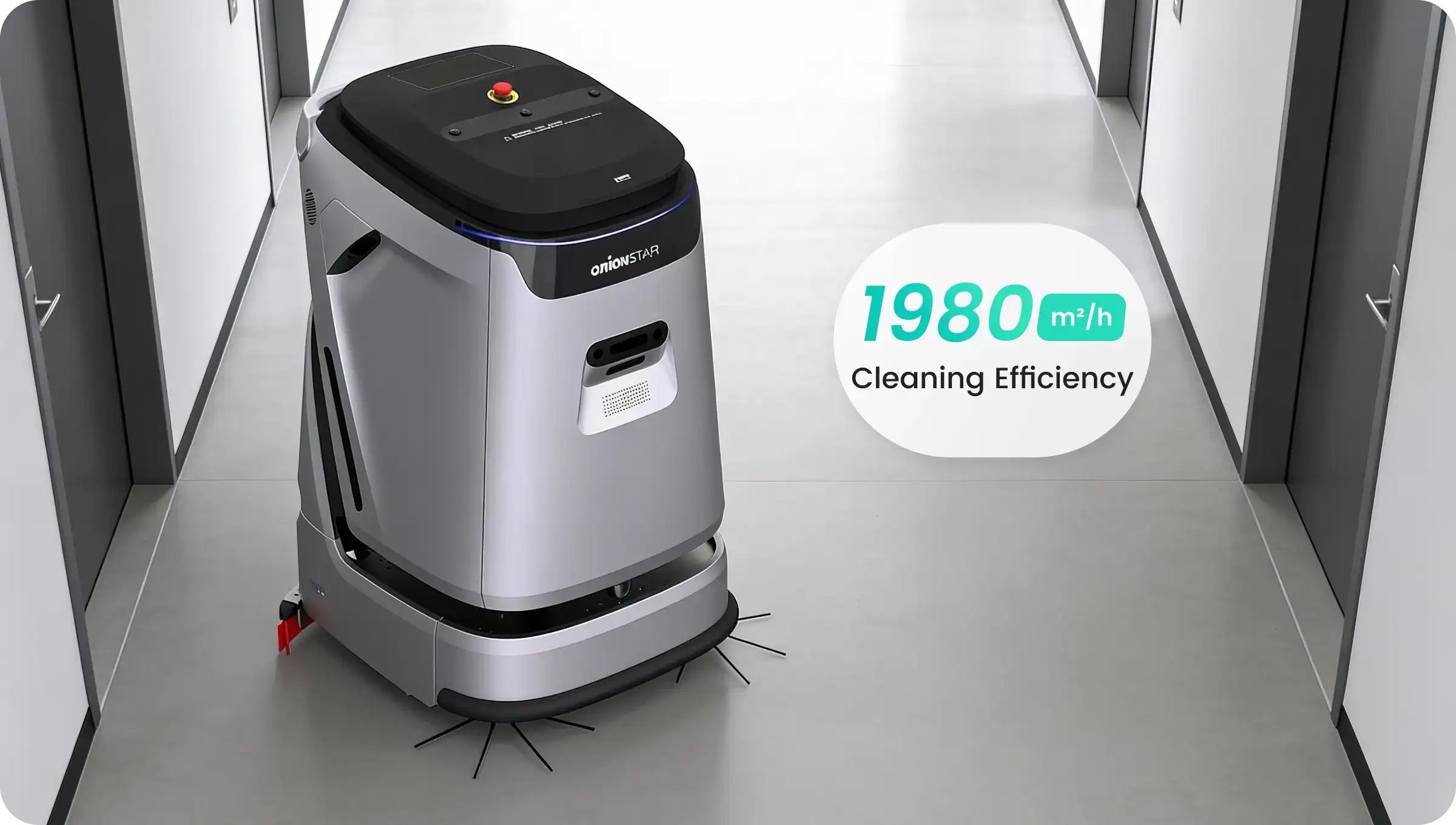
Conversely, the CleaniBot S55 Pro operates as an agile, multi-functional unit for dynamic public zones. It seamlessly handles sweeping, scrubbing, vacuuming, and dust mopping. With noise levels as low as 45 dB in dust mopping mode and a minimum passing width of 700 mm according to manufacturer data, the S55 Pro perfectly navigates narrow corridors, busy lobbies, and tight reception areas without disrupting tenants.
Moreover, both models integrate robust digital management capabilities. They support remote deployment, OTA updates, and cloud-based data reporting via Wi-Fi and 4G connectivity. This allows facility teams to track cleaning routes, monitor water usage, and generate audit-ready session logs. To address privacy and data protection standards, OrionStar robots process environmental and navigation data locally to ensure operational safety. Visual data from onboard sensors is used strictly in real-time for obstacle avoidance and is neither stored nor transmitted. Cloud-based reporting relies solely on anonymized operational metrics. Users are responsible for ensuring fleet deployment complies with local data privacy regulations, including GDPR, ensuring tenant privacy is maintained during operation without storing identifiable personal imagery.
These results are not theoretical projections; they are the reality that facility managers and building operators are already verifying on the ground today.
The true value of automation lies in supporting human workers, not replacing them. The industry consensus is clear: robotics should focus on task automation rather than job automation. Floor cleaning often comprises up to 30 percent of a typical commercial cleaning job. By assigning these massive, repetitive, and manually exhausting tasks to machines, facility management teams fundamentally shift their labor allocation. Humans transition away from pushing heavy scrubbers toward executing high-value work. They can focus on rigorous quality assurance, detailed spot cleaning, and direct customer service.
Furthermore, hybrid cleaning fleets foster the development of new professional skills. Custodial staff step into new, elevated roles as fleet supervisors, monitoring leads, and internal trainers. They learn to interpret analytics, manage smart building integrations, and oversee daily robotic operations. As a result, the workforce grows more motivated, capable, and professional. The introduction of automation directly addresses chronic labor shortages while creating a safer, less physically demanding environment for essential facility personnel.
Commercial cleaning robots are rapidly transitioning from optional upgrades to essential facility management infrastructure. The demands of large commercial buildings are simply too vast and complex for traditional manual methods alone. Going forward, the integration of autonomous systems will define operational excellence, dictating which facilities can maintain high standards while controlling costs. The OrionStar CleaniBot series, with its diverse range of models designed to adapt to specific spatial demands, offers a robust framework for this transition. Facility managers seeking to build hybrid fleets have reliable tools available to explore and align with their unique operational needs. Ultimately, the future of building operations belongs to those who view automation as a fundamental layer of their daily management strategy.