REQUEST DEMO
Resources > Blogs > Optimizing Facility Operations: How Building Management Uses Commercial Cleaning Robots in Commercial Buildings

Optimizing Facility Operations: How Building Management Uses Commercial Cleaning Robots in Commercial Buildings

2026-07-12 22:28 OrionStar

Optimizing Facility Operations: How Building Management Uses Commercial Cleaning Robots in Commercial Buildings

Introduction

Building management teams in commercial buildings today face a complex convergence of operational pressures, including a chronic shortage of entry-level labor, rising costs that account for up to 80% of cleaning budgets, and increasing demands for sustainability compliance. As manual janitorial roles experience turnover rates as high as 75%, property managers are seeking reliable ways to standardize maintenance quality while controlling expenses. Commercial cleaning robots have emerged as a critical solution to these challenges, offering a way to automate repetitive floor care tasks, provide verifiable data for quality assurance, and maintain high-traffic environments with minimal human intervention.

The Growing Need for Smarter Cleaning in Commercial Buildings

  • Chronic labor shortages and an aging workforce are leaving entry-level janitorial roles vacant across the global facilities market.
  • High employee turnover, ranging from 35% to 75% annually, creates continuous recruitment, onboarding, and productivity costs.
  • Significant labor cost pressure exists where loaded hourly rates for cleaners can be 30–42% higher than base wages due to benefits and overhead.
  • Inconsistencies in manual cleaning quality and gaps in documentation hinder the ability of facility managers to meet strict compliance and QA reporting standards.

How Commercial Cleaning Robots Can Help

  • LiDAR navigation allows for precise map construction and localization within complex indoor environments.
  • Autonomous path planning ensures systematic floor coverage, reducing missed spots and redundant cleaning cycles.
  • Multi-sensor obstacle avoidance systems, utilizing ultrasonic and vision sensors, are designed to maximize operational safety around tenants and furniture.
  • Auto-charging and docking capabilities enable robots to manage their own power cycles, supporting 24/7 maintenance workflows.
  • Real-time monitoring and digital reporting provide facility managers with transparent data on coverage, runtime, and cleaning frequency.
  • In accordance with global data protection regulations, such as GDPR, these systems process navigation data without storing identifiable personal imagery, ensuring tenant privacy is maintained during operation.

A Closer Look: OrionStar CleaniBot S55 Pro in Action

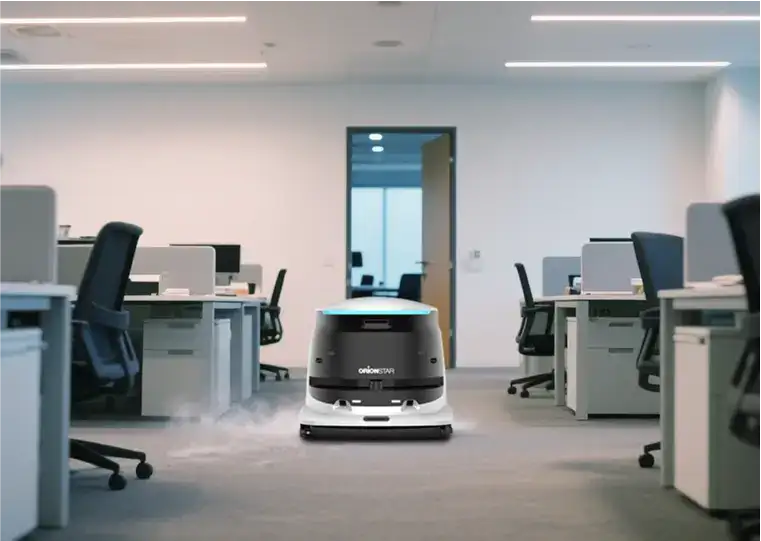
The OrionStar CleaniBot S55 Pro exemplifies these advanced capabilities through its InstantClean Floor Care System, which integrates sweeping, scrubbing, vacuuming, and mopping into a single autonomous platform. According to manufacturer data, the S55 Pro can construct maps for areas up to 10,000 m², making it suitable for the vast footprints of modern commercial complexes. Its operational efficiency is notable, reaching up to 1,368 m²/h in sweep and vacuum modes, and it offers an extended runtime of up to 28 hours in dust mopping mode. These specifications allow the S55 Pro to translate autonomous navigation into practical, large-scale productivity, maintaining a distance of as close as 5 cm from walls to support precision edge-cleaning. Actual performance and efficiency may vary based on specific floor environments and layouts.

Benefits for Building Managers and Property Management Teams

  • Significant Cost Reduction: Autonomous cleaning solutions typically offer an estimated payback period of 9 to 18 months by offsetting the high cost of manual labor; actual financial performance depends on site-specific factors.
  • Improved Labor Allocation: One robot can handle the equivalent of two full-time employees' repetitive floor coverage, allowing human staff to focus on higher-value tasks.
  • Verified Operational Savings: Internal case studies show that autonomous units can generate between $5,000 and $6,000 in monthly labor savings in large-format facilities, though results may vary by region.
  • Consistent Cleaning Quality: Robots minimize the performance variance caused by worker fatigue or absenteeism, reproducing high-quality results shift after shift.
  • Audit-Ready Documentation: Automated session logs provide timestamped evidence of cleaning completion, supporting workflows in environments requiring high hygiene standards, such as healthcare and corporate facilities.
  • Discreet Public Operation: With noise levels as low as 45 dB in dust mopping mode, robots can maintain common areas during business hours without disrupting tenants or visitors.

Real-World Applications

Lobbies

Lobbies serve as the first point of contact for tenants and require constant floor maintenance to remove tracked-in debris. Robots can perform quiet dust mopping or light scrubbing during peak hours, utilizing advanced sensors to navigate through high foot traffic.

Corridors

Long, repetitive corridors are often the most labor-intensive areas to clean manually. Autonomous path planning allows robots to execute precise zigzag patterns over kilometers of hallway, promoting uniform cleanliness and allowing staff to focus on vertical surfaces and restrooms.

Common Spaces

Breakrooms, cafeterias, and shared lounges often have shifting furniture layouts. Robots with real-time map updating and ultrasonic sensors can adapt to these dynamic environments, maintaining floor hygiene between scheduled deep cleans.

Integration with Other Smart Systems

Commercial cleaning robots are increasingly integrated into the broader smart building ecosystem, functioning as mobile IoT nodes. By connecting with Building Management Systems (BMS), robots can align their cleaning schedules with real-time occupancy data, ensuring they operate in zones only when they are vacant to maximize efficiency. Furthermore, the operational telemetry provided by these robots—such as water usage, energy consumption, and area coverage—feeds directly into Computerized Maintenance Management Systems (CMMS). This integration supports a move toward predictive maintenance and provides the traceable, audit-ready data required for modern facility management.

Supporting ESG and Sustainability Goals

  • Resource Conservation: Automated scrubbing systems often use advanced water-management technologies that reduce the volume of chemicals and water required per square meter.
  • Certification Support: The precise data reporting provided by robots helps facilities earn points toward green building certifications such as LEED and BREEAM by documenting efficient resource use.
  • Energy Optimization: Integrated robots can support a building's decarbonization pathway by operating during off-peak energy hours or in coordination with smart lighting and HVAC schedules.
  • Summary: Automation provides the transparency and resource efficiency necessary for building managers to meet global ESG disclosure requirements like GRESB and CSRD.

Closing

The adoption of commercial cleaning robots is fundamentally changing how building management teams maintain large-scale commercial buildings. By addressing the critical challenges of labor scarcity and rising operational costs, these autonomous systems provide a reliable, data-driven approach to facility maintenance. The OrionStar CleaniBot series offers a range of models designed to adapt to various sub-spaces and floor types, ensuring that property managers can find a configuration that fits their specific operational needs and long-term sustainability goals.