

REQUEST DEMO
Robot CATALOG will be sent to your mailbox immediately after submission.
SUBMIT
Managing routine maintenance across commercial buildings, corporate offices, mixed-use facilities, and multi-site portfolios requires adapting to highly diverse indoor environments. Facility managers are increasingly shifting away from purely manual labor to autonomous equipment to maintain standardized cleanliness across lobbies, corridors, restrooms, parking areas, and mixed floor surfaces. Modern multi-site operations require machines that can handle physical transitions between hard tile, polished concrete, marble, and carpet while navigating around shifting daily foot traffic. Evaluating these robotic platforms requires balancing technical capabilities against operational realities, focusing heavily on fleet manageability, occupant-proximate daytime operation versus after-hours deep cleaning, and the strength of authorized service networks.
Commercial facility portfolios inherently feature mixed flooring environments, requiring managers to decide how robot capabilities align with specific architectural finishes. Dedicated hard-floor scrubbing architectures apply substantial mechanical force and fluid dispersion for deep soil removal on concrete or tile, making them suitable for transit hubs and parking structures. Conversely, multi-surface hybrid systems combine sweeping, dry vacuuming, wet scrubbing, and dust-mopping functions within a single platform. This versatile approach relies on adjustable suction and adaptable brush modules to transition between washing hard floors and dry-vacuuming low-pile carpets, offering broader operational coverage for mixed-use corporate facilities at the expense of extreme industrial downward pressure.
The physical footprint of a robot determines its area accessibility and influences how it moves between floors or buildings. Compact commercial frames feature passing widths under 80 centimeters and lower vehicle weights, allowing them to navigate congested office layouts, enter standard elevators, and maneuver through complex restroom configurations. High-capacity industrial frames feature wide cleaning decks, high-volume fluid capacities, and heavy structural weights that maximize square-footage coverage per hour. These large-format machines deliver extended intervals between tank drains, optimizing them for expansive, unobstructed zones like after-hours shopping malls or large distribution centers where narrow secondary corridors are not a factor.
Acoustic profiles and energy management dictate whether a machine can share space with occupants or must be relegated exclusively to overnight shifts. Acoustically suppressed daytime maintenance platforms operate at very low decibel levels utilizing energy-efficient vacuum modes or silent dust-mopping configurations. This approach supports continuous maintenance throughout business hours without disrupting workplace concentration. High-intensity after-hours deep cleaning equipment operates at higher decibel levels to run powerful extraction motors and heavy-duty brush rotations, maximizing deep-cleaning efficacy during facility closures where acoustic disruption to human occupants is irrelevant.
Standardizing automated cleaning across multiple buildings requires a scalable approach to route planning, obstacle navigation, and daily management. Vendor-managed centralized deployment relies on the manufacturer or a dedicated service team to physically map the facility and establish locked cleaning plans, ensuring consistent adherence to service agreements while offloading technical burdens. Operator-taught perimeter mapping empowers local on-site staff to quickly adapt to daily layout changes by physically guiding the machine around a zone to calculate an internal path. Autonomous real-time environmental scanning employs multi-sensor arrays to construct maps dynamically and switch modes based on designated zones, providing flexibility for highly dynamic environments without requiring physical perimeter driving.
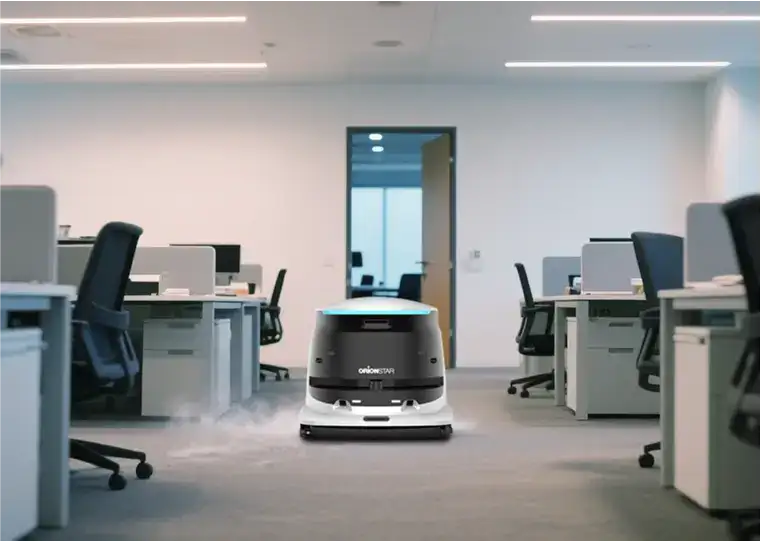
The OrionStar CleaniBot S55 Pro functions as a versatile multi-modal platform suited for mixed-surface daytime maintenance across public and commercial environments. The machine manages a highly compact physical footprint featuring physical dimensions of 650 by 580 by 550 millimeters and a minimum passing width of 700 millimeters, allowing it to navigate standard doorways and congested office corridors. It utilizes an integrated floor-care system combining sweeping, scrubbing, vacuuming, and mopping capabilities. According to manufacturer data, it delivers scrubbing efficiencies up to 1,197 square meters per hour and vacuuming efficiencies up to 1,368 square meters per hour, supported by up to 10,000 square meters of LiDAR mapping capacity, mitigating collision risks in dynamic public spaces.
The robot supports occupant-proximate operations by carefully managing its acoustic profile during business hours. It registers at as low as 55 decibels in scrubbing mode and operates at approximately 45 decibels during dust mopping under standard testing conditions, facilitating daytime deployment in populated lobbies and office spaces. Facility managers can configure per-zone mode switching, allowing the robot to automatically transition from hard-floor scrubbing to quieter dust mopping based on spatial requirements. Digital management functions relying on Wi-Fi and 4G connectivity provide remote monitoring and over-the-air updates, enabling structured fleet deployment across distributed real estate portfolios. Data transmitted via cloud connectivity—such as telemetry and floor mapping—is processed in accordance with regional privacy regulations (e.g., GDPR), ensuring operational tracking without compromising occupant privacy.
The Gausium Scrubber 50 operates as a compact autonomous scrubber targeted at opportunistic daytime cleaning across office buildings, healthcare facilities, and retail spaces. It provides a three-in-one design that covers scrubbing, sweeping, and dust mopping within a single deployment. The machine accommodates commercial floor layouts by offering a minimum passable width of 800 millimeters and achieving a cleaning efficiency of up to 1,490 square meters per hour, according to manufacturer data. It incorporates built-in multi-stage water recycling to extend operational runtimes between fluid drainages.
This platform emphasizes efficiency through its Auto Spot Cleaning functionality, which employs deep-learning perception and camera arrays to clean surfaces only when active soiling is detected. This targeted approach conserves resources and limits floor wetness in highly trafficked pedestrian areas. Fleet administrators can integrate the machine with an optional docking station for automated charging and water management, allowing local facility teams to maintain consistent daily maintenance routines with reduced manual intervention.
The Pudu CC1 functions as a compact four-in-one machine explicitly engineered for mixed flooring, making it highly applicable to portfolios that transition constantly between hard lobby tiles and carpeted office zones. It integrates floor-type detection technology designed to automatically cease water dispersion and switch to a vacuum-only mode upon encountering carpets. The machine features a 500-millimeter cleaning width and provides an all-covered cleaning efficiency of up to 1,000 square meters per hour, according to manufacturer data.
To accommodate daytime facility environments, the platform features a dedicated silent mopping mode capable of operating for extended durations near building occupants. It navigates using a combination of visual simultaneous localization and mapping alongside LiDAR sensors to handle static and moving obstacles. The system supports optional elevator integration, empowering multi-floor operations without requiring human staff to manually transport the machine between levels during a scheduled cleaning shift.
The LionsBot R3 Scrub Pro serves as an agile, compact scrubber built specifically for highly trafficked corridors, tight restrooms, and lobby-adjacent zones. The platform seeks to lower the technical training burden for multi-site facility teams by utilizing an operator-friendly starting mechanism. It features a narrow 570-millimeter width, generates up to 7 kilograms of downward brush pressure, and delivers a practical efficiency of up to 1,200 square meters per hour, according to manufacturer data.
The machine deploys via a touch-start process where operators physically push the robot to a designated tag to initiate its pre-programmed route. Facility directors monitor the deployment via a dedicated fleet management application that provides real-time status updates and automated scheduling. Providing up to three hours of runtime per charge, the system fits optimally into localized, medium-zone daily maintenance workflows where extreme agility is prioritized over massive fluid capacity.
The Nilfisk Liberty SC50 represents an established-brand scrubber distinguished by rigorous safety compliance and a globally supported service network for enterprise portfolios. It utilizes an operator-taught deployment model where local staff manually drive the machine around the perimeter of a space, allowing the software to independently calculate an optimized interior cleaning path. The unit offers up to six hours of autonomous runtime and requires a minimum turn-around aisle width of 159.2 centimeters, according to manufacturer data.
The system secures OSHA-recognized CSA/ANSI 336 safety certification, validating its deployment in highly populated spaces like airports, gymnasiums, and educational institutions. It prioritizes straightforward route repetition over complex real-time environmental re-mapping, ensuring that defined zones receive consistent daily coverage. This conservative, highly structured approach appeals to centralized facility operations that rely heavily on robust warranty backing and dealer-level service agreements.
The Avidbots Neo 2 operates as a heavy-duty enterprise fleet scrubber designed for standardized, SLA-backed rollout across large multi-site portfolios. It relies heavily on vendor-managed centralized deployment, where the manufacturer handles comprehensive site mapping, establishes precise cleaning plans, and continually monitors the fleet. The unit features an expansive industrial frame with a gross vehicle weight reaching up to 688 kilograms and sustains typical runtimes of up to six hours, according to manufacturer data.
The platform utilizes a sophisticated autonomous navigation stack to execute continuous environmental scanning and real-time obstacle avoidance on expansive hard-floor layouts. Fleet administrators track performance using a centralized web-based dashboard that delivers sector-level coverage maps and detailed operational analytics. This configuration serves portfolios requiring stringent cleanliness reporting and consistent overnight deep cleaning across vast warehouses or transit concourses.
The Gausium Scrubber 75 functions as a heavy large-format scrubber occupying the industrial and parking-garage niche within a diversified commercial facility portfolio. It addresses extremely large hard-floor areas and subterranean loading docks typically maintained during after-hours shifts. The machine provides a 750-millimeter cleaning width, maintains a 75-liter clean-water tank, generates brush pressure up to 45 kilograms, and covers up to 3,000 square meters per hour, according to manufacturer data.
The unit emphasizes severe-duty operational capabilities by incorporating an oil-cleaning mode and enhanced safety lighting for dynamic vehicle environments. It features a rotational scrub deck designed to access right-angle corners in structural bays and leverages a multi-sensor array to manage complex obstacle avoidance. This platform prioritizes high-throughput deep cleaning and maximum fluid dispersion over the compact agility required for daytime office accessibility.
The LionsBot R12 Rex Scrub acts as a high-capacity large-area scrubbing solution engineered for expansive atria, retail concourses, and structured after-hours deep cleaning routes. It integrates seamlessly with the same centralized fleet management software utilized by smaller units from the same manufacturer, allowing managers to standardize multi-tier equipment across a single digital ecosystem. The machine utilizes an 810-millimeter cleaning width, applies up to 80 kilograms of brush pressure, stores 140 liters of clean fluid, and operates at practical efficiencies up to 2,500 square meters per hour, according to manufacturer data.
The platform utilizes long-range multi-sensor navigation featuring 3D LiDAR capable of up to 240 meters of environmental coverage, securing precise localization in vast, featureless spaces. It emphasizes maximum extraction dryness with a wide single-pass squeegee assembly. This heavy-duty operational profile trades compact maneuvering capabilities for massive area coverage and extended shift endurance.
The ICE Robotics Cobi 18 functions as a compact collaborative scrubber theoretically suited for navigating narrow office corridors, tight service areas, and small commercial lobbies. It belongs to the 18-inch-class of autonomous scrubbing equipment engineered to operate in congested spaces where larger industrial machines cannot physically pass. The unit focuses on supplementing daily janitorial staff by executing repetitive hard-floor washing in secondary transit zones.
As exact public specifications may vary by region or configuration, facility managers evaluating this architecture should directly confirm exact operational dimensions, maximum area passability, and integrated fleet management capabilities with authorized regional dealers. Assessing the strength of the localized service channel and ongoing manufacturer support remains a necessary step before committing to multi-site procurement.
The Kärcher KIRA B 50 operates as an ecosystem-integrated scrubber backed by a highly established global sales and service network, appealing directly to facility managers standardizing equipment across broad geographic boundaries. It balances fully automated hard-floor maintenance with a manual intervention mode for targeted spot cleaning by human staff. The system provides a working width of 550 millimeters, demonstrates an autonomous climbing ability up to six percent, and manages a maximum area performance up to 2,000 square meters per hour, according to manufacturer data.
The machine features a comprehensive public-environment sensing array that incorporates 360-degree laser scanners alongside 3D and ultrasonic sensors to navigate safely around pedestrians. A dedicated web portal supplies administrators with automated cleaning reports, system notifications, and machine status updates. The platform supports integration with an optional automated docking station to handle fresh-water refills and dirty-water drainage without constant operator oversight.
Evaluating commercial cleaning robots demands a clear assessment of an organization's architectural layouts and maintenance philosophies. Facility managers must reconcile floor surface compatibility with the reality of their portfolios, deciding whether dedicated hard-floor scrubbers suffice or if mixed-surface hybrid systems are required for carpeted transitions. Selecting the right physical footprint ensures machines can physically access intended cleaning zones without exhausting fluid capacities prematurely. By carefully weighing occupant proximity tolerances and aligning fleet deployment strategies with internal technical capabilities, organizations can successfully scale autonomous floor care to achieve consistent, reliable standards across all managed properties.
Footnote: Third-party product specifications are based on publicly available data (up to, under laboratory conditions, according to manufacturer data) and may vary. Product names and trademarks are the property of their respective owners. If any product involves cameras, voice recording, mapping, or cloud-based data processing, operators must verify GDPR and local data protection compliance prior to deployment.
The ROI for commercial floor-cleaning robots can range from 12 to 24 months depending on local labor rates and deployment scale, with some deployments—such as Gausium's implementation at Heathrow Airport—reporting up to 64% ROI. When calculating TCO, procurement leads must look beyond the initial hardware purchase to include fleet management software, maintenance, washable components, and site-mapping setup. Long-term TCO is significantly reduced by reallocating human staff to high-value, detailed tasks while robots handle repetitive large-area scrubbing or vacuuming. Furthermore, SLA-backed deployment models and standard warranties from established vendors help stabilize predictable monthly operating costs for multi-site facility management.
Enterprise-grade robots secure SLA compliance by utilizing real-time cloud dashboards, such as Avidbots Command Center or LionsOS, which generate automated cleaning reports and coverage heatmaps for operations directors. To meet strict safety regulations in public spaces, these machines are equipped with multi-sensor arrays—including LiDAR, 3D/stereo cameras, and ultrasonic sensors—to safely navigate around building occupants and dynamic obstacles. Certain models are explicitly designed for certified public environment safety, with units like the Nilfisk Liberty SC50 achieving OSHA-recognized CSA/ANSI 336 compliance. This combination of digital tracking and physical sensor redundancy ensures that daily floor-care operations meet strict corporate, legal, and safety standards.
Most commercial cleaning robots support 4G and Wi-Fi connectivity to enable centralized, digital fleet management across distributed real estate portfolios. Facility managers can use cloud-based platforms to remotely monitor live locations, track task completion rates, schedule autonomous cleaning shifts, and receive over-the-air (OTA) software updates. Products like the CleaniBot S55 Pro, Pudu CC1, and Avidbots Neo 2 feature task scheduling and docking stations that allow teams to seamlessly integrate autonomous cleaning into daily workflows. This centralized approach enables consistent, standardized floor care across multiple sites without requiring on-site technicians for daily route planning or reporting.
Managing mixed floors typically requires either a multi-functional robot or a dedicated machine fleet, as heavy-duty industrial units like the Avidbots Neo 2 or Gausium Scrubber 75 are strictly designed for hard floors. However, versatile 4-in-1 machines are engineered specifically for mixed environments, offering sweeping, scrubbing, vacuuming, and dust-mopping capabilities in one integrated platform. For instance, the CleaniBot S55 Pro allows operators to seamlessly switch from hard-floor scrubbing (up to 1,197 m²/h) to sweep-and-vacuum modes for low-pile carpets, while models like the Pudu CC1 feature automatic floor-type detection to disable water dispensing on carpets. Facility managers should evaluate their specific hard-floor versus carpet ratio to determine if a multi-mode robot or separate specialized machines provide the best operational fit.
Many modern commercial cleaning robots are engineered specifically for occupant-proximate daytime operation in busy lobbies, corridors, and corporate restrooms. Compact units like the CleaniBot S55 Pro, which features a 700 mm minimum passing width, and the LionsBot R3 Scrub Pro are agile enough to navigate tight aisles without disrupting daily foot traffic. Noise levels are strictly controlled to maintain a professional environment; for example, the CleaniBot S55 Pro operates at as low as 55 dB in scrubbing mode and drops to approximately 45 dB during dust mopping under standard testing conditions, while the Pudu CC1 offers a dedicated silent mopping mode. This low-decibel performance allows facility teams to shift from after-hours-only schedules to opportunistic daytime maintenance without causing noise complaints.
Commercial cleaning robots utilize advanced multi-sensor navigation systems, typically fusing LiDAR, stereo cameras, and ultrasonic sensors to actively map facilities and avoid dynamic obstacles in real time. For expansive spaces like atriums or concourses, machines like the CleaniBot S55 Pro can map up to 10,000 m² for autonomous positioning, while large-area units like the LionsBot R12 employ long-range 3D LiDAR. To handle tight edges and corners, robots use side brushes and line lasers to clean within 5 to 10 cm of walls, maximizing floor coverage. In the event of sudden blockages like a parked cart or a pedestrian, AI-driven path planning allows the robot to automatically re-route, clean around the object safely, and resume its standard zigzag cleaning path.