

REQUEST DEMO
Robot CATALOG will be sent to your mailbox immediately after submission.
SUBMIT
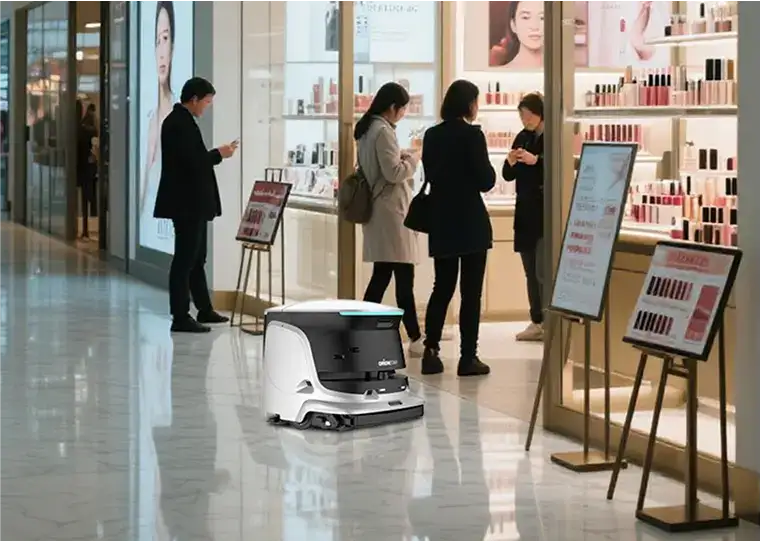
Managing facility hygiene in expansive retail environments presents a unique set of challenges that traditional maintenance methods struggle to meet efficiently. Shopping malls, retail complexes, and large department stores are dynamic ecosystems characterized by high-traffic public walkways, sprawling atriums, and bustling food courts. The flooring landscape in these spaces is rarely uniform, often requiring rapid transitions between polished concrete corridors, marble entryways, tiled dining areas, and carpeted lounge zones. In recent years, the industry has shifted away from semi-autonomous or walk-behind equipment in favor of fully autonomous systems capable of navigating these complex environments independently. Deploying a dedicated shopping mall cleaning robot allows facility managers to optimize labor allocation while maintaining consistently high standards of cleanliness across vast square footage.
When evaluating fully autonomous floor care solutions for retail environments, decision-makers must carefully weigh several operational factors. A primary consideration is the equipment's ability to adapt seamlessly to multiple floor surfaces without requiring manual intervention or brush changes. Furthermore, operations must be divided into daytime and nighttime strategies. Daytime deployment demands low-noise operation to avoid disrupting the shopper experience, alongside advanced obstacle avoidance to navigate unpredictable pedestrian traffic safely. Conversely, nighttime operations focus on restorative, deep cleaning capabilities where scrubbing pressure and large tank capacities take precedence over acoustic considerations. The ability to integrate with smart building systems for multi-floor navigation via elevators also represents a significant operational advantage for modern retail complexes.
The OrionStar CleaniBot S55 Pro emerges as a highly adaptable solution specifically engineered to handle the diverse terrain found in modern retail complexes. Its navigation framework is designed to process dynamic environments, allowing the machine to maneuver safely around temporary promotional kiosks and unpredictable pedestrian movements in busy atriums. The system demonstrates strong versatility across mixed floor surfaces, smoothly transitioning from scrubbing hard tiles in food courts to maintaining polished marble walkways without interrupting its cleaning cycle.
For daytime operations, the CleaniBot S55 Pro operates at a specialized low acoustic signature, ensuring that its presence remains unobtrusive to shoppers and store employees. When deployed after hours, the machine utilizes its robust battery capacity and adjustable downward pressure to execute intensive deep cleaning tasks. Facility managers can rely on its autonomous mapping capabilities to establish distinct daytime spot-cleaning routes and comprehensive nighttime restorative paths, maximizing the utility of the machine across a full twenty-four-hour management cycle, depending on the selected cleaning modes and schedules.
The Gausium Scrubber 50 is widely recognized for its sophisticated environmental perception and AI-driven spot-cleaning capabilities. This machine utilizes advanced camera and sensor arrays to identify specific spills or debris, allowing it to address localized messes in high-risk areas like food courts, allowing it to optimize resources by focusing strictly on areas that require attention. This targeted approach significantly conserves water and battery life, making it highly efficient for continuous daytime deployment amidst heavy foot traffic.
Coupled with an optional specialized workstation, the Scrubber 50 achieves a high level of autonomy by automatically docking to recharge, empty its wastewater, and refill its clean water tanks. This capability makes it an asset for expansive department stores where minimizing manual maintenance intervention is a priority. During nighttime shifts, the robot systematically covers extensive pathways, utilizing its consistent scrubbing mechanisms to lift stubborn dirt from tiled and concrete surfaces across the retail footprint.
Offering a multifunctional approach to floor care, the Pudu CC1 integrates sweeping, scrubbing, vacuuming, and mopping into a single compact unit. This four-in-one capability is particularly advantageous for mixed-use retail complexes where the flooring transitions frequently between hard walkways and carpeted seating or retail zones. The machine intelligently adjusts its cleaning mode based on the surface it detects, designed to halt water deployment on carpets while maintaining strong suction for dust and debris removal.
Its relatively compact dimensions allow the CC1 to navigate tight retail aisles and crowded promotional areas that larger industrial scrubbers might struggle to access. Despite its smaller footprint, it maintains a rigorous cleaning standard and operates with minimal noise, making it highly suitable for daytime deployment. During off-hours, it systematically addresses accumulated grime, proving to be a reliable component of a comprehensive retail facility maintenance strategy.
The LionsBot R3 Scrub Pro combines heavy-duty cleaning mechanisms with an approachable, highly aesthetic design that blends well into premium retail environments. It delivers substantial downward scrubbing pressure, making it highly effective at removing ingrained dirt and scuff marks from high-traffic polished concrete and tiled corridors. The robust build quality ensures durability, while its sensor suite allows it to navigate safely around structural columns, escalators, and shoppers.
Operating well within acceptable noise limits for public spaces, the R3 Scrub Pro can be deployed during regular shopping hours to maintain pristine conditions in entryways and atriums. Its intuitive mobile application interface allows facility staff to monitor its progress and adjust cleaning zones on the fly. When utilized for nighttime restorative cleaning, the machine leverages its efficient water management system to cover substantial square footage before requiring a manual tank service.
Building on a long legacy of industrial floor care, the Nilfisk Liberty SC50 brings robust mechanical reliability into the fully autonomous sphere. It is engineered to handle the vast, open expanses of regional shopping malls, delivering consistent water distribution and scrubbing action across large areas. The machine utilizes a highly reliable mapping system that ensures precise coverage of wide corridors and expansive food courts without missing critical edges or corners.
Safety and consistency are the hallmarks of the Liberty SC50, featuring redundant sensor systems that immediately halt the machine if a shopper steps directly into its path. While it is fully capable of navigating daytime environments safely, its substantial size and powerful scrubbing action make it exceptionally well-suited for rigorous nighttime deep cleaning. Facility operators often rely on this model to restore the shine to marble and polished concrete floors after the heavy foot traffic of a busy retail day has subsided.
Designed specifically for massive floor plans, the Avidbots Neo 2 is a heavy-duty autonomous scrubber tailored for sprawling regional malls and expansive mixed-use complexes. It utilizes an advanced AI platform that continuously updates its environmental maps, allowing it to adapt to overnight layout changes such as seasonal decorations or newly installed retail kiosks. Its wide cleaning path and large solution tanks enable it to clean vast stretches of flooring with exceptional efficiency.
Given its substantial footprint and industrial-grade scrubbing capabilities, the Neo 2 is primarily favored for extensive nighttime operations where deep restorative cleaning is required. It excels at lifting heavy soil from extensive polished concrete and tiled walkways, operating for hours without requiring human intervention. While it features sophisticated obstacle avoidance, its sheer size generally dictates that it is best utilized when shopper foot traffic is minimal or entirely absent.
As a larger counterpart within its product family, the Gausium Scrubber 75 is engineered to tackle the most demanding spatial requirements of major retail destinations. It features an expansive scrubbing width and high-capacity tanks, allowing it to manage thousands of square meters in a single deployment. The machine incorporates front-mounted brush heads that allow it to clean remarkably close to walls and retail storefronts, reducing the need for manual edge mopping.
The Scrubber 75 is equipped with an array of precision sensors, including LIDAR and 3D cameras, facilitating safe navigation through complex, multi-level mall layouts. It is particularly adept at handling the heavy-duty restorative cleaning required during nighttime shifts, applying significant pressure to eradicate stubborn stains in high-volume food courts. Through its integration with automated docking stations, it can sustain prolonged cleaning operations with negligible oversight from facility staff.
The LionsBot R12 Rex Scrub is a heavy-duty autonomous machine built for maximum coverage and high-volume liquid handling in the largest retail complexes. It features a dual-brush system and exceptional downward pressure, designed to restore heavily soiled hard floors to baseline conditions swiftly. The unit's tight turning radius relative to its massive size allows it to navigate wide mall corridors efficiently while sweeping and scrubbing simultaneously.
Because of its significant physical presence and powerful mechanical action, the R12 Rex Scrub is overwhelmingly designated for after-hours facility maintenance. It rapidly processes expansive atriums and long thoroughfares, ensuring that the entire mall is thoroughly deep-cleaned before morning opening hours. The high-definition touchscreen and detailed reporting dashboard provide facility managers with precise data regarding water usage, area covered, and operational efficiency.
The ICE Robotics Cobi 18 provides a highly maneuverable, compact scrubbing solution designed to weave seamlessly through dynamic daytime retail environments. Its small form factor allows it to clean effectively within narrow department store aisles and heavily congested food court seating areas where larger machines cannot operate. The user interface is intentionally simplified, enabling retail staff to deploy the machine for rapid spill response with just a few screen taps.
During daytime operations, the Cobi 18 maintains a low acoustic profile, ensuring that shoppers remain undisturbed while the floors are actively maintained. It utilizes an advanced vision system to navigate around constantly moving pedestrians and shopping carts safely. While it may not possess the tank capacity for entire-mall overnight deep cleaning, it serves as a highly effective daily maintenance tool that complements larger nocturnal scrubbing fleets.
The Kärcher KIRA B 50 transitions renowned German engineering standards into a fully autonomous floor care platform tailored for expansive commercial spaces. It delivers highly consistent cleaning results across mixed hard surfaces, utilizing roller brush technology that effectively captures small debris while simultaneously scrubbing the floor. The machine is supported by a sophisticated docking station that autonomously manages battery charging, fresh water refilling, and wastewater draining.
This autonomous management makes the KIRA B 50 highly viable for extended operations across multi-floor retail environments, provided there is integration with smart elevator systems. It operates quietly enough to be deployed during lower-traffic daytime periods, yet possesses the mechanical rigor necessary for thorough nighttime restorative cleaning. Facility teams appreciate its durable construction and the detailed operational reports it generates, which aid in optimizing long-term cleaning schedules.
Integrating fully autonomous floor care systems represents a significant operational upgrade for modern retail facilities. By understanding the distinct requirements of mixed floor surfaces, daytime noise constraints, and nighttime deep cleaning necessities, facility managers can select the appropriate robotic solutions to maintain their properties. As autonomous technology continues to evolve, these systems will become increasingly integral to ensuring that expansive shopping environments remain pristine, safe, and visually appealing to consumers.
How do autonomous scrubbers handle transitions between carpets and hard floors? Advanced autonomous robots utilize specialized floor detection sensors to identify surface changes in real-time. When transitioning from a hard surface like tile to a carpeted area, multifunctional robots will automatically lift their scrubbing mechanisms and halt water dispensing. They then engage their vacuuming modules to clean the carpeted sections without causing moisture damage. This automated adjustment allows a single machine to map and maintain mixed-use environments without requiring manual intervention or physical boundary markers.
Can these machines operate safely among crowds during daytime shopping hours? Fully autonomous cleaning robots are equipped with complex sensor arrays including LIDAR, 3D depth cameras, and ultrasonic sensors to navigate dynamic environments. These systems continuously scan their surroundings to detect both static obstacles and moving pedestrians, calculating safe bypass routes instantly. If a shopper unexpectedly steps into the machine's path, the robot is programmed to halt immediately to prevent any collision. Additionally, machines intended for daytime use are designed to operate at low decibel levels to ensure the shopping experience remains uninterrupted.
What is the difference between daytime maintenance and nighttime deep cleaning for these robots? Daytime maintenance primarily focuses on spot cleaning, spill response, and maintaining a baseline level of hygiene while safely navigating around heavy foot traffic. During these hours, machines operate on lower power settings to minimize noise and often target specific high-risk zones like food courts. Nighttime deep cleaning takes advantage of empty corridors to utilize maximum scrubbing pressure, higher water flow, and faster travel speeds. This after-hours operation is dedicated to restorative floor care, lifting ingrained dirt and sanitizing vast areas thoroughly.
Disclaimer: Third-party product specifications are based on public data (up to, under laboratory conditions, according to manufacturer data) and may vary. Product names and trademarks belong to their respective owners. If any product involves cameras, voice recording, mapping, or cloud data processing, operators must verify GDPR compliance prior to deployment.
Labor accounts for 60-80% of total facility cleaning costs, and autonomous floor scrubbers are primarily evaluated on how much repetitive floor-care labor they can offset. For daily-use facilities with 50,000+ sq ft of cleanable hard floor — a threshold most regional and super-regional shopping malls exceed — the typical payback period lands around 9 to 18 months, with overnight routes often paying back faster due to shift-premium labor savings. A single robot commonly offsets roughly one full-time equivalent of repetitive floor coverage, while annual operating costs (consumables, wear items, preventive maintenance) typically run $4,000-$7,000 per robot — far below the $40,000-$55,000 loaded annual cost of one full-time cleaner. Buyers should model ROI using loaded labor rates (base wage multiplied by 1.35-1.45 to include taxes, benefits, supervision, and turnover) rather than base wage alone, and should stress-test the model by cutting expected labor savings by 25% to confirm the business case holds under suboptimal conditions. (Source: Sproutmation ROI Guide)
The three common deployment models — capital purchase, equipment lease/financing, and RaaS — differ primarily in cash flow structure and support accountability. A capital purchase delivers the strongest long-term ROI but requires the facility team to own maintenance planning, map updates, and asset lifecycle management. Equipment leasing reduces upfront spend while preserving asset ownership, though service contracts may be separate, fragmenting uptime accountability. RaaS bundles the robot, software, deployment, and preventive maintenance into a single monthly fee (typically $575-$2,300/month depending on robot class and contract term), making it the easiest path for mall operators who lack in-house robotics expertise or who prefer operating-expense budgeting. For multi-location mall portfolios, RaaS or leasing often accelerates internal approval because procurement can compare the monthly cost directly against avoided labor, while a single vendor remains accountable for deployment and uptime.
Three major forces are accelerating adoption in 2026: AI-driven automation, sustainability mandates, and persistent labor challenges. AI-powered cleaning robots now offer real-time debris and spill detection, enabling immediate response in high-traffic mall food courts and retail corridors rather than relying solely on scheduled routes. Sustainability mandates are pushing mall operators to reduce water consumption, chemical usage, and energy waste — several competing robots already feature water recycling filtration systems that reduce freshwater consumption by approximately 80%. Labor challenges remain the strongest driver, as cleaning has high turnover, rising wage pressures, and workforce shortages, making autonomous floor coverage an increasingly strategic rather than optional investment. The global cleaning robot market was valued at approximately $7.2 billion in 2025 and is projected to grow to $53.2 billion by 2033, reflecting broad cross-sector acceleration. (Sources: Grand View Research)
Shopping malls typically feature diverse floor surfaces — polished tile in corridors, carpet in retail areas, and polished concrete in atriums — requiring robots that can adapt cleaning behavior across transitions. The OrionStar CleaniBot S55 Pro addresses this with multiple cleaning modes switchable by zone: scrubbing and power scrubbing for hard floors, ECO vacuum for quiet dust removal, sweep and vacuum for debris including low-pile carpet, and dust mopping for delicate polished surfaces like marble. Competing robots offer similar flexibility: the Pudu CC1 provides a dedicated carpet vacuuming mode with 17,000 Pa suction, the Avidbots Neo 2 features Active Cleaning technology that dynamically adjusts cleaning parameters when floor types change, and the Gausium Scrubber 50 supports disc or roller brush heads for different floor materials. Mall facility managers should verify that the robot supports zone-based mode switching so that different areas can be assigned different cleaning behaviors without manual equipment changes.
Daytime cleaning in occupied shopping malls requires robots quiet enough to avoid disturbing shoppers and retailers, typically meaning noise levels at or below approximately 55-70 dB. The OrionStar CleaniBot S55 Pro operates at 55 dB in scrubbing mode and 45 dB in dust mopping mode, making it among the quietest options available and well-suited for daytime mall operation. The Pudu CC1 lists a working noise level below 70 dB, while the LionsBot R12 Rex Scrub produces approximately 70 dB — acceptable for daytime use but more noticeable in quiet retail corridors. Mall operators prioritizing daytime cleaning should select robots with low-decibel dust mopping or ECO vacuum modes, which typically run quieter than heavy scrubbing modes, and should schedule more intensive power scrubbing for pre-opening or post-closing windows when noise constraints are relaxed.
Most autonomous cleaning robots use a combination of LiDAR, 3D depth cameras, RGB cameras, and ultrasonic sensors for navigation, mapping, and obstacle avoidance — and several models process environmental data via cloud-connected platforms, which may trigger GDPR obligations when deployed in European shopping malls. The OrionStar CleaniBot S55 Pro uses LiDAR, a stereo camera, ultrasonic sensors, and line lasers, with Wi-Fi/4G connectivity supporting cloud-based maintenance, OTA updates, and data reporting; operators should verify whether any camera-derived data is stored or transmitted and ensure compliance with applicable data protection regulations. Robots that use RGB cameras for AI-powered stain detection (such as the Gausium Scrubber 50) or visual SLAM navigation (such as the Pudu CC1) may require additional scrutiny, as image capture in public mall spaces could involve processing of personal data. Mall operators should request data flow documentation from the vendor, confirm whether mapping data is stored locally or transmitted to cloud servers, and conduct a data protection impact assessment before deployment in GDPR-regulated markets.