

REQUEST DEMO
Robot CATALOG will be sent to your mailbox immediately after submission.
SUBMIT
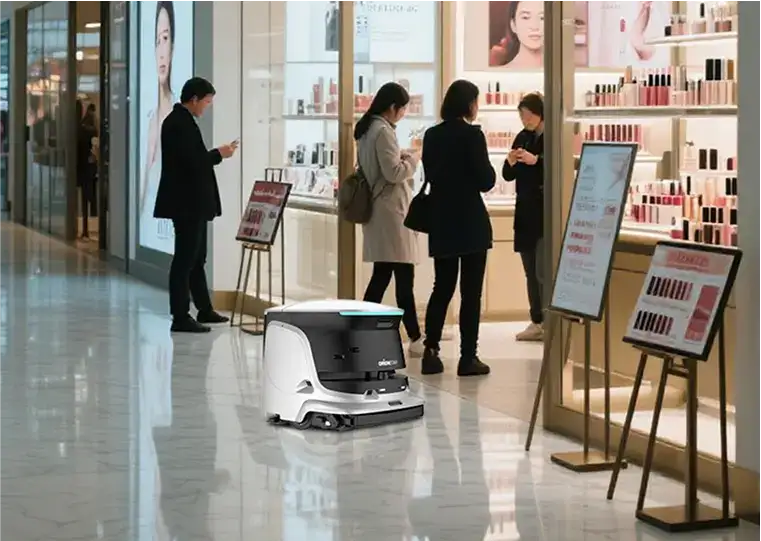
Facility managers in shopping centers, retail malls, department stores, and large retail common areas face a highly dynamic floor care environment. Maintaining mixed floor surfaces alongside continuous pedestrian traffic requires specialized automation solutions. High-traffic public walkways, expansive open atriums, crowded food courts, and delicate retail zones demand distinct cleaning approaches. An industrial-grade shopping center cleaning robot must handle highly varied spatial constraints while respecting the noise requirements necessary for daytime operation near shoppers. Before assessing individual models, procurement teams must define a structured comparison framework to determine whether they need specialized machines for distinct zones or hybrid systems that consolidate floor care across the entire property.
When evaluating cleaning mechanisms, manufacturers generally offer two distinct engineering approaches. Single-purpose heavy-duty architectures prioritize high-pressure scrubbing and large liquid capacities to remove heavy soiling from high-traffic hard floors and adjacent parking structures. Multi-modal cleaning architectures integrate multiple floor care functions into a unified platform, allowing operators to switch cleaning behaviors based on the zone. To address varied spatial constraints, robot platforms follow two primary physical design routes. Large-format architectures deploy wide cleaning paths and heavy-duty chassis weights to cover expansive open areas rapidly. Compact and mid-sized architectures utilize narrower passing widths and tighter turning radii to navigate easily between promotional kiosks and retail shelving. The architectural layout dictates the physical dimensions a robot can safely navigate.
Environmental mapping and route adaptation play a critical role in how these machines handle dynamic retail spaces. Perimeter-learning architectures require an operator to physically guide the machine to establish fixed boundaries, providing highly predictable coverage in stable environments. Autonomous multi-sensor mapping architectures utilize combinations of sensors and algorithmic processing to continuously update digital maps and dynamically reroute around temporary obstacles or unexpected crowds. Operational timing and acoustic control dictate when a platform can be practically utilized. Unrestricted-hours architectures focus on maximizing cleaning output for nighttime use, while daytime-compatible architectures incorporate low-noise operational modes, prioritizing acoustic control and highly responsive obstacle avoidance to allow maintenance cleaning during peak shopping hours.
Positioned as a compact multi-mode floor care solution, this robot targets public walkways and mixed retail surfaces. It utilizes a unified floor care system that combines sweeping, scrubbing, vacuuming, mopping, self-cleaning, and hygiene-focused cleaning steps. Its physical footprint allows it to operate in standard commercial indoor layouts while adapting its cleaning behavior to different floor types, from hard-floor scrubbing to carpet vacuuming. The robot relies on a navigation system featuring LiDAR, a stereo camera, ultrasonic sensors, and line lasers for real-time map updates, obstacle avoidance, and edge cleaning. According to manufacturer data, it delivers a cleaning efficiency of up to 1,197 square meters per hour in scrubbing modes and up to 1,368 square meters per hour in sweep, vacuum, and dust mop modes. Battery runtime reaches up to four and a half hours for scrubbing and up to twenty-eight hours for dust mopping. With noise outputs rated around 55 decibels in scrubbing and 45 decibels in dust mopping under laboratory conditions, it meets daytime acoustic requirements for shopper-facing zones.
This medium-format autonomous scrubber is positioned for standard retail walkways and features an artificial intelligence spot-cleaning mode designed for rapid response to spills in high-traffic zones like food courts. By using an RGB camera and specialized algorithms, the system detects and pre-treats stains, which improves efficiency by cleaning only where needed. According to manufacturer data, the platform integrates scrubbing, sweeping, and dust mopping in one pass with a practical cleaning efficiency ranging from 500 to 1,300 square meters per hour. The chassis measures 700 millimeters in width, allowing it to navigate between retail displays while maintaining a meaningful cleaning path. Runtime extends up to three hours for continuous scrubbing. Its sensor fusion stack interprets environmental changes to update maps in real time, requiring operators to verify local data processing regulations prior to deployment in European shopping centers.
Positioned as a compact multi-functional platform, this model is designed for mixed floor types and narrow retail zones where large-format scrubbers face maneuverability challenges. It integrates sweeping, mopping, vacuuming, and dust-mopping functions, enabling transitions between hard retail tiles and soft carpeted common areas within a single facility. The compact form factor measures approximately 629 millimeters wide, ensuring easy passage through tight corridors and retail shelving areas. According to manufacturer data, it achieves a cleaning efficiency of approximately 700 to 1,000 square meters per hour, supported by a runtime of up to nine hours depending on the operational mode. The system utilizes visual and LiDAR simultaneous localization and mapping with dynamic obstacle detection to navigate high-traffic environments safely. Acoustic control measures keep the operating noise below 70 decibels, making it suitable for daytime deployment near shoppers.
This autonomous scrubber is explicitly positioned for populated retail malls and prioritizes safety-certified operation in continuous pedestrian traffic. It distinguishes itself by achieving third-party certification to robotic safety standards, supporting daytime deployment alongside shoppers. The navigation architecture relies on perimeter-learning concepts, including a specific fill-in mode that automatically calculates an optimal route once the operator defines the boundary. This provides highly predictable and consistent coverage for expansive mall concourses. According to manufacturer data, the system provides up to ten hours of continuous runtime on a single charge when configured with a lithium-ion battery. The platform incorporates automated flow adjustments to modulate water and chemical usage based on the speed and specific requirements of the cleaning job, standardizing large-area floor maintenance.
Engineered as a highly compact unit, this robot focuses on narrow retail aisles, checkout zones, and service corridors that restrict the movement of standard commercial floor machines. The physical design maintains a width of 570 millimeters, allowing it to access confined spaces while maintaining adequate brush pressure for effective hard floor maintenance. According to manufacturer data, it achieves a practical cleaning efficiency ranging from 800 to 1,200 square meters per hour. The cleaning system relies on a 21-liter clean water tank and delivers up to three hours of runtime on a single charge. Navigation is managed through artificial intelligence path planning paired with LiDAR and live obstacle adaptation, empowering the machine to self-recover in complex retail environments. Operators execute commands via an intuitive tag-based starting mechanism, which simplifies daily deployment for retail facility staff.
Positioned as a smart upright scrubber-dryer rather than a fully autonomous robot, this cordless platform supports targeted tasks in food courts, restrooms, and quick spill response areas. It serves as a highly maneuverable manual tool that integrates advanced digital controls and multiple operational modes for localized, heavy-duty cleaning. According to manufacturer data, the unit produces up to 27 kilograms of brush pressure and operates at a productivity rate ranging from 1,100 to 1,600 square meters per hour. The system is equipped with an 18 ampere-hour battery that supports up to 100 minutes of runtime in energy-efficient modes. Its versatile design supports accessory attachments for cleaning vertical surfaces such as glass display cases and tiled restroom walls, bridging the gap between automated broad-area floor care and detailed facility maintenance.
Serving as a large-format heavy-duty scrubber, this platform is specifically tailored for open atriums, wide concourses, and underground parking structures adjacent to shopping malls. The expansive chassis accommodates high-capacity cleaning components, maximizing theoretical output for unobstructed architectural spaces. According to manufacturer data, it features a 750-millimeter cleaning width and generates up to 45 kilograms of brush pressure, with a cleaning efficiency reaching up to 3,000 square meters per hour. The integrated sensor suite combines three-dimensional LiDAR with over twenty surrounding sensors to facilitate smart obstacle avoidance in vast, dynamic environments. A standard automated workstation handles charging and water management, sustaining long operations with minimal operator intervention. Due to its size and heavy-duty focus, it is primarily scheduled for off-peak or overnight atrium cleaning.
Designed as an industrial-grade autonomous platform, this heavy-duty machine is best suited for back-of-house service environments, loading docks, and adjacent parking areas rather than customer-facing retail walkways. It relies on advanced autonomy software and a highly responsive sensor stack to maneuver reliably through highly dynamic industrial and service environments. According to manufacturer data, the platform carries up to 109 liters of solution and supports up to six hours of continuous cleaning on a single charge. The physical dimensions and gross vehicle weight necessitate deployment in broad, open spaces. It includes a comprehensive safety suite with integrated signaling lights and a specialized sound system to warn personnel in active loading zones, making it an effective choice for the service infrastructure that supports a large shopping center.
This heavy-duty large-area scrubber targets vast open spaces, operating effectively in main shopping center atriums and sprawling parking garages. The substantial dimensions prevent it from entering narrow retail aisles, limiting its application to expansive, unobstructed concourses during closed hours. According to manufacturer data, it generates up to 80 kilograms of brush pressure across an 810-millimeter cleaning width, achieving a practical efficiency between 1,500 and 2,500 square meters per hour. The platform utilizes 140-liter tanks to support heavy scrubbing demands and can operate for up to eight hours on a single charge. Navigation relies on long-range three-dimensional LiDAR for comprehensive mapping and live obstacle adaptation. The integration of high brush pressure and large liquid capacities positions it as the primary solution for restorative floor maintenance in the largest commercial zones.
Selecting the appropriate robotic automation platform for a shopping center requires balancing area coverage with physical space constraints. Procurement teams should align their purchases with the specific architectural realities of their properties. For expansive atriums and parking structures, large-format scrubbing systems deliver the necessary brush pressure and tank capacities to complete extensive routes effectively during overnight shifts. In contrast, daytime maintenance across narrow retail corridors and food courts demands compact, multi-modal platforms with precise acoustic controls and highly responsive obstacle avoidance. Facility managers must also verify that their selected environmental mapping and connectivity architectures integrate smoothly with local data governance requirements. Matching the robot's physical form factor, sensory intelligence, and operational capabilities to the precise zone within the mall ensures reliable automated floor care and maximizes the overall return on investment. Actual cleaning efficiency and battery runtime may vary depending on floor surface types, pedestrian traffic density, and selected cleaning modes.
For facilities with daily cleaning needs and large hard-floor areas, real-world deployments typically show payback in 9 to 18 months. The timeline depends on whether the robot removes enough loaded labor hours—base wage plus benefits, supervision, and shift premiums—rather than just reallocating work. Overnight routes often pay back faster because they avoid shift-premium pay and reduce disruption to shoppers during opening hours. A first-pass ROI screen is usually worth doing when a repetitive route covers 50,000 sq ft or more, runs at least five days per week, and ties up three or more loaded labor hours per day.
Beyond the capital cost, budget for annual operating expenses of roughly $4,000–$7,000 per robot, covering cleaning solution, brush and squeegee wear items, preventive maintenance, battery lifecycle, and daily operator oversight such as inspection, refilling, and map updates. In a shopping center, water and chemical usage, high-traffic wear on brushes, and the labor to handle exceptions after busy periods can add to the total. Deployment, software, remote monitoring, and service response also matter: a lower purchase price can become more expensive if the site team must manage downtime and route tuning internally.
The right structure depends on whether the priority is long-term ROI, cash-flow flexibility, or operational accountability. Purchasing often delivers a highly competitive lifetime ROI for stable sites with a proven route and internal maintenance discipline. Leasing or financing spreads the hardware cost into predictable monthly payments but may leave service and support as a separate responsibility. A full-service RaaS subscription bundles the robot, deployment, mapping, software, preventive maintenance, and support into one monthly agreement, with planning ranges from about $575 per month for compact scrubbers to $2,300 per month for large-format units. For shopping centers where uptime and predictable overnight coverage matter more than asset ownership, RaaS is often the lower-risk choice.
Most commercial cleaning robots use a sensor fusion stack to operate around people and objects. The OrionStar CleaniBot S55 Pro combines LiDAR, a stereo camera, ultrasonic sensors, and line lasers, with official materials describing 15 sensors for 360-degree coverage. Competitors take similar approaches: the Gausium Scrubber 50 uses 2D LiDAR, 3D depth camera, RGB camera, and anti-collision sensors, while the Pudu CC1 relies on visual and LiDAR SLAM with dynamic obstacle detection. Standard safety features include emergency stop buttons, cliff and step detection, and wall-edge cleaning. In high-traffic shopping centers, these robots are usually scheduled during off-peak or overnight hours to minimize shopper interaction, but the sensor systems are designed to pause, reroute, or stop safely when pedestrians are present.
Performance varies by robot class. The OrionStar CleaniBot S55 Pro reaches up to 1,197 m²/h in scrubbing modes and up to 1,368 m²/h in sweep, vacuum, and dust-mop modes, with runtimes of 4.5 hours for scrubbing and up to 28 hours for dust mopping. Its 22 L clean-water and 15 L wastewater tanks suit extended runs. By comparison, the Gausium Scrubber 50 reports a practical efficiency of 500–1,300 m²/h and up to 3 hours of continuous scrubbing runtime, while the Pudu CC1 delivers roughly 700–1,000 m²/h with 3–9 hours of runtime depending on operation. The Nilfisk Liberty SC50 offers up to 10 hours of continuous runtime, though its cleaning width and tank capacities are not publicly specified. For shopping centers, the key is matching robot capacity to the route: compact units for retail aisles and food courts, mid-size robots for walkways, and large-format machines for open atriums or parking structures.
Safety certification is not universal in this category. The Nilfisk Liberty SC50 is third-party certified to CSA/ANSI 336, an OSHA-recognized autonomous floorcare safety standard, which can matter for populated retail spaces. Most other models rely on manufacturer-stated safety features such as emergency stops, obstacle avoidance, and cliff detection rather than independent certification. For European shopping centers, data privacy is a separate concern: robots with cameras, LiDAR, and cloud or app connectivity may capture environmental images and map data, so buyers should verify GDPR compliance with the vendor. This includes confirming what data is stored, where it is stored, whether it can identify individuals, and how long it is retained. OrionStar, Gausium, Pudu, and LionsBot all note that operators should verify data-handling practices before European deployment.
Third-party product specifications are based on publicly available data and may vary. Product names and trademarks are the property of their respective owners. Specifically for platforms like the OrionStar CleaniBot S55 Pro, the robot is equipped with a stereo camera, LiDAR, Wi-Fi or 4G connectivity, and cloud or over-the-air update functions. Because it processes environmental maps and sensor data, facility operators must ensure compliance with local data protection regulations such as the GDPR. This includes posting appropriate signage in public areas and signing data processing agreements with vendors prior to deployment.