

REQUEST DEMO
Robot CATALOG will be sent to your mailbox immediately after submission.
SUBMIT
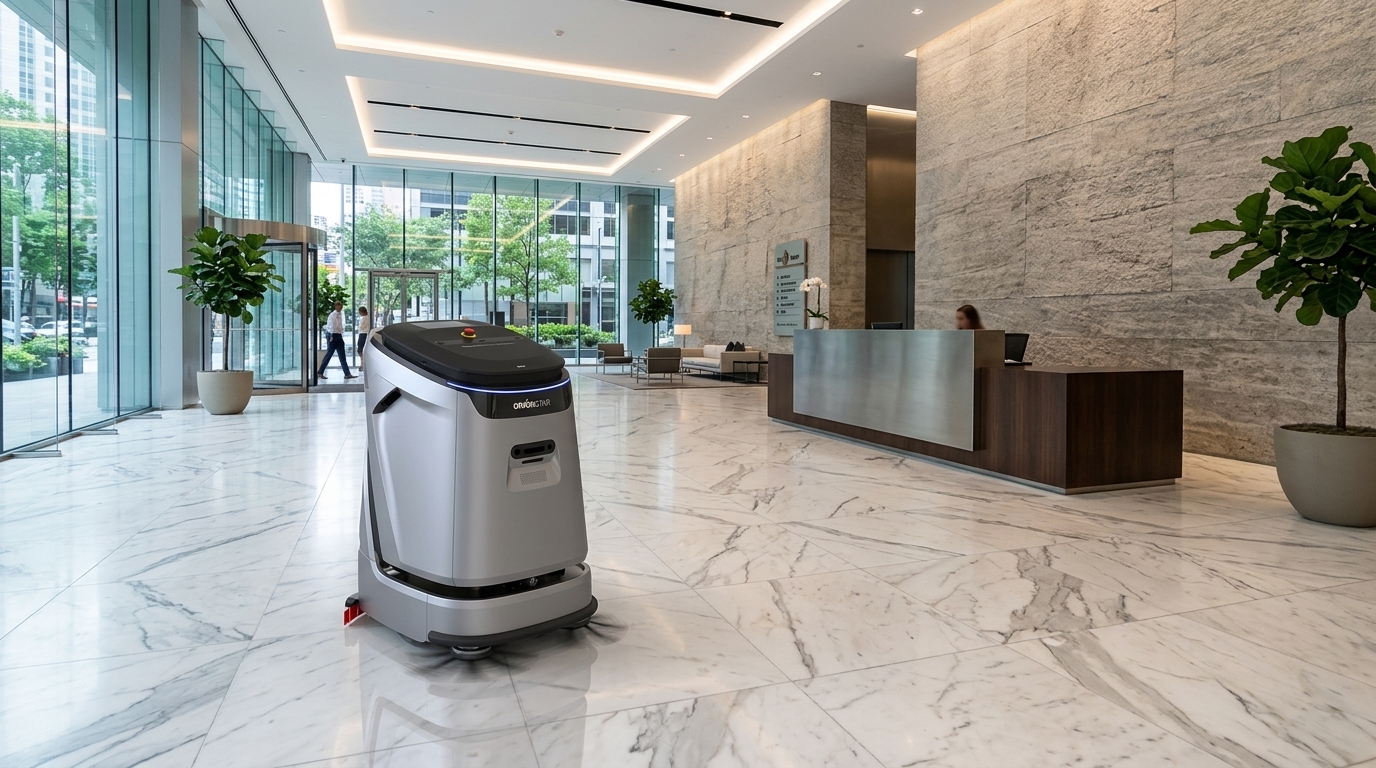
Evaluate our OrionStar CleaniBot C5 on repeated accepted floor results, staff interventions and the complete service cycle. Its 550mm main width and separate 45L tanks describe the setup to document; its theoretical maximum is not your trial result.
A useful evaluation begins by defining the work, not by asking which robot is suitable. “Commercial use” can mean a wide open retail floor, a hospital corridor, a warehouse aisle, a school cafeteria, or an office lobby. Those environments can differ in floor condition, debris type, pedestrian traffic, furniture movement, access hours, and acceptable cleaning outcomes.
Write a short operating brief before any demonstration. Identify the routes that matter, the surfaces to be cleaned, the normal level and type of soil, the hours when cleaning can occur, and the staff member who would intervene if the robot needs help. This prevents a polished demonstration on an easy route from becoming the basis for a decision about a much harder one.
Define success in observable terms. For example, a route may need to be completed within its available operating window, leave the floor at the agreed visual standard, avoid creating avoidable work for nearby staff, and require no more intervention than your team can realistically provide. The point is not to demand perfection; it is to establish what acceptable daily operation looks like at your site.
A fair trial compares like with like. If one run occurs on a freshly prepared floor with clear access and another occurs after normal foot traffic, the difference may reflect the environment rather than the machine. Control does not mean making conditions artificial. It means documenting the conditions that influence the result so that repeated runs can be interpreted sensibly.
Use the same route boundaries, cleaning window, starting floor condition, and acceptance check whenever practical. If conditions cannot be held constant, record what changed: a spill, an unusually busy shift, delivery activity, moved furniture, weather-related tracked-in dirt, or a different floor preparation routine. Those notes make the evidence more useful than an isolated pass-or-fail impression.
Also avoid comparing different cleaning approaches without saying so. A robot performing routine maintenance cleaning should not be judged against the outcome expected from a separate intensive restoration task. Decide what work is being tested, then compare observed results with the standard that applies to that work.
| Trial variable | How to keep it comparable | What to record |
|---|---|---|
| Route | Use the same start, finish, turns, access points, and route boundaries across repeated runs. | Route changes, blocked areas, door conditions, and floor transitions. |
| Soil condition | Test under normal operating conditions when possible; avoid selecting only unusually clean areas. | Visible debris, tracked-in soil, spills, and whether pre-cleaning occurred. |
| Operating window | Run during a defined time period that reflects expected use. | Start and finish time, traffic level, and interruptions. |
| Cleaning standard | Use the same visual or operational acceptance criteria for each run. | Remaining soil, missed sections, streaking, edge results, and any follow-up work. |
| Human involvement | Assign the same supervision expectation where possible. | Who intervened, why, how long it took, and whether the intervention would be practical daily. |
A route that appears to finish successfully may still require a level of human involvement that changes its value for the facility. Record every intervention during the trial, including setup help, route recovery, obstacle clearing, refilling, emptying, cleaning checks, and manual follow-up. Do not treat these as minor exceptions; they are part of the operating model.
For each intervention, note the trigger, the responsible person, the elapsed time, and whether the same situation is likely to recur. A one-time adjustment during initial setup is different from a repeated need to move objects, reopen access, clean a component, or restart a route. This distinction helps the team estimate routine workload without inventing savings or performance assumptions.
Ask staff to capture observations in plain language. “Stopped near stock cart; operator moved cart and resumed” is more useful than “minor issue.” Short, consistent notes reveal patterns across runs and prevent a final decision from depending on memory or a vendor-led recap.
Product information can help you build a shortlist, but it should not replace site observation. Translate each capability statement into a practical question. If a model supports a task, ask whether it performs that task to your required standard on your routes, surfaces, soil conditions, and operating schedule. A capability is a reason to test, not proof of a site outcome.
Document CleaniBot C5’s 550mm main cleaning width and 45L clean/45L wastewater tank setup in the trial record. Hold route boundaries and pass overlap steady, and record starting water state, service returns and accepted cleaning result so repeat runs can be interpreted. C5 is worth trialling when recurring scrub coverage and a defined water-service loop are the work being evaluated. These inputs help distinguish a machine result from a change in pass overlap or preparation, so a fair shortlist is based on comparable cleaning outcomes, not an easier starting condition.
With a suitable configured workstation, C5 supports automatic charging, clean-water refill, wastewater discharge, and wastewater-tank self-cleaning. Treat that as a configuration question: identify the proposed workstation arrangement, confirm where water and wastewater handling would occur, and observe the required staff tasks. These supported functions do not mean that routine maintenance disappears.
OrionStar CleaniBot S55 Pro is positioned as a compact commercial cleaning robot and supports six cleaning modes. Consider CleaniBot S55 Pro when compact positioning and mode flexibility appear relevant to the areas you want to test, then check the actual surfaces, route geometry, cleaning results, and daily handling needs. Six modes alone do not establish compatibility with every floor or every cleaning requirement.
| Public information | Decision question to ask | Evidence to collect during the trial |
|---|---|---|
| C5 is positioned as a large-capacity scrubber for large commercial settings. | Do the site’s floor area, routes, and operating pattern make that positioning relevant? | Observed route completion, cleaning quality, access constraints, and staff handling needs. |
| C5 supports scrubbing, vacuuming, sweeping, dust mopping, and wastewater recovery. | Which supported task is needed on each selected route, and does the result meet the defined standard? | Before-and-after observations, remaining soil, and manual follow-up required. |
| A suitable configured C5 workstation supports charging, water refill, wastewater discharge, and wastewater-tank self-cleaning. | Can the proposed setup be accommodated and operated as intended at this location? | Observed configuration, water and wastewater workflow, and routine staff actions. |
| S55 Pro is compact and supports six cleaning modes. | Does the selected route and surface mix make those characteristics useful in practice? | Route observations, surface results, mode used, and intervention notes. |
Demos are useful for learning how a robot is intended to operate, but they are not automatically comparable. One supplier may show a carefully staged route, while another may be asked to work around active traffic, variable soil, or unusual floor conditions. Normalize the request so each candidate faces the same facility questions.
Provide the same route map, cleaning window, representative floor conditions, and acceptance criteria to every candidate. Ask each presenter to explain what preparation is required, what happens when the route changes, and what staff must do after completion. If a condition is excluded from the demonstration, note it rather than silently assuming it will work in daily use.
Keep the evaluation team consistent as well. The same facilities representative and cleaning lead should score the key outcomes where possible. This reduces the chance that different observers apply different standards to different demonstrations.
CleaniBot C5’s manual describes a theoretical maximum cleaning efficiency of 1980m²/h. Keep it in the product-information column, not the observed-outcome score: use accepted route area and elapsed full-cycle time from the trial for the site decision. A candidate earns an operational place by repeatedly finishing accepted work with sustainable staff effort. A high theoretical rating cannot rescue a trial that misses priority segments or depends on interventions the shift cannot support. The published test conditions are not supplied, so the rating cannot be treated as a comparable measured site result.
You can weight categories differently by site. A public venue may prioritize route reliability around people, while a back-of-house operation may prioritize cleaning window fit and the practical work required from the cleaning team. The matrix is not a universal ranking tool; it is a way to make your own priorities visible.
| Evaluation area | Question | Record for each candidate |
|---|---|---|
| Cleaning outcome | Did the route meet the agreed cleaning standard? | Observed result, missed areas, residue, and manual follow-up. |
| Route fit | Could it operate through the selected route under representative conditions? | Blocked points, turns, transitions, access issues, and route changes. |
| Interventions | How often did staff need to step in? | Trigger, resolution, time involved, and recurrence. |
| Daily workflow | What preparation and post-run work is required? | Staff tasks, supplies or handling steps, and handoff requirements. |
| Configuration fit | What site setup is needed for the proposed arrangement? | Space, utility, workflow, and operating questions still open. |
| Repeatability | Did results remain consistent across comparable runs? | Run-by-run notes and conditions that affected outcomes. |
At the end of a trial, separate findings into three groups: observed strengths, observed limitations, and unanswered questions. This format is more useful than a single overall score because it shows whether a limitation is manageable, whether it conflicts with the intended workflow, or whether another trial condition is needed.
Avoid turning a short trial into a broad promise about every site condition. A robot may perform well on the tested routes while still needing further observation around seasonal soil, changing layouts, peak traffic, or different surface conditions. Conversely, one interruption should be investigated in context before it becomes a reason to reject a candidate.
The final choice should be tied to the work you actually expect the robot to do. If the evidence shows that the candidate meets the defined standard on representative routes with an intervention level your team can support, you have a practical basis for moving forward. If the evidence is incomplete, keep the open questions attached to the decision rather than filling gaps with assumptions.
Bring a basic site profile to the conversation: floor types, target routes, approximate cleaning windows, normal traffic patterns, soil conditions, available space, current cleaning workflow, and the staff roles that would support daily operation. Include photographs or route sketches if they help explain constraints, but keep the discussion centered on representative work rather than ideal conditions.
Ask which cleaning tasks are supported by the proposed model, what configuration is included in the discussion, what staff actions remain necessary, and which site conditions should be demonstrated. For CleaniBot C5, ask whether a workstation is part of the proposed setup and, if so, how the clean-water refill, wastewater discharge, charging, and wastewater-tank self-cleaning functions would be configured for the location. Ask which water-service alternatives are available for the exact quoted configuration and how filling, wastewater handling and daily inspection would work. Availability and inclusion need confirmation in the proposal.
Also ask to run your chosen routes more than once, record interventions, and review the results against your acceptance criteria. Those questions turn a product conversation into an evidence-based evaluation without assuming that any model is automatically right for every facility.
A fair trial uses representative routes and holds the important conditions as consistent as practical: route boundaries, operating window, starting floor condition, cleaning standard, and observation method. When conditions change, record the change so results are interpreted in context rather than compared as if they were identical.
Run enough comparable cycles to see whether the result repeats and to expose normal variation such as traffic, moved objects, and changing soil. There is no universal number that fits every facility. The useful stopping point is when the team can distinguish recurring patterns from one-off events and can clearly identify remaining unanswered questions.
No. Cleaning quality is essential, but it is only one part of daily fit. Compare route completion, staff interventions, preparation, post-run work, configuration needs, and repeatability. A strong-looking floor result may be less useful if it depends on a workflow your team cannot realistically sustain.
Consider C5 when you are evaluating a large commercial setting and need to test a candidate that supports scrubbing, vacuuming, sweeping, dust mopping, and wastewater recovery. Confirm the fit on your own routes and workflow. If a suitable configured workstation is proposed, ask to observe the related charging, clean-water refill, wastewater discharge, and wastewater-tank self-cleaning workflow as part of the evaluation.
No. CleaniBot S55 Pro supports six cleaning modes, but a mode count does not establish suitability for every surface, route, or soil condition. Evaluate the specific floor areas you intend to clean and document the observed results under representative operating conditions.