

REQUEST DEMO
Robot CATALOG will be sent to your mailbox immediately after submission.
SUBMIT
The field of Building Management in commercial buildings is currently facing a significant convergence of operational challenges, characterized by severe labor shortages, escalating wage compression, and increasingly strict regulatory compliance requirements. As the gap between high cleanliness standards and available human capacity widens, facility operators are seeking capital-intensive yet sustainable alternatives to maintain service quality. In response to these pressing pressures, commercial cleaning robots have emerged as a highly effective, data-driven solution to bridge the workforce gap, optimize operational costs, and ensure consistent facility maintenance.
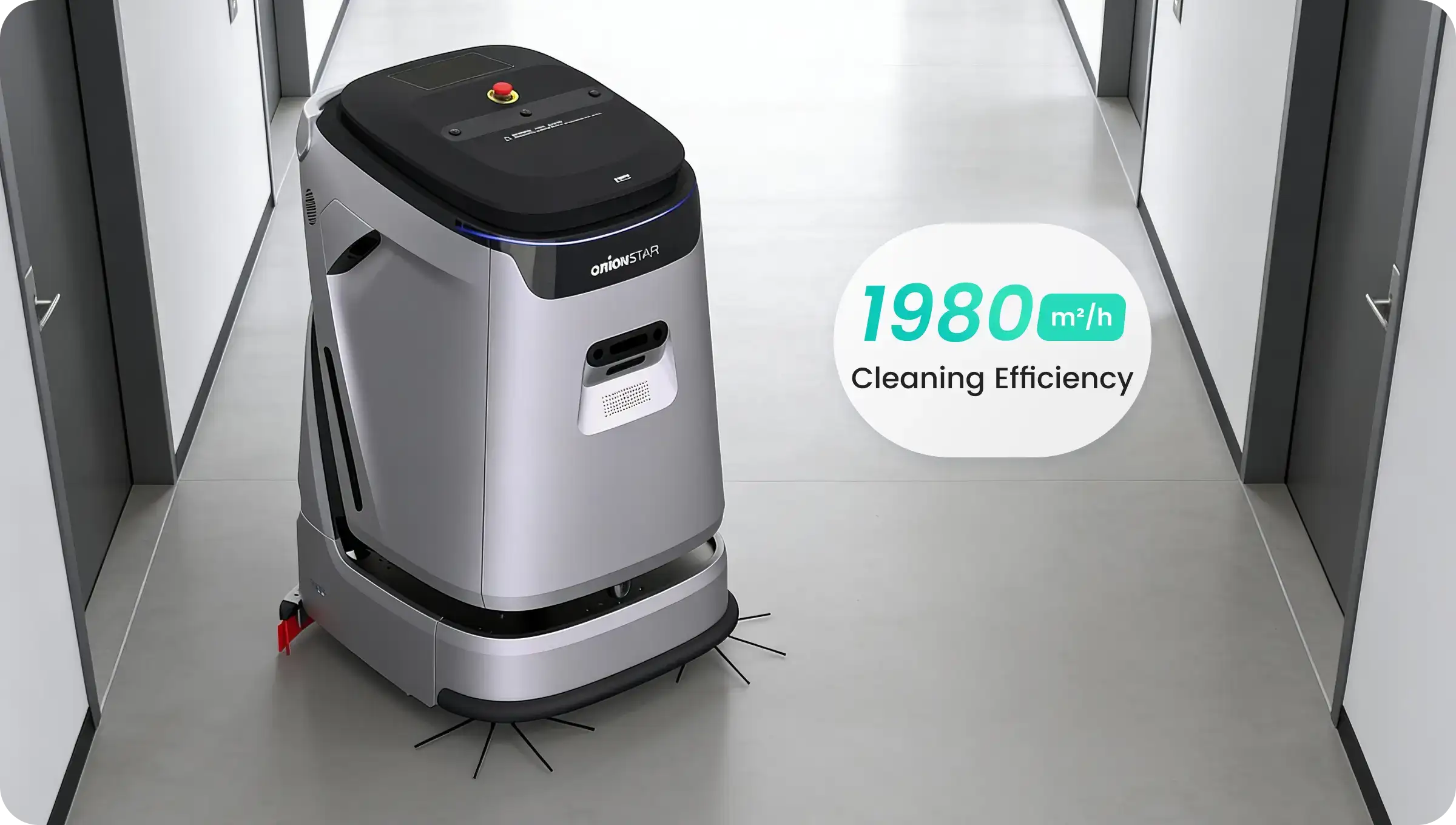
Illustrating how these general autonomous capabilities function in a real-world setting, the OrionStar CleaniBot C5 operates as an industrial-grade autonomous floor-scrubbing system designed to navigate and maintain expansive areas. According to manufacturer data, it can process a maximum cleaning area capacity of up to 1,980 square meters per hour, supported by a combined 90-liter water tank system that minimizes manual refilling downtime. The unit also features an automatic docking station for self-cleaning and auto-charging, while executing tasks at a noise level of less than 68 dB(A), allowing it to integrate seamlessly into active public environments without causing excessive acoustic disturbance.
These high-traffic entry points present constant challenges with dirt tracking and require consistently high standards of appearances to maintain building prestige. Autonomous robots can be programmed to run continuous aesthetic maintenance loops during peak hours, using their obstacle avoidance technology to seamlessly navigate around visitors and baggage.
Long, expansive hallways often consume a disproportionate amount of manual labor time and are prone to inconsistent cleaning quality. Robotic systems excel in these linear environments by executing precise, edge-to-edge path planning that ensures precise overlapping passes without the fatigue associated with human operators.
Subterranean and enclosed parking facilities accumulate heavy oil stains, tire marks, and industrial grime that standard mops cannot effectively remove. Industrial-grade cleaning robots apply consistent downward scrubbing pressure to lift stubborn debris, while auto-discharging waste water at designated docking stations to handle the high volume of dirt.
Break rooms, cafeterias, and shared gathering areas feature dynamic layouts where chairs, tables, and foot traffic constantly shift. Advanced mapping allows the robots to adapt their routes in real-time, maneuvering safely through temporary bottlenecks while thoroughly cleaning and scrubbing floors during off-peak hours.
Modern commercial cleaning robots function as vital nodes within broader smart building ecosystems by pushing validated data packets over facility Wi-Fi directly to Computerized Maintenance Management Systems (CMMS) or Building Management Systems (BMS). Each automated cleaning cycle generates actionable data—including zone coordinates, timestamps, and consumable statuses—which the CMMS analyzes against baseline thresholds to automatically trigger work orders or preventive maintenance alerts. Furthermore, advanced deployments can integrate these robotic fleets with elevator control software and IoT sensor networks, allowing the machines to navigate across different floors autonomously and adjust their cleaning schedules based on real-time building occupancy data.
Commercial cleaning robots are fundamentally changing the way Building Management maintains commercial buildings by addressing severe labor shortages, standardizing cleanliness, and providing verifiable data for compliance. As facilities continue to evolve into interconnected, sustainable ecosystems, these autonomous machines bridge the critical gap between operational efficiency and elevated environmental standards. For those looking to implement scalable solutions across varying facility sizes, the OrionStar CleaniBot series offers multiple models designed to adapt to diverse spatial requirements and structural complexities.