

REQUEST DEMO
Robot CATALOG will be sent to your mailbox immediately after submission.
SUBMIT
Supercenters, hypermarkets, and grocery-anchored big-box stores present demanding operational environments characterized by wide aisles, high foot traffic, extended operating hours, and mixed hard flooring. Managing these sprawling facilities requires continuous floor maintenance that minimizes disruptions to ongoing retail operations. Facility managers face the dual challenge of addressing embedded grime in backroom logistics areas and responding to sticky food spills in customer-facing grocery aisles, all while attempting to optimize constrained labor resources. As these large-format venues increasingly transition to automated maintenance solutions, selecting the appropriate robotic fleet demands careful evaluation of machine endurance, heavy-duty floor conditioning, safety compliance, and spatial adaptability around retail displays.
To determine an optimized deployment strategy, retail operations managers must evaluate robotic solutions across several core dimensions. The first critical factor is operational autonomy and continuous coverage. Supercenters require extensive square footage to be cleaned within extended operating windows, often spanning multiple shifts. Managing water refills, tank maintenance, and battery charges can consume significant labor hours, making the robot's degree of autonomy a primary procurement consideration. Retail buyers typically choose between high-capacity standalone platforms that utilize massive onboard water tanks frequently exceeding one hundred liters to sustain continuous cleaning, and workstation-enabled continuous cycling systems. The latter pairs moderate onboard tank capacities with fully automated docking stations that independently execute water draining, high-pressure internal tank rinsing, clean water refilling, and battery recharging.
The second evaluation dimension involves floor conditioning and debris management. The mixed environments of hypermarkets present varied floor challenges, ranging from liquid spills in food aisles to forklift tire marks and scattered packaging debris in logistics backrooms. Operations teams typically deploy machines utilizing heavy-duty down pressure, often reaching eighty kilograms or more, to target embedded grime and warehouse marks. Alternatively, they employ multi-phase systems applying moderate pressure of roughly fifteen to thirty kilograms to simultaneously sweep small retail debris, scrub stubborn dirt, and absorb wastewater in a single automated pass. Furthermore, integrating artificial intelligence-targeted spot cleaning allows vision sensors to actively identify distinct spills and automatically transition to high-intensity local scrubbing, thereby conserving water resources over a long shift.
Dynamic navigation and spatial adaptability form the third critical pillar of the comparison framework. Retail spaces are highly dynamic environments where aisles are frequently reconfigured with seasonal displays, pallets are temporarily staged during restocking, and shoppers navigate the store unpredictably. Facilities may execute learn-and-repeat route mapping for high coverage repeatability or leverage vision-assisted dynamic routing to actively calculate real-time optimal paths bypassing unexpected obstacles. Because modern platforms rely on advanced sensing to maneuver through these spaces, operators evaluating systems that utilize cameras, deep learning, or cloud-based map processing for navigation must verify compliance with GDPR and other local data protection regulations prior to deployment.
The final dimension is the physical fleet footprint and multi-zone access. While the main circulatory aisles of a supercenter are wide and accommodating, areas like checkout lanes, employee corridors, and dedicated food courts present narrow clearances. Organizations balance this by deploying consolidated large-footprint platforms for massive open zones, utilizing mid-sized agile platforms with passing widths between eight hundred and nine hundred millimeters that autonomously navigate typical grocery aisles, or adopting compact and assistive form factors specifically targeted at congested zones and immediate daytime spill response.
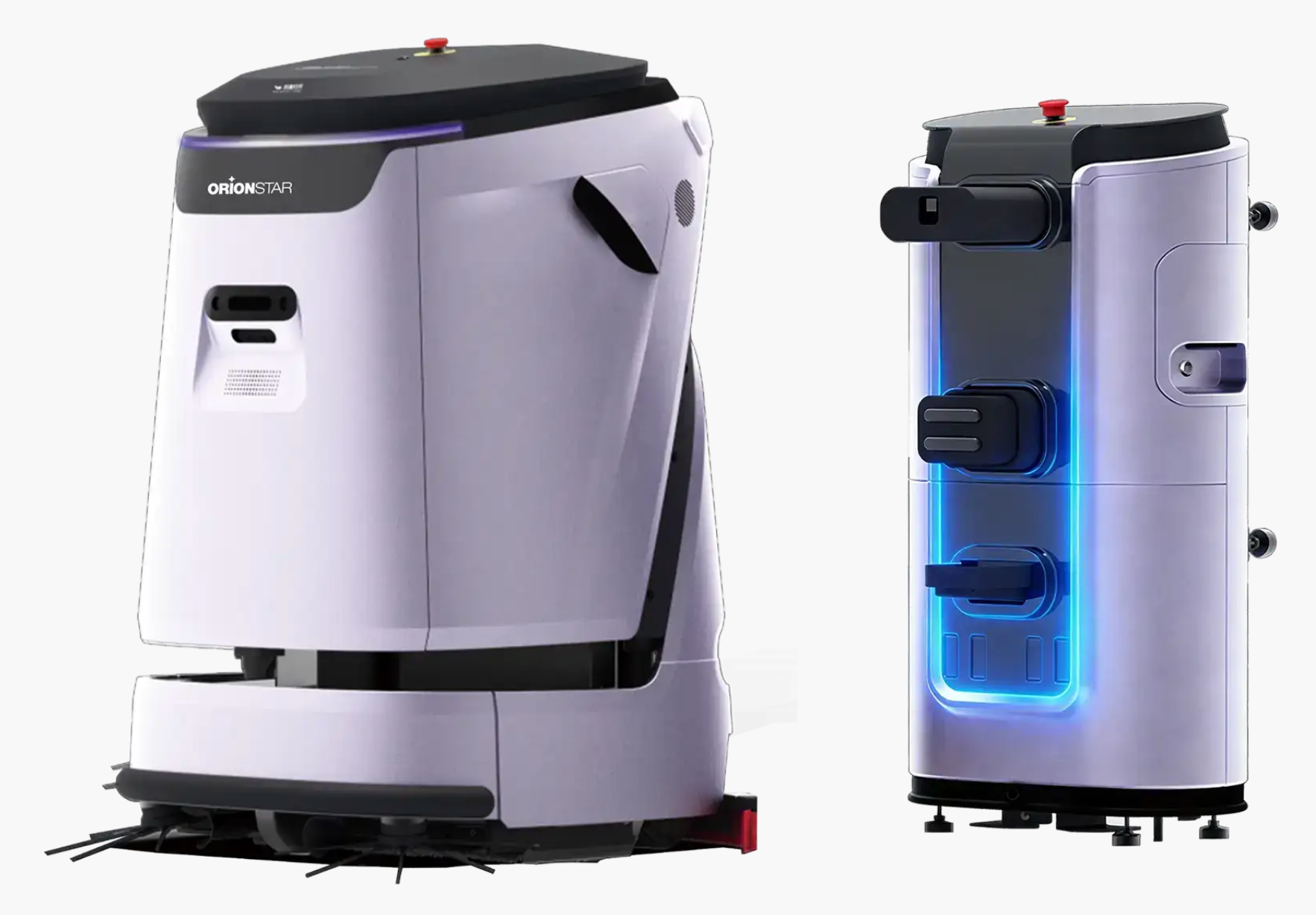
The OrionStar CleaniBot C5 operates as a heavy-duty autonomous scrubber highly suited for the sprawling floor plans and multi-shift requirements of supercenters and hypermarkets. Its capability to handle high-traffic public spaces and logistics areas makes it highly relevant for large retail floors mixing customer-facing zones with backroom storage. Under laboratory conditions, the machine utilizes a dual-rolling-brush system applying up to 25 kg of downward pressure to execute scrubbing, dust-mopping, and water absorption simultaneously. The robot relies on a combined 90 L water tank capacity and is engineered to dock autonomously at an optional workstation, which manages clean-water refilling, waste-water discharge, and high-pressure internal tank rinsing. According to manufacturer data, it achieves a theoretical coverage of up to 1,980 square meters per hour depending on floor layout and obstacle density, and offers a scrubbing runtime of roughly 3 hours. Navigating via a smart obstacle-avoidance system, it operates with a minimal passing width of approximately 880 mm.
The Tennant T7AMR functions as a ride-on robotic floor scrubber tailored for wide-aisle supercenters requiring extended cleaning runs without frequent manual intervention. Its extensive deployment history in major grocery and big-box store environments highlights its integration into high-volume retail operations. According to manufacturer data, the unit delivers heavy-duty floor conditioning by applying up to 86 kg of main down pressure through a disk scrub head with a 650 mm cleaning path. To support all-night or extended-hour retail cleaning, it houses a 110 L solution tank and a 129 L recovery tank, yielding an estimated runtime of up to 6.5 hours under optimal operational settings when equipped with high-capacity lithium-ion batteries. The robot is powered by the BrainOS artificial intelligence navigation platform, which supports learn-and-repeat operations and automatic braking to manage the variable obstacles found in shopping environments.
The Avidbots Neo 2W operates as a highly robust autonomous scrubber designed primarily for industrial usage but deeply capable in warehouse-scale retail backrooms and expansive sales floors. Its heavy-duty construction handles the mixed environments of grocery-anchored stores facing high volumes of restocking traffic and temporary pallet placements. According to manufacturer data, the platform carries 109 L of solution and 135 L of recovery water, supporting up to 6 hours of continuous operation on a single charge. The navigation architecture relies on computer vision and deep learning to execute dynamic route planning and real-time obstacle avoidance. This system utilizes a dedicated bulk navigator to frequently update maps, dynamically rerouting around temporary displays or forklift tines commonly encountered in large-format operations.
The Nilfisk Liberty SC50 serves as a mid-to-large capacity autonomous scrubber-dryer focused on environments demanding precise, repeatable route coverage like shopping centers and supermarkets. The system's compliance with established workplace safety standards makes it a strong candidate for unattended overnight cleaning in retail areas accessible to the public. According to manufacturer data, the unit is capable of achieving up to 6 hours of runtime on a single charge and features a fill-in mode where the operator maps the perimeter while the robot automatically calculates the interior path. Navigation relies on route recording and playback, claiming highly precise route coverage by strictly retracing taught paths and pausing for unexpected objects. The model holds certification to the CSA/ANSI 336 safety standard, providing an added layer of operational assurance for retail environments.
The Kärcher KIRA B 50 is structured as a German-engineered autonomous floor scrubber well-suited for medium to large retail areas seeking to minimize manual edge-cleaning and tank maintenance. Its design explicitly supports public-area operation, making it highly applicable for continuous usage in grocery-anchored supercenters. Under laboratory conditions, the platform delivers approximately 3.5 hours of battery runtime and utilizes a roller brush head to pre-sweep and scrub in a single step. The machine supports a fully autonomous docking station that independently handles water refilling, dirty-water draining, and battery charging to enable extended multi-shift coverage. It relies on high-performance sensors for safe collision avoidance and holds IEC 63327 public safety certification, alongside offering a VDA 5050 communication interface for standardized fleet integration.
The Gausium Scrubber 50 operates as a mid-sized autonomous floor scrubber positioned explicitly for large-format retail and supermarket settings mixing wide aisles with tighter service areas. Its design emphasizes resource efficiency and targeted cleaning, integrating well with the extended operating hours of high-traffic stores. According to manufacturer data, the robot features a three-in-one scrubbing, sweeping, and dust-mopping capability, achieving a maximum theoretical scrubbing efficiency of up to 1,987 square meters per hour. The navigation system fuses light detection and ranging sensors with depth and visual cameras to map areas, update routes dynamically, and perform artificial intelligence-driven spot cleaning for detected spills. When paired with its optional workstation, the robot independently manages power charging and water exchanges to extend operational periods.
The Pudu CC1 functions as a compact, multi-functional cleaning robot engineered for large-scale commercial spaces requiring versatile coverage across mixed flooring. Its smaller footprint allows it to target front-of-store zones, food courts, and narrower aisles that larger scrubbers cannot easily access. Under laboratory conditions, the machine executes sweeping, scrubbing, vacuuming, and dust-mopping through a single unit, providing up to 5 hours of runtime during scrubbing operations. The system leverages visual simultaneous localization and mapping alongside artificial intelligence-driven perception to identify floor types automatically and execute localized spot scrubbing for spills. According to manufacturer data, the unit requires a minimum path clearance of 70 cm and features optional autonomous docking infrastructure for automatic water refilling and charging.
The SoftBank Robotics Whiz serves as a commercial autonomous vacuum sweeper dedicated to maintaining carpeted retail areas, entryways, or specific dry-floor zones within a larger supercenter. While it does not perform wet scrubbing, it operates as a complementary fleet unit to automate sweeping tasks and reallocate manual labor to more intensive hard-floor maintenance. The machine relies on the BrainOS artificial intelligence platform to follow pre-programmed routes dynamically, safely responding to moving obstacles and navigating around temporary retail displays. According to manufacturer data, the system includes integrated signaling lights, blue light alerts, and safety sensors to maintain secure operation in public commercial spaces, reporting fleet utilization metrics through a proprietary cloud platform.
The ICE Robotics Cobi 18 is deployed as a compact autonomous scrubber designed specifically to navigate tight aisles, produce areas, and back-of-house corridors within expansive commercial facilities. Its minimal spatial requirements allow facility managers to maintain smaller, localized retail zones without committing to complex, facility-wide robotic mapping. According to manufacturer data, the platform offers an 18-inch cleaning path and yields a productivity rate of up to roughly 650 square meters per hour. The machine delivers up to 90 minutes of runtime on a single charge and utilizes a suite of navigation sensors to manage tight clearances, bright sunlight, and highly reflective surfaces like store mirrors. Operators can teach specific routes once, allowing the robot to repeat them automatically multiple times per day.
The Pudu SH1 operates as a cordless, smart upright scrubber-dryer designed for manual operation to provide localized, intensive cleaning and rapid spill response. Rather than functioning as an autonomous coverage platform, it acts as an essential assistive tool for retail staff maintaining checkout lanes, food courts, and produce sections during peak trading hours. According to manufacturer data, the device applies up to 27 kg of brush pressure and delivers a scrubbing and drying cycle in a single pass. The unit utilizes a multi-mode operation system, including heavy-duty and low-residue settings, powered by an 18 Ah battery that yields up to 100 minutes of runtime under economy conditions. It is engineered to separate air, liquid, and debris within the wastewater tank to streamline manual maintenance tasks in fast-paced retail settings.
Procuring the appropriate robotic cleaning fleet for a supercenter requires balancing spatial access with continuous multi-shift endurance. Based on the framework of operational autonomy, facility managers should prioritize heavy-duty platforms featuring either substantial onboard tank capacities or automated docking workstations to minimize manual intervention during extended operating hours. For floor conditioning, analyzing the specific soil types present in grocery aisles versus logistics backrooms will determine whether a facility benefits most from extreme mechanical down pressure, integrated multi-phase sweeping, or artificial intelligence-targeted spot cleaning. Navigational requirements mandate that decision-makers assess how dynamically their retail displays change; environments with frequent layout modifications should leverage vision-assisted dynamic routing, while static layouts may favor learn-and-repeat mapping for exact route compliance. Finally, addressing fleet footprint means evaluating aisle dimensions meticulously, as deploying a combination of consolidated large-capacity scrubbers for wide areas alongside compact, agile models for checkout lanes and congested food courts often yields a highly efficient comprehensive floorcare strategy.
For large retail environments with daily cleaning needs and substantial hard-floor area, most buyers model payback in roughly 9 to 24 months. An OrionStar analysis of large retail stores cites a typical window of 9 to 18 months for facilities with at least 50,000 square feet of hard floor, noting that labor represents 60–85% of total cleaning costs and a single autonomous scrubber can often offset approximately one full-time floor-tech position in repetitive coverage. Gausium's retail ROI guide frames the same calculation around three inputs—floor area, opening hours, and loaded labor cost—and arrives at a broadly similar one-to-three-year range, with stores that have large sales floors, long trading hours, and expensive or scarce labor landing at the faster end. Industrial benchmarks from inRobots place high-throughput warehouses and distribution centers at 6–12 months, while mixed-use industrial facilities often fall between 18 and 24 months; supercenters usually sit between these two benchmarks because they combine high traffic with extended operating hours. The exact figure depends on local wages, shift premiums, turnover costs, and whether the robot is purchased outright or subscribed.
Outright purchase generally delivers the strongest long-term return if capital is available and the site is stable. Equipment is typically amortized within one to two years, after which savings continue to accumulate. Leasing or financing lowers the upfront cash outlay and turns the expense into predictable monthly payments, though service and maintenance may still be billed separately, which can fragment uptime accountability. Robotics-as-a-Service (RaaS) bundles hardware, software, support, and maintenance into a single monthly subscription—commonly cited in the $575–$2,300 per month range depending on robot class and contract terms—which simplifies budgeting as an operating expense but usually results in a higher total cost over the contract life. For a supercenter, the decision often comes down to whether the priority is maximizing long-term ROI, preserving cash flow, or outsourcing uptime risk to the vendor.
Beyond the machine itself, buyers should plan for consumables such as brushes, squeegees, and cleaning solution; preventive maintenance; battery care; and periodic software updates. Annual operating costs for an autonomous scrubber—including consumables, preventive maintenance, and daily oversight—are often estimated in the $4,000–$7,000 range, which is generally below the loaded annual cost of a full-time cleaning employee in many Western markets. Service coverage varies by vendor: Tennant offers an AMR Core Service Plan and a factory-direct service network, while Kärcher distributes through authorized dealers and provides software updates through 2033 for the KIRA B 50. If the deployment is in the EU or another jurisdiction with strict data rules, additional compliance effort is required for cameras, LiDAR, and cloud-connected fleet reporting; operators should verify GDPR compliance regarding how sensor data is captured, stored, transmitted, and processed.
Supercenters, hypermarkets, and large-format retail stores commonly present 10,000–30,000+ m² of cleanable hard floor, so uninterrupted single-shift operation usually calls for machines with combined water-tank capacities of 90 L or more and scrubbing runtimes of 4–6 hours. The OrionStar CleaniBot C5 carries a 90 L combined tank (45 L clean plus 45 L waste), delivers a theoretical coverage of up to 1,980 m² per hour, and runs approximately 3 hours in scrubbing mode or up to 8 hours in mopping mode. Larger competitors push these figures higher: the Tennant T7AMR offers roughly 110 L solution and 129 L recovery tanks with up to 6.5 hours of lithium-ion runtime and an estimated 4,250 m² coverage per cycle, while the Avidbots Neo 2W carries 109 L solution and 135 L recovery tanks with up to 6 hours of runtime. Machines with 3-hour scrubbing runtimes, including the CleaniBot C5 and Gausium Scrubber 50, can still cover very large floors if paired with an auto-charging and water-exchange workstation, which enables multi-shift operation without manual intervention.
Current-generation robots rely on sensor fusion—typically combining 2D or 3D LiDAR, depth cameras, RGB cameras, and anti-collision sensors—to detect shoppers, carts, strollers, and temporary displays in real time and reroute around them. The CleaniBot C5 uses multiple sensors with smart obstacle avoidance and a minimum passing width of approximately 880 mm, allowing it to move through typical retail corridors and doorways. The Gausium Scrubber 50 narrows that to about 800 mm and adds AI spot-cleaning via an RGB camera to target localized spills. Some platforms, such as the Avidbots Neo 2W, emphasize dynamic environments with features like Bulk Navigator for frequent map updates and Advanced Obstacle Detection for floor-level objects such as pallets and forklift tines. Buyers should measure their narrowest active aisles before shortlisting, because a robot that cannot physically traverse key routes—no matter how advanced its navigation—will deliver limited value.
In North America, the key OSHA-recognized safety standard for autonomous battery-powered cleaning machines is CSA/ANSI C22.2 No. 336; the Nilfisk Liberty SC50 is one of the models publicly certified to this standard. In Europe, IEC 63327 provides safety certification for autonomous cleaning machines operating in public-access areas; the Kärcher KIRA B 50 and Gausium Scrubber 50 are among the models that reference this certification. Manufacturers also commonly point to ISO 13849 for safety-related control systems and ISO 3691-4 for driverless industrial trucks. For EU deployments, machines that use cameras, 3D sensors, or cloud-based fleet reporting may capture visual or spatial data of shoppers and staff, which triggers GDPR obligations. Facility operators should confirm what data is collected, whether it is stored or processed in the cloud, and whether the vendor provides the documentation needed for a privacy impact assessment before the robot operates in shopper-facing areas.
Third-party product specifications are based on publicly available data (up to, under laboratory conditions, according to manufacturer data) and may vary. Product names and trademarks are the property of their respective owners. If any product involves cameras, voice recording, mapping, or cloud data processing, the operating entity must verify GDPR compliance prior to deployment.