

REQUEST DEMO
Robot CATALOG will be sent to your mailbox immediately after submission.
SUBMIT
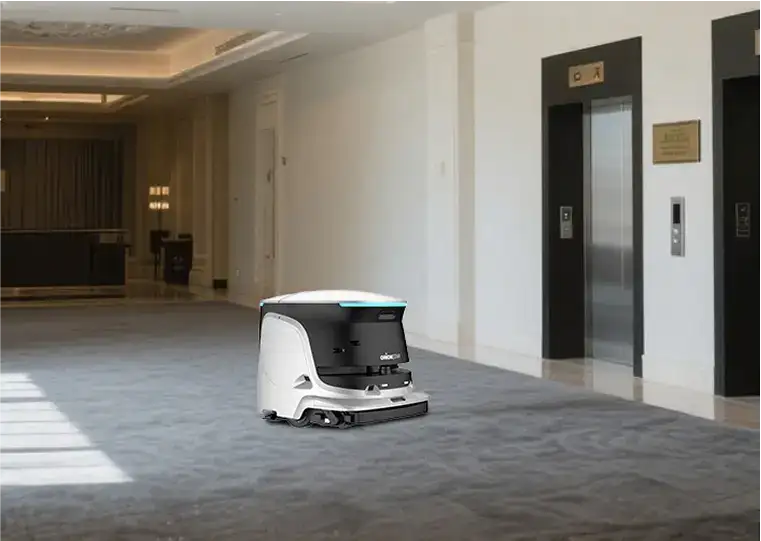
Convention centers, exhibition halls, trade show floors, and large event spaces present unique maintenance challenges due to mixed flooring topographies and dense pedestrian traffic. Venue operations managers face constant pressure to execute quick turnaround cleaning between sessions while maintaining quiet, discreet operation during active daytime events. The rapid construction and teardown of temporary booth setups further complicate spatial navigation, demanding floor-care solutions capable of rapid re-mapping and safe operation around evolving obstacles. Procuring automated floor-care platforms requires balancing these operational constraints with the need for large open-area coverage. Evaluating the best commercial cleaning robots for convention centers involves analyzing core technical factors to align automation capabilities with shifting facility workflows.
Convention centers feature diverse flooring topographies, transitioning frequently from polished entrance lobbies and expansive concrete exhibition halls to heavily trafficked, carpeted meeting rooms. Facility managers must align robotic capabilities with the predominant surface types requiring routine maintenance. Dedicated hard-floor scrubbing systems focus on aggressive liquid-based soil removal. These platforms utilize high down-pressure, specialized brushes, and substantial fluid capacity to manage heavy stains and scuff marks across expansive zones. Dedicated dry vacuuming systems focus on debris collection and carpet care, relying on dual-fan suction and high-efficiency filtration to extract embedded dirt in conference rooms. Integrated multi-surface systems focus on functional versatility, incorporating capabilities that allow operators to transition between wet scrubbing, dry vacuuming, and dust mopping to service mixed environments without requiring a separate machine for every surface type.
Event spaces experience drastic layout shifts, ranging from vast, empty floors during overnight turnarounds to complex, densely packed trade show layouts with temporary booth structures. The physical footprint and coverage capacity of the robot dictate its effectiveness across these shifting spatial demands. High-volume ride-on architectures maximize square-meter coverage per hour in unobstructed halls, integrating wide cleaning paths and extensive solution tanks to execute long, continuous runs. Mid-size maneuverable architectures optimize navigation through standard commercial layouts, featuring standardized passing widths to clean complex booth corridors and food-service areas effectively. Ultra-compact spot-cleaning architectures prioritize tight-space accessibility over total area coverage, utilizing minimal footprints to maintain congested registration areas and back-of-house corridors where larger machines cannot operate safely.
The rapid construction and teardown of temporary exhibits require cleaning robots to adapt seamlessly to altered floor plans and unpredictable pedestrian flows. The methodology used to map spaces and detect obstacles determines how quickly a machine can be redeployed after an event change. Teach-and-repeat mapping methodologies rely on manual route demonstration, utilizing onboard sensors to halt or maneuver safely when temporary obstacles appear in the memorized path. Autonomous dynamic mapping methodologies rely on independent environmental scanning, utilizing real-time spatial sensors to automatically generate optimal coverage patterns and seamlessly reroute around newly erected temporary structures. Facility administrators should verify that any selected mapping, camera, and cloud-data processing technologies comply with applicable data protection and privacy regulations, such as GDPR, prior to deployment.
Facility operations demand a strict balance between rapid, heavy-duty turnaround cleaning between sessions and unobtrusive, discreet maintenance while events are actively running. The acoustic output and battery endurance of the platform dictate when and where it can be deployed among attendees. High-intensity active cleaning profiles deploy full scrubbing and vacuuming power for comprehensive soil removal, generally operating at standard commercial noise levels suited for off-hours turnaround shifts. Low-decibel continuous maintenance profiles deploy specialized energy-saving vacuum modes or passive dust-mopping mechanisms for minimal acoustic disruption, providing extended battery life capable of lasting through active daytime event sessions.
The OrionStar CleaniBot S55 Pro is positioned as an autonomous multi-mode commercial floor-care robot for large indoor environments, explicitly supporting routine facility cleaning in exhibition halls and hotels. The system incorporates a 550 mm cleaning width and achieves a scrubbing efficiency of up to 1,197 m²/h, according to manufacturer data. For low-decibel continuous maintenance, facility managers can utilize a dust-mop runtime of up to 28 h under laboratory conditions, generating 45 dB of dust-mopping noise to support quiet operation during active events. The unit navigates using a combination of LiDAR, a stereo camera, and ultrasonic sensors, while Wi-Fi and 4G connectivity support remote deployment and operational reporting.
Gausium Scrubber 50 is positioned as a compact AI-powered autonomous scrubber tailored for medium-to-large mixed spaces. According to manufacturer data, the platform utilizes LiDAR navigation to map environments and navigate shifting venue layouts safely. The system incorporates an RGB camera to facilitate AI spot cleaning, directing the machine to address specific stains rather than executing redundant full-floor passes. Venue operations teams can further enhance deployment autonomy by utilizing an optional workstation to automate water management and charging between sessions.
Nilfisk Liberty SC50 is positioned as an autonomous scrubber emphasizing consistent coverage and route repetition across expansive facility floors. The unit relies on SLAM-based navigation to orient itself, operating dynamically without requiring prior manual pre-mapping before deployment. According to manufacturer data, the platform focuses on executing highly repeatable cleaning paths alongside human staff, supported by TrackClean reporting to provide facility management teams with clear oversight of total area coverage.
Karcher KIRA B 50 is positioned as a German-engineered autonomous scrubber designed to maintain corridors, food courts, and general public access areas. The machine carries a public-area safety certification, enabling safe operational deployment alongside active pedestrian traffic during event hours. According to manufacturer data, the unit also features a VDA 5050 interface, providing standard communication protocols for seamless integration into broader automated facility-management ecosystems.
Pudu CC1 is positioned as a versatile four-in-one cleaning robot designed for environments that transition frequently between different flooring topographies. The machine combines capabilities intended for moving seamlessly between hard-floor maintenance and carpeted area vacuuming. By addressing both sweeping and scrubbing requirements within a single architectural framework, the platform allows facility operations teams to service mixed spaces efficiently without deploying dedicated specialized units for every distinct room type.
Pudu MT1 Vac is positioned as an AI-powered robotic sweeper and vacuum explicitly targeting the dry cleaning requirements of convention centers and large event spaces. The system focuses on extracting debris from expansive carpeted zones while utilizing specialized surface recognition to adjust operational parameters dynamically. Facility operators can attach an optional vertical cleaning module intended for edge maintenance and fixture cleaning, allowing the unit to manage dust accumulation on temporary trade show booths and seating structures.
SoftBank Robotics Whiz is positioned as an AI-powered autonomous vacuum dedicated to managing carpeted conference spaces and breakout rooms. The machine utilizes an intelligent navigation stack to maneuver safely through complex meeting room layouts and dynamic pedestrian environments. The platform allows cleaning teams to maintain consistent carpet appearance between busy event sessions, focusing strictly on dry soil removal and debris collection in pre-function areas.
ICE Robotics Cobi 18 is positioned as a compact autonomous scrubber engineered to access tight aisles, small zones, and back-of-house areas. The minimal spatial footprint of the machine allows it to navigate congested registration setups or narrow service corridors that exceed the spatial footprint of larger platforms. According to manufacturer data, the unit provides localized hard-floor maintenance, serving as a highly maneuverable supplementary cleaning tool for complex architectural layouts.
Tennant T7AMR is positioned as a BrainOS-powered ride-on autonomous scrubber engineered to manage massive open exhibition halls and extensive facility corridors. The high-capacity tank architecture allows the platform to maintain wide public walkways while maximizing square-meter coverage per hour. By leveraging ride-on dimensions and robust solution storage, the system supports the long continuous runs necessary for aggressive overnight turnaround cleaning in unobstructed venues.
Pudu SH1 is positioned as an upright smart scrubber-dryer targeted for localized intensive cleaning and spot maintenance tasks. The upright form factor allows facility staff to address severe spills and stubborn stains efficiently in food-service zones or highly trafficked entryways. Rather than covering broad exhibition floors autonomously, the unit provides a targeted, maneuverable response tool to manage isolated soil accumulation rapidly between active event sessions.
Targeted procurement recommendations depend heavily on the specific architectural demands of the convention center. Facilities requiring extensive overnight turnaround cleaning in massive, unobstructed exhibition halls benefit most from large ride-on architectures that maximize total liquid capacity and square-meter coverage. Venues transitioning constantly between hard-floor pre-function spaces and carpeted breakout rooms should evaluate integrated multi-surface platforms to consolidate their fleet operations. For continuous daytime maintenance, procurement teams must prioritize low-decibel profiles and extended runtime capacities to minimize acoustic disruption near attendees. Ultimately, aligning the navigation sensor suite and mapping methodology with the frequency of temporary booth construction ensures that the selected automated solution adapts safely and efficiently to ever-changing event layouts.
Labor is typically 60–80% of total cleaning costs, so the financial case for an autonomous floor-cleaning robot rests mainly on labor offset. Real-world deployment data for daily-use facilities with 50,000+ sq ft of hard-floor coverage commonly shows payback periods of 9–18 months, with overnight routes often paying back faster because they remove shift-premium labor. Unit purchase prices vary widely by robot class and region: third-party procurement guides place commercial cleaning robots in the roughly USD 30,000–150,000 range per deployed unit, while compact-to-large autonomous scrubbers are commonly listed from about USD 27,500 up to USD 41,820. A distributor estimate suggests a robot can cost around USD 27 per day to operate versus roughly USD 144 per shift for human labor, with up to 3x the coverage. Annual robot operating expenses—including solution, brushes, preventive maintenance, and oversight time—are typically in the USD 4,000–7,000 range. For a venue with nightly, repeatable cleaning routes, this often translates to roughly one full-time-equivalent of labor offset per robot, but the exact payback depends on local loaded labor rates, shifts, and route size. Sources: Sproutmation ROI guide, LinkedIn procurement evaluation, RobotLAB cleaning.
Start with the floor area that actually needs cleaning, not the building's total square footage. Match each zone to a robot's cleaning width, efficiency, and runtime. For example, the OrionStar CleaniBot S55 Pro lists up to 1,197 m²/h in scrubbing modes and up to 1,368 m²/h in sweep/vacuum and dust-mop modes, with runtimes from 4.5 h for scrubbing up to 28 h for dust mopping. Competitor data shows Gausium Scrubber 50 practical efficiency of 500–1,300 m²/h and about 3 h of scrubbing runtime; Tennant T7AMR is quoted with up to 4,250 m² coverage per charge and 4–6.5 h runtime; Kärcher KIRA B 50 lists up to 25,450 ft²/h and roughly 3.5 h runtime. Because a single unit cannot cover an entire convention center in one shift, most large venues need multiple robots, optional self-docking stations, or a mix of compact and large units for different zones. Procurement models include outright purchase, equipment lease/finance, and Robotics-as-a-Service (RaaS). Purchase typically offers a highly competitive long-term ROI but requires CapEx and internal maintenance planning; lease/finance spreads payments; RaaS bundles support and software for a predictable monthly fee. The choice should be modeled against loaded labor savings, route ownership, and local service coverage rather than sticker price alone. Sources: product specifications, competitors.md, Sproutmation ROI guide.
Autonomous cleaning robots use cameras, LiDAR, 3D sensors, and cloud connectivity for navigation and reporting. In Europe, this means GDPR applies to any personal data the sensors might capture—images of attendees, staff, or badges, plus location and operational data. Procurement teams should require vendors to document what data is collected, where it is stored, how long it is retained, who can access it, and whether processing is local or cloud-based. A Data Protection Impact Assessment (DPIA) is advisable for venues with high footfall. Market analysis notes that European buyers increasingly demand clear data-handling and security assurances to meet GDPR and public-sector rules, and that vendors designing for repairability, recyclability, and energy efficiency are better aligned with tightening EU sustainability procurement criteria. Safety standards such as IEC 60335-2-117 and CSA 22.2 No. 336-17 (public-area safety certification cited for the Kärcher KIRA B 50) may also be relevant, depending on the deployment country. Sources: National Law Review Europe cleaning robot market summary, competitors.md.
Convention centers typically combine hard-floor lobbies and exhibition halls with carpeted meeting rooms, breakout areas, and polished surfaces. Most autonomous cleaning robots are optimized for one dominant surface type. The OrionStar CleaniBot S55 Pro supports sweeping, scrubbing, vacuuming, mopping, and dust-mopping modes and is designed for mixed commercial floors, but its specification emphasizes hard-floor and low-pile carpet use. The Pudu CC1 is marketed as a 4-in-1 unit for carpet vacuuming, hard-floor mopping, dust pushing, and combined functions; the Pudu MT1 Vac targets dry cleaning of carpeted areas and includes optional vertical suction for edges and fixtures; SoftBank Robotics Whiz is positioned as a vacuum for carpeted conference spaces. By contrast, the Kärcher KIRA B 50 and Gausium Scrubber 50 are primarily scrubber-dryers for hard floors. For a venue with a true mix of carpet and hard flooring, buyers usually either deploy a multi-function unit in transition zones or operate a small fleet of specialized machines rather than expecting one robot to excel everywhere. Sources: product specifications, competitors.md.
Navigation stacks vary by vendor but generally combine LiDAR SLAM or VSLAM, stereo or RGB cameras, ultrasonic sensors, 3D depth cameras, and line lasers. The OrionStar CleaniBot S55 Pro uses LiDAR with map construction up to 10,000 m² per individual map layer, supporting multi-zone management for larger venues, a stereo camera for cliff/step detection, ultrasonic obstacle avoidance, and line lasers that allow close wall and corner cleaning. Tennant's T7AMR and SoftBank's Whiz use BrainOS vision-based AI with obstacle and people avoidance. Gausium's Scrubber 50 adds an RGB camera and AI for spot cleaning and rerouting. Kärcher's KIRA B 50 uses 3D sensors and laser scanners with 360-degree obstacle detection and is safety-certified for public access. These systems can detect and slow for pedestrians and temporary structures, but they rely on an initial map and clear pathways. Rapid, unmapped layout changes—such as a full exhibition build or teardown—usually require re-mapping or human oversight. For best results, venues should schedule autonomous routes during lower-traffic windows and assign staff to handle exceptions, refill tanks, and inspect results. Sources: product specifications, competitors.md.
Runtime and coverage depend heavily on the cleaning mode. The OrionStar CleaniBot S55 Pro lists scrubbing runtime of 4.5 h with efficiency up to 1,197 m²/h, sweep/vacuum runtime of 4.5 h with efficiency up to 1,368 m²/h, ECO vacuum runtime up to 19.5 h, and dust-mop runtime up to 28 h; charging time is less than 4 h. Competitor figures include Gausium Scrubber 50 at roughly 3 h scrubbing runtime, Tennant T7AMR at 4–6.5 h, Kärcher KIRA B 50 at about 3.5 h, and ICE Cobi 18 at around 90 minutes. For a large exhibition hall, one robot per shift is rarely enough; fleet planning should account for charging breaks, tank refills, transit between zones, and the fact that real-world coverage is typically 50–70% of manufacturer-rated efficiency. Optional self-docking stations that auto-refill water, drain wastewater, and recharge can extend effective uptime and are worth evaluating for high-frequency routes. Battery technology in the sector has improved—one market report notes average runtimes improved by about 20% between 2021 and 2024—so newer units can cover more ground per shift than earlier generations. Sources: product specifications, competitors.md, IndustryResearch.biz commercial cleaning robots market report.
Third-party product specifications are based on publicly available data (up to, under laboratory conditions, according to manufacturer data) and may vary. Product names and trademarks are the property of their respective owners. If any product involves cameras, voice recording, mapping, or cloud data processing, facility operators must verify GDPR compliance prior to deployment.