

REQUEST DEMO
Robot CATALOG will be sent to your mailbox immediately after submission.
SUBMIT
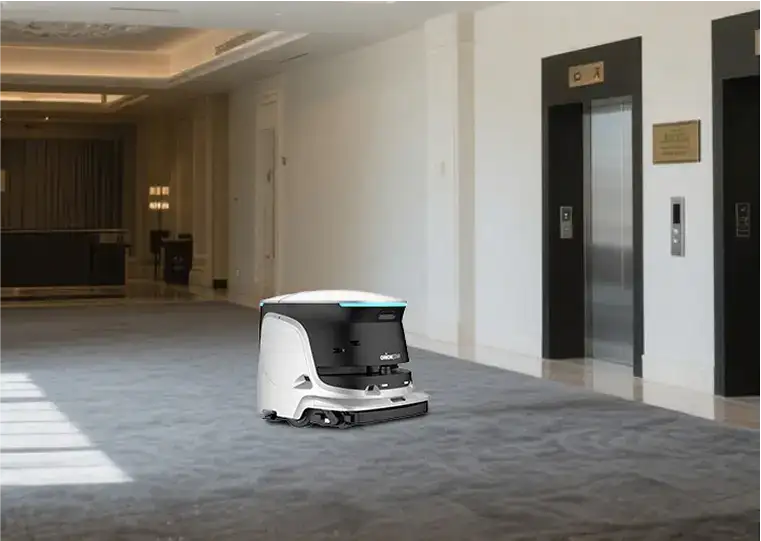
Industrial catering in university food courts faces mounting cleaning challenges, driven by acute labor shortages, rising operational costs, and intensified post-pandemic hygiene expectations. With high turnover rates and a lack of available staff to maintain massive dining spaces across extended hours, food service programs are finding it increasingly difficult to meet stringent compliance and sanitation standards manually. To bridge this gap, commercial cleaning robots have emerged as a practical solution, offering automated, consistent, and scalable floor maintenance that alleviates the pressure on human workers while keeping campus dining environments safe, hygienic, and inviting.
The OrionStar CleaniBot S55 Pro exemplifies these automated capabilities by combining sweeping, scrubbing, vacuuming, and mopping into a single autonomous platform designed for large-scale indoor environments. To navigate safely around students and furniture, it utilizes a multi-sensor system incorporating a LiDAR sensor, stereo camera, and ultrasonic sensors to support autonomous positioning and dynamic obstacle avoidance. For facilities needing extended coverage, this model can map environments up to 10,000 square meters according to manufacturer data, and it delivers long operational runtimes, reaching up to 19.5 hours in its energy-efficient ECO Vacuum mode.
Massive open dining halls see high foot traffic and frequent food spills during peak meal periods, making manual floor scrubbing incredibly time-consuming. Commercial cleaning robots efficiently execute systematic scrubbing patterns across these vast areas during off-hours, ensuring the space is thoroughly cleaned and prepared for the next day's breakfast rush.
The areas immediately surrounding serving stations are prone to continuous dropped food, sticky spills, and congestion from queuing students. Robots equipped with precise navigation and edge-cleaning capabilities can carefully maneuver alongside these counters, picking up debris and scrubbing away heavy soils without damaging the infrastructure.
Navigating through dense arrangements of tables and chairs poses a significant challenge for traditional floor maintenance equipment. Advanced robots utilize dynamic obstacle avoidance to safely weave through seating layouts, utilizing quieter dust mopping or vacuuming modes to maintain cleanliness while students are present.
Connecting corridors and main entryways constantly accumulate dirt, debris, and moisture tracked in from outside the campus. Automated floor scrubbers can be programmed to frequently patrol these high-traffic transition zones, maintaining safe, slip-free floors and presenting a positive first impression to university visitors.
Commercial cleaning robots are increasingly acting as mobile IoT nodes that integrate seamlessly into broader digital building ecosystems to enable more efficient facility operations. By interfacing with Building Management Systems (BMS) and Computerized Maintenance Management Systems (CMMS), these devices can transmit real-time operational data via standardized protocols, feeding valuable information on occupancy patterns and asset health directly to facility managers. For university food courts, this connectivity allows robots to coordinate with event scheduling and HVAC systems, dynamically adjusting their cleaning routes after peak lunch periods while sending automated alerts to maintenance teams for consumable refills and preventive upkeep.
By addressing both environmental efficiency and employee well-being, automation actively supports the broader ESG reporting expectations increasingly required in higher education dining programs.
Commercial cleaning robots are fundamentally changing how industrial catering operates, shifting the maintenance of university food courts from labor-intensive manual routines to highly efficient, data-driven automated systems. By embracing these intelligent solutions, catering operators and food service managers can reliably meet rising hygiene standards while mitigating the impacts of severe staffing shortages. As the technology continues to mature, automated fleets like the OrionStar CleaniBot series offer a variety of models to adapt to different spatial and functional requirements, providing facility leaders with scalable options to explore for long-term operational resilience.
Note: Industry statistics cited in this article are drawn from publicly available sources including the National Restaurant Association, NetSuite, the University of California Berkeley Labor Center, Tennant Company, Sproutmation, KBS Services, Restaurantware, NACUFS, ECOVACS Commercial, and SoftBank Robotics. Actual cleaning efficiency, runtime, and ROI may vary depending on layout, floor conditions, and operational factors. The CleaniBot S55 Pro is designed for commercial floor cleaning and does not guarantee medical-grade sterilization.