

REQUEST DEMO
Robot CATALOG will be sent to your mailbox immediately after submission.
SUBMIT
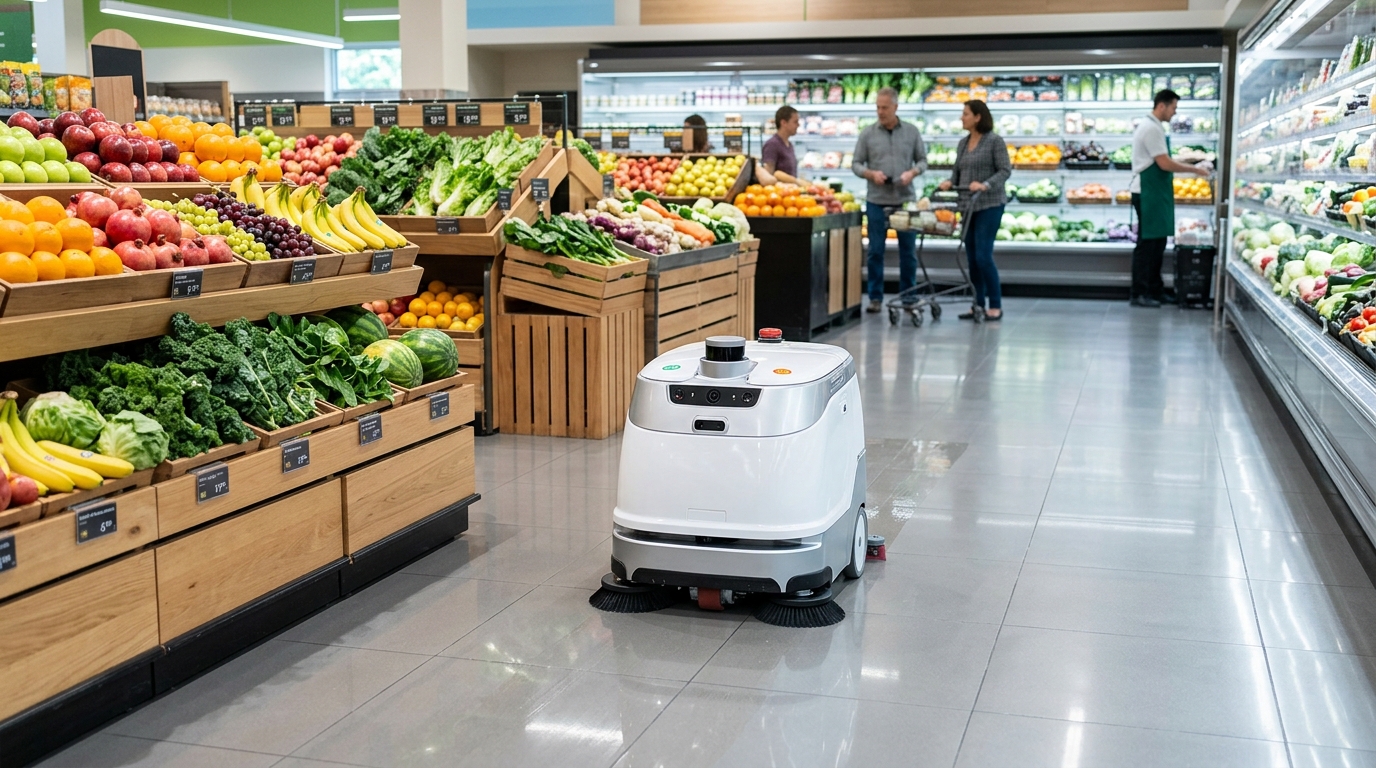
Supermarket Chains face significant operational demands in produce departments, where the constant threat of fruit and vegetable spills, refrigeration condensation, and strict food safety regulations coincide with persistent labor shortages and rising facility maintenance costs. To navigate these complex challenges of maintaining consistent daily hygiene, mitigating costly slip-and-fall liabilities, and controlling high employee turnover rates, operators are increasingly turning to commercial cleaning robots as a reliable, automated solution.
The OrionStar CleaniBot S55 Pro demonstrates these broader autonomous capabilities through a multi-sensor navigation system designed to map and adapt to dynamic retail environments. According to manufacturer data, the unit utilizes an array of 15 sensors—including LiDAR, stereo cameras, and ultrasonic sensors—to support real-time map construction of up to 10,000 square meters while actively avoiding obstacles and detecting steps. Engineered to execute routine tasks with minimal intervention, it can deliver a maximum cleaning efficiency of up to 1,368 square meters per hour in sweep and vacuum modes, and it maintains operational noise as low as 45 decibels during dust mopping to minimize shopper disruption.
These zones experience frequent organic debris from dropped fruits, vegetables, and leafy greens, compounding the risk of immediate slips and pest attraction. Commercial cleaning robots can continuously sweep and scrub these pathways, lifting small organic debris and localized dirt before it is trampled into the flooring and compounds the cleaning challenge.
Misting systems used to keep produce fresh frequently spray excess water onto the adjacent walkways, creating persistent slick spots that increase slip hazards for shoppers. Autonomous scrubbers utilizing immediate water recovery systems can efficiently remove this moisture in a single pass, significantly reducing potential slip risks for foot traffic.
Condensation runoff from open refrigerated cases consistently pools along the base of the units, often accumulating unnoticed by store staff. Robots equipped with edge-cleaning capabilities and line lasers can navigate closely alongside these displays, capturing pooled water near the source without damaging the refrigeration hardware.
The areas bridging the produce department and checkout lanes experience the highest concentration of cart and pedestrian traffic, quickly accumulating tracked-in dirt and residual moisture. Cleaning robots deployed in these transition spaces can operate during off-peak windows or utilize low-noise modes to maintain appearance standards without bottlenecking the flow of exiting customers.
Commercial cleaning robots increasingly function as connected nodes within a supermarket’s broader smart building ecosystem. Their digital management capabilities—including Wi-Fi and 4G connectivity, remote deployment, cloud-based maintenance, and data reporting—allow operational data such as coverage maps and consumable status to feed into existing facility management workflows. By leveraging occupancy data from Building Management Systems (BMS), robots can schedule cleaning during low-traffic windows in the produce department to minimize shopper disruption. Over time, the operational data generated during cleaning cycles can support predictive maintenance planning and help facility teams make evidence-based decisions about resource allocation and scheduling.
By optimizing resource usage and providing transparent environmental data, automated floor care directly supports the retail sector’s broader commitments to achieving net-zero emissions and sustainable facility management.
Commercial cleaning robots are significantly improving the way supermarket chains manage and maintain produce departments, shifting the approach from reactive spot-cleaning to consistent, data-backed facility care. By addressing persistent labor shortages, mitigating slip-and-fall liabilities, and enhancing hygiene standards, these autonomous platforms offer a scalable solution to modern retail challenges. The OrionStar CleaniBot series provides multiple configurations to accommodate varying floor types and facility layouts, enabling operators to tailor their automated cleaning strategy to the precise needs of their individual stores.
Note: Industry statistics cited in this article are drawn from publicly available sources including the U.S. Bureau of Labor Statistics, Liberty Mutual Workplace Safety Index, and published retail industry reports. Actual cleaning efficiency, battery runtime, and mapping capacity may vary depending on floor types, environmental complexity, network stability, and obstacle density. Hygiene performance may vary based on floor type, soil level, and operating conditions. The CleaniBot S55 Pro is designed for commercial floor cleaning and does not guarantee medical-grade sterilization.