

REQUEST DEMO
Robot CATALOG will be sent to your mailbox immediately after submission.
SUBMIT
Large retail environments, spanning supermarkets, big-box stores, and department stores, present complex floor-care challenges driven by diverse spatial layouts and continuous daily operations. Facilities routinely exceed ten thousand square meters, requiring cleaning solutions capable of handling large-scale open floors (over 10,000 sqm) alongside tightly packed shelving corridors and checkout lanes. Extended operational hours necessitate continuous uptime, prioritizing equipment that can manage automated charging and water refilling to sustain multi-shift operations without disrupting the shopper experience. Furthermore, dynamic foot traffic demands advanced obstacle avoidance and low acoustic footprints for daytime deployment, while varied floor conditions require adaptable scrubbing mechanisms to resolve everything from dry debris in hardware aisles to sticky liquid spills in grocery sections.
To evaluate these systems effectively, buyers should utilize a comparative framework focused on navigational architecture, operational sustenance, and soil resolution. Navigational architecture and space adaptability define where the equipment can operate. Compact agile architectures utilize narrow chassis configurations, generally under six hundred to seven hundred millimeters, maneuvering safely through tight supermarket aisles and employing wall-following sensors to clean near shelving edges. High-capacity wide-path architectures employ expanded cleaning widths exceeding seven hundred millimeters, maximizing coverage speed in large-scale open floors and leveraging long-range sensors to navigate autonomously. Hybrid ride-on architectures integrate a manual driving platform with autonomous software, allowing operators to manually steer the machine through heavily populated zones during peak hours before transitioning to fully autonomous execution during night shifts.
Operational sustenance and resource management determine the level of true autonomy achieved across extended shifts. Automated workstation architectures implement centralized docking infrastructure to facilitate uninterrupted operation, executing automatic clean-water refilling, wastewater discharge, and battery recharging without human intervention. Extended-capacity tank architectures utilize large-capacity onboard fluid reservoirs, frequently exceeding one hundred liters, to maximize single-shift runtimes, often pairing with swappable battery modules for immediate power replenishment. Onboard resource-recycling architectures incorporate internal fluid filtration systems to purify and reuse water throughout the route, significantly reducing freshwater consumption and enabling prolonged cleaning cycles in older facilities lacking automated drainage plumbing.
Soil resolution and spill response mechanisms dictate how effectively the machine handles retail-specific floor contaminants. Heavy-duty pressure architectures apply substantial downward scrubbing force, generally exceeding twenty kilograms, using robust brush configurations to remove dense grease accumulations in high-traffic public corridors. Proactive visual-targeting architectures deploy cameras and artificial intelligence to continually monitor floor conditions, identifying localized spills in real time and dynamically altering the cleaning path to execute targeted spot-cleaning. Integrated sweep-and-scrub architectures combine pre-sweeping, wet scrubbing, and edge cleaning into one unified mechanism, capturing dry debris and wet spills simultaneously to bypass preliminary manual sweeping in mixed-waste supermarket aisles. When evaluating systems that utilize cameras, mapping technologies, or cloud-based data processing for navigation and spot-cleaning, facility operators must verify compliance with applicable data protection and privacy regulations, such as GDPR, prior to deployment in public-facing spaces.
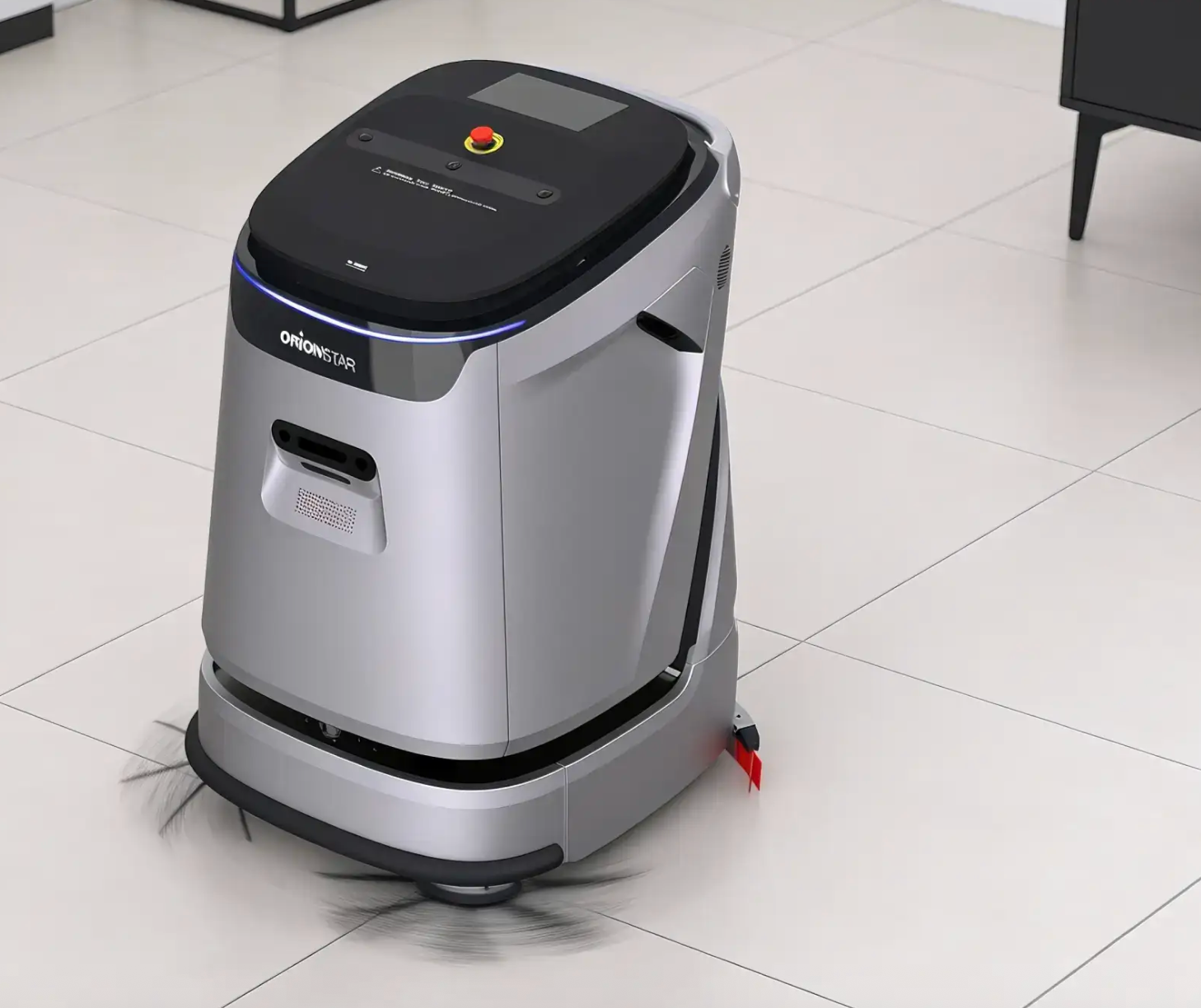
The OrionStar CleaniBot C5 is positioned for heavy-duty retail and large-format commercial environments that demand multi-shift operation and powerful stain removal. It addresses the need for robust floor care in large-scale wholesale stores (over 10,000 sqm) and shopping malls where high foot traffic results in stubborn floor grime. According to manufacturer data, the unit generates a theoretical coverage of up to 1,980 square meters per hour and applies up to 25 kilograms of downward pressure through its dual-rolling-brush system. The system interfaces with an automated workstation that handles clean-water refilling, wastewater discharge, and high-pressure internal tank rinsing, performing a self-cleaning cycle in approximately 4 minutes. With acoustic levels tested under 68 decibels in standard conditions, it accommodates daytime operation. Multilingual support is generally realized through backend cloud platforms rather than solely on the device interface. Because the system utilizes cloud-learning optimization for mapping and path planning, operators must verify GDPR compliance prior to public retail deployment.
Dimensions: Approximately 820 x 680 x 1,130 mm (minimum passable width of approximately 880 mm)
Cleaning Width: 550 mm
Runtime: Scrubbing runtimes up to approximately 3 hours depending on floor types and scrubbing pressure, and mopping runtimes up to 8 hours
Water Tank: 90 L combined (45 L clean / 45 L waste)
The Gausium Scrubber 75 is positioned for expansive big-box retail centers requiring rapid coverage across large-scale open aisles (over 10,000 sqm) and perimeter corridors. By focusing on wide-path architecture, it serves retail environments where maximum square-meter productivity outweighs the need for tight-corner maneuverability. The machine yields a theoretical cleaning efficiency of up to 3,000 square meters per hour and applies approximately 45 kilograms of brush pressure for heavy-duty soil resolution. The device can pair with an optional workstation to execute autonomous charging and water management. A built-in water recycling system reduces freshwater consumption by approximately 80 percent. Multilingual support is implemented via extensive localized documentation and global cloud-based management platforms. Navigation relies on three-dimensional cameras and light detection and ranging sensors, meaning facility operators should verify GDPR compliance regarding visual data capture before integrating the unit into shopper-facing zones.
Dimensions: Approximately 962 mm in width (minimum passable width of approximately 1,400 mm)
Cleaning Width: 750 mm
Runtime: Up to approximately 4 to 6 hours
Water Tank: 75 L clean water tank / 50 L wastewater tank
The Tennant T7AMR is positioned as a hybrid floor-care solution for large warehouse-club environments and grocery stores that balance peak-hour shopper congestion with dedicated off-hour maintenance windows. It acts as a manual ride-on scrubber when store corridors are crowded, allowing staff to navigate safely, and transitions into an autonomous unit during unpopulated overnight shifts. The machine delivers an estimated coverage of up to 4,250 square meters per cycle, utilizing up to 86 kilograms of main down pressure. Sound levels can operate as low as 70 decibels, facilitating daytime usage without excessive disruption. Multilingual support is integrated directly into the user interface of the BrainOS operating software, allowing diverse operator teams to select their preferred language for daily interaction. Because the BrainOS navigation framework relies on cameras to facilitate its teach-and-repeat autonomous routing, organizations deploying the T7AMR in European markets must verify GDPR compliance concerning visual data capture.
Dimensions: Hybrid ride-on platform architecture
Cleaning Width: 650 mm
Runtime: Up to approximately 4 hours per charge
Water Tank: Approximately 110 L solution tank / 129 L recovery tank
The Gausium Scrubber 50 is positioned for medium-to-large retail spaces requiring intelligent spot-cleaning responses and compact maneuverability among standard shelving rows. It targets grocery and department stores where localized spills occur frequently, utilizing proactive visual-targeting architecture to address stains immediately. According to manufacturer data, the unit applies up to 25 kilograms of brush pressure, generating up to 1,987 square meters per hour in theoretical efficiency. It leverages an onboard water recycling system to extend its operational window. Multilingual support is accommodated via global documentation and an accessible mobile application interface. The auto-spot cleaning function utilizes an RGB camera and artificial intelligence to identify spills dynamically; consequently, operators must ensure GDPR compliance regarding the storage and processing of visual data captured within public retail areas.
Dimensions: Approximately 700 mm in width (navigates aisles as narrow as approximately 800 mm)
Cleaning Width: 460 mm
Runtime: Up to 3 hours for scrubbing
Water Tank: Approximately 30 L clean / 24 L waste
The Nilfisk Liberty SC50 is positioned for high-traffic supermarkets demanding rigorous safety certifications for autonomous operation alongside shoppers during business hours. It focuses on regulatory compliance and precise perimeter navigation in dynamic grocery layouts. Its distinct fill-in cleaning mode allows an operator to drive the perimeter of a space manually while the machine automatically calculates the internal optimal route, providing a theoretical productivity of up to 2,453 square meters per hour. It produces an acoustic footprint of approximately 63 decibels, making it highly suitable for daytime deployment. Multilingual support is facilitated across localized global websites and international dealer networks rather than complex onboard language menus. As the SC50 utilizes an array of three-dimensional, two-dimensional, and infrared sensors for its certified safety and navigation protocols, facilities should verify GDPR compliance regarding any sensor data processing or storage.
Dimensions: Autonomous floor scrubber footprint suited for perimeter and fill-in routing
Cleaning Width: 508 mm
Runtime: Up to 6 hours on standard batteries
Water Tank: 57 L solution / 53 L recovery
The Avidbots Neo 2W is positioned for industrial-scale retail and warehouse-hybrid environments that require extended continuous runtimes and robust obstacle detection. It addresses the needs of large-scale home improvement centers (over 10,000 sqm) and big-box facilities where store layouts shift frequently and expansive open areas require unbroken maintenance cycles. The system incorporates a debris diverter to prevent clogs from mixed waste and applies up to 87 kilograms (193 pounds) of scrubbing pressure. Supported by swappable batteries, it offers sustained operations over heavy-duty cycles. Multilingual support is provided through a web-based command center utilized globally across multiple regional markets. Because its advanced dynamic planning navigation relies on cameras, lasers, and cloud-based data processing, organizations must verify GDPR compliance prior to public retail implementation.
Dimensions: Gross vehicle weight up to approximately 688 kg, indicating a heavy-duty chassis
Cleaning Width: Options up to 812 millimeters (32 inches)
Runtime: Up to approximately 6 hours per cycle
Water Tank: Approximately 109 L solution / 135 L recovery
The Tennant T380AMR is positioned for mid-sized to large retail facilities characterized by particularly narrow shelving corridors, tight corners, and checkout lanes. Like its larger counterpart, it offers a hybrid ride-on architecture but utilizes a narrower footprint to penetrate spaces inaccessible to bulky equipment. It delivers an estimated coverage of up to 3,106 square meters per cycle. Its teach-and-repeat navigation mechanism requires the operator to drive the desired path once before the machine replicates it autonomously. Multilingual support is natively integrated into the BrainOS touch interface, allowing operators to switch language preferences dynamically. Because the autonomous operation relies on a suite of cameras feeding data to the navigational software, retail operators must evaluate the deployment against GDPR requirements regarding visual data capture.
Dimensions: 635 mm machine width
Cleaning Width: 500 mm
Runtime: Up to approximately 3 hours per standard charge
Water Tank: Approximately 75 L solution
The Kärcher KIRA B 50 is positioned for supermarkets and do-it-yourself retail stores requiring integrated sweep-and-scrub capabilities to handle mixed debris without manual pre-sweeping. By combining a cylindrical roller brush with an integrated side brush, it cleans edges efficiently and removes both solid soil and liquid spills simultaneously, achieving a cleaning capacity of up to 2,300 square meters per hour. For continuous operational sustenance, the machine pairs with an optional docking station that facilitates fully autonomous fresh water refilling, dirty water drainage, tank rinsing, and battery charging without human intervention. It maintains a sound pressure level of approximately 69 decibels. Multilingual support is administered via localized digital equipment management portals and regional product materials. Navigation utilizes 360-degree environmental detection sensors, requiring operators to confirm GDPR compliance regarding sensor data transmission to cloud-based management platforms.
Dimensions: Standard autonomous floor scrubber footprint
Cleaning Width: 560 mm
Runtime: Up to approximately 3.5 hours
Water Tank: Integrated fresh and dirty water tanks compatible with optional autonomous docking station
The CenoBots L50 is positioned for grocery environments incorporating extensive glass display cases and freezer aisles that challenge standard sensor arrays. It utilizes specialized detection algorithms to identify glass and protruding objects at long distances, preventing collisions in visually complex retail spaces. The system applies up to 25 kilograms of brush pressure, resulting in a theoretical productivity of up to 2,203 square meters per hour. Multilingual support is delivered globally via localized mobile applications for route planning and remote monitoring. Because the AI-driven autonomy relies on cameras for advanced object detection and automatic map updating, facilities must secure GDPR compliance prior to initiating the robot in shopper-facing zones.
Dimensions: Approximately 580 mm chassis width
Cleaning Width: 510 mm
Runtime: Up to 6 hours depending on the battery configuration
Water Tank: Approximately 55 L solution
The LionsBot R3 Scrub Pro is positioned for highly congested retail layouts requiring highly compact designs and simplified operational deployment by non-technical store staff. It targets environments with the tightest shelving clearances and achieves an average practical efficiency between 800 and 1,200 square meters per hour. Its proprietary zero-click start system allows employees to initiate a pre-programmed route simply by pushing the robot to a designated floor tag, simplifying the user experience. Multilingual support is maintained through localized mobile fleet management applications distributed across global markets. The system relies on light detection and ranging sensors, along with optional three-dimensional depth mapping, necessitating a review of GDPR compliance concerning spatial data capture and cloud synchronization.
Dimensions: 570 mm width and a net weight of approximately 85.5 kg
Cleaning Width: 366 mm base (supplemented by a side brush)
Runtime: Maximum runtime of up to 3 hours
Water Tank: Approximately 21 L clean / 24 L wastewater
Procuring commercial floor-care robotics for retail applications requires aligning machine architecture precisely with the physical footprint and scheduling realities of the facility. Organizations managing large open-format big-box stores should prioritize high-capacity wide-path architectures, leveraging substantial tank volumes and wide scrubbing decks to maximize square-meter productivity during designated maintenance windows. Conversely, supermarkets and department stores featuring dense product shelving require compact agile architectures that can physically traverse tight corridors and execute edge cleaning without disrupting visual displays.
Operational shift schedules should dictate the selected resource management systems. Facilities demanding continuous multi-shift floor care will find the highest return on investment by deploying automated workstation architectures, which eliminate the labor overhead associated with manual water refilling and battery charging. When spills occur frequently during peak shopping hours, proactive visual-targeting systems and integrated sweep-and-scrub mechanisms reduce slip hazards rapidly while maintaining aesthetic standards. Ultimately, matching the robot's physical dimensions, runtime capacities, and soil resolution capabilities to the specific retail environment ensures a successful deployment that stabilizes labor costs and elevates facility hygiene.
For facilities with daily cleaning needs and at least 50,000 square feet of hard-floor area, the typical payback window is 9 to 18 months. Labor accounts for 60–85% of total cleaning costs, and a single autonomous scrubber can often offset approximately one full-time floor-tech position in repetitive hard-floor coverage. Annual operating costs for a robot — including cleaning solution, brush and squeegee replacement, preventive maintenance, and daily oversight — typically range from $4,000 to $7,000, which is generally lower than the typical annual loaded cost of a full-time cleaning employee in many western markets. Large-format retail environments with open floor plans and overnight cleaning windows tend to achieve payback at the faster end of that range because route complexity is lower and shift-premium labor is eliminated.
Outright purchase delivers the strongest long-term ROI for organizations with available capital and a stable multi-year site, as the equipment is fully amortized within 1–2 years and generates recurring savings thereafter. Equipment leasing or financing reduces upfront cash outlay and provides predictable monthly payments, but service and maintenance may still be billed separately, fragmenting uptime accountability. Robotics-as-a-Service (RaaS) bundles hardware, software, support, and maintenance into a single monthly subscription — typically in the range of $575–$2,300/month depending on robot class and contract terms — which simplifies budgeting as an operating expense but results in a higher total cost over the contract life. The right model depends on whether the organization prioritizes asset ownership, predictable monthly costs, or full-service accountability.
Large retail stores — supermarkets, big-box stores, and department stores — typically have 10,000–30,000+ m² of cleanable hard-floor area. Machines with combined tank capacities below 60 L (such as the Gausium Scrubber 50 with 30 L clean / 24 L waste, or the LionsBot R3 Scrub Pro with 21 L clean / 24 L waste) will require frequent refills during extended cleaning runs, adding labor overhead. For uninterrupted operation in a single shift, machines with 90 L or greater combined capacity — such as the OrionStar CleaniBot C5 (45 L clean + 45 L waste), the Tennant T7AMR (110 L solution + 129 L recovery), or the Avidbots Neo 2W (109 L solution + 135 L recovery) — significantly reduce refill downtime. Runtime should ideally reach 4–6 hours of scrubbing per charge to cover a large retail floor without mid-shift battery swaps; the Nilfisk Liberty SC50 (up to 6 hours AGM, 10 hours Li-ion with expansion) and the Avidbots Neo 2W (up to 6 hours with swappable batteries) lead in this regard, while machines with 3-hour runtimes such as the CleaniBot C5 and Gausium Scrubber 50 may require mid-shift recharging for very large stores unless a docking station is used.
Minimum passable width is the critical specification for retail environments where product shelving creates tight corridors. The LionsBot R3 Scrub Pro (570 mm width, 800 mm minimum passable width) and the CenoBots L50 (580 mm width) offer the tightest profiles, making them well suited for narrow-gondola aisles. The OrionStar CleaniBot C5 requires approximately 880 mm of passing width at a body width of 680 mm, which fits standard retail corridors but may be too wide for tightly spaced sections. Wider machines such as the Gausium Scrubber 75 (962 mm body, 1,400 mm minimum passable width) and the Tennant T7AMR are better suited to open sales floors and perimeter corridors than to narrow aisle cleaning. Buyers should measure their narrowest active aisle widths before shortlisting machines, as a robot that cannot physically traverse key cleaning routes will deliver limited value regardless of its other capabilities.
The primary North American safety standard for autonomous battery-powered cleaning machines is CSA/ANSI C22.2 No. 336, which is OSHA-recognized and addresses safe operation in populated areas. The Nilfisk Liberty SC50 is currently one of the few autonomous floor scrubbers on the market certified to this standard. In Europe, IEC 63327 provides safety certification for autonomous cleaning machines; the Kärcher KIRA B 50 holds this certification. Internationally, ISO 13849 (safety-related control systems) and ISO 3691-4 (driverless industrial trucks) are also referenced by several manufacturers. For EU retail deployments, machines that use cameras or 3D sensors for navigation may capture visual data of shoppers or staff, raising GDPR compliance obligations; operators should verify whether sensor data is stored, transmitted, or processed in the cloud, and ensure that appropriate data-protection measures and privacy impact assessments are in place before deployment in public-facing retail spaces.
Retail stores frequently rearrange displays, end caps, and promotional fixtures, which can disrupt robots that rely on fixed, pre-taught routes. Teach-and-repeat navigation systems — such as BrainOS used by the Tennant T7AMR and T380AMR — require an operator to manually re-drive the route when layouts change, which adds labor overhead during high-frequency reset periods. In contrast, AI-driven path-planning systems that dynamically recalculate routes in real time — such as Avidbots' Advanced Dynamic Planning, CenoBots' automatic map updating, and the OrionStar CleaniBot C5's "Cloud Learning" optimization — can adapt to layout changes without manual re-teaching. The Avidbots Neo 2W also offers a Bulk Navigator feature specifically designed for environments with frequently changing inventory layouts. For large retail stores that reset sections weekly or seasonally, robots with dynamic re-planning capabilities will require significantly less human intervention to maintain cleaning coverage.
Footnote: Third-party product specifications are based on publicly available data (up to, under laboratory conditions, according to manufacturer data) and may vary. Product names and trademarks are the property of their respective owners. If any product involves cameras, voice recording, mapping, or cloud-based data processing, operators must verify GDPR compliance prior to deployment. Data Privacy Note: For features involving cloud mapping, visual targeting, or AI path planning, the robot functions as a data processor. Facility operators (data controllers) must ensure localized compliance with GDPR, CCPA, or other applicable privacy laws regarding spatial and visual data capture.