REQUEST DEMO
Resources > Blogs > Mastering Event Turnarounds: Commercial Cleaning Robots for Wedding Catering in Hospitality Venues

Mastering Event Turnarounds: Commercial Cleaning Robots for Wedding Catering in Hospitality Venues

2026-06-25 21:24 OrionStar

Mastering Event Turnarounds: Commercial Cleaning Robots for Wedding Catering in Hospitality Venues

Introduction

Wedding catering operations in hospitality venues are currently navigating complex challenges of structural labor shortages, escalating operational costs, and stringent compliance requirements, particularly during high-demand event turnarounds. To address these compounding pressures without compromising the standards expected at premium events, commercial cleaning robots are increasingly emerging as a strategic solution for automated facility maintenance.

The growing need for smarter cleaning in hospitality venues

  • Wedding caterers and catering professionals face a severe labor shortage crisis, with industry surveys indicating that 65% of U.S. hotels report active staffing deficits, particularly in their housekeeping and maintenance departments.
  • The physical demands of performing cleaning duties alongside strenuous catering tasks contribute to excessive work rates, leading to high injury-driven turnover and prevalent musculoskeletal disorders among staff.
  • Event-driven environments create extreme workload variability, compressing complex banquet setups, sudden spill responses, and post-event deep cleaning into tight, unpredictable turnaround windows.
  • Rising wage expectations and loaded labor rates—costing between $40,000 and $55,000 annually for a full-time floor-cleaning position—place immense cost pressures on facility management budgets.

How commercial cleaning robots can help

  • LiDAR navigation allows these machines to precisely orient themselves within complex, ever-changing event spaces.
  • Autonomous path planning ensures comprehensive floor coverage by dynamically calculating the most efficient routes around tables, chairs, and temporary staging areas.
  • Auto-charging and docking capabilities enable continuous, multi-shift operation by allowing machines to independently return to base for power and fluid management.
  • Advanced obstacle avoidance technologies continuously scan the environment to safely steer clear of moving guests, catering staff, and unexpected hazards in high-traffic zones.
  • Real-time monitoring through cloud-based fleet management platforms provides operators with instant visibility into operational status, cleaning performance, and route history.
  • Because these robotic platforms often utilize spatial mapping, cameras, and cloud-based data processing, operating entities must verify GDPR compliance prior to deployment. Spatial and visual data are processed locally for navigation and obstacle avoidance purposes only, without capturing or storing personally identifiable information such as facial recognition data.

A closer look: OrionStar CleaniBot C5 in action

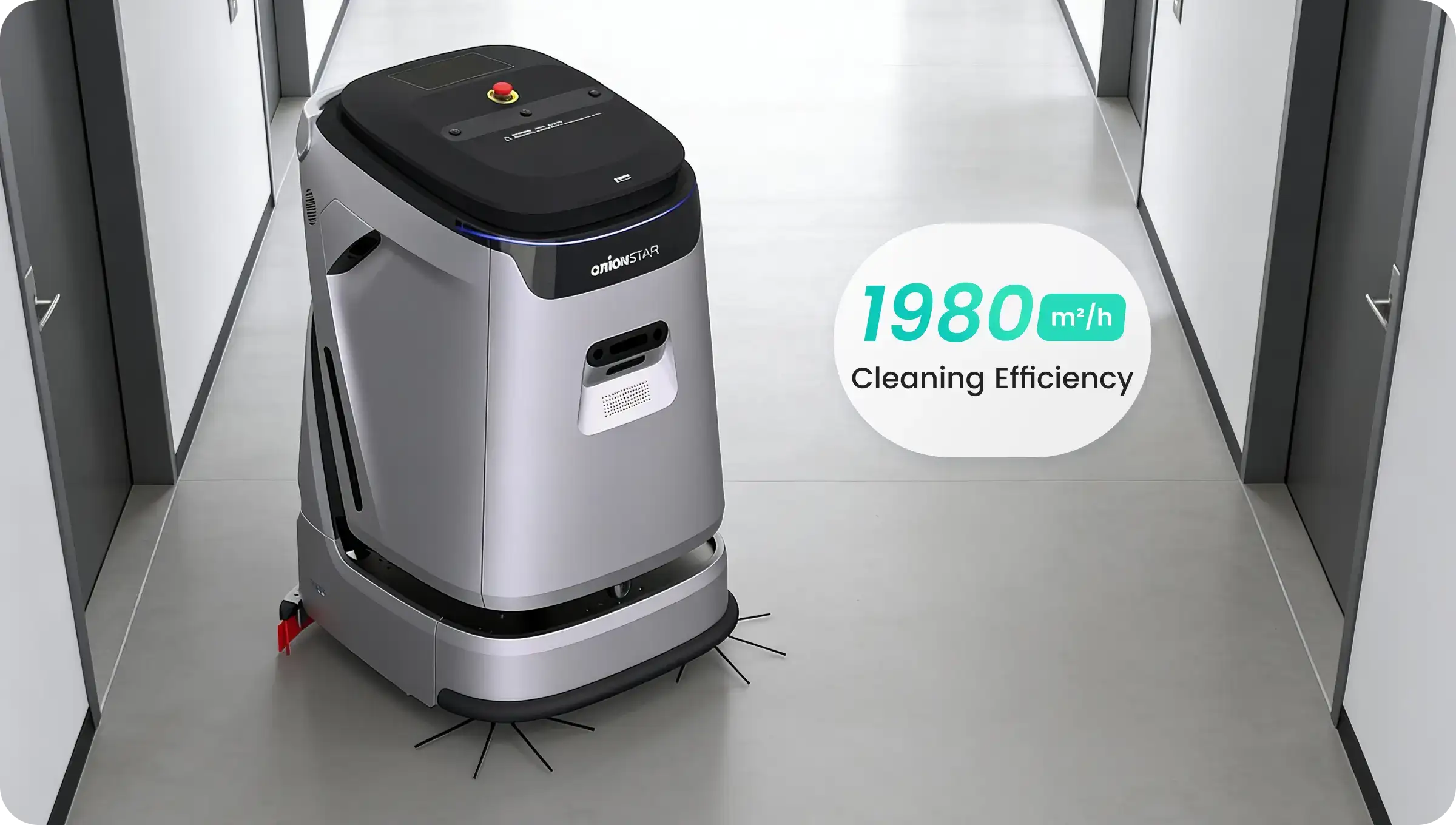
The OrionStar CleaniBot C5 illustrates how these advanced robotic capabilities are engineered for large-scale, heavy-duty applications. By integrating autonomous path planning and smart mapping, the unit can map an operating area of up to 10,000 square meters, allowing it to navigate expansive event spaces efficiently. Its automated workflow is supported by an auto-charging workstation that handles clean-water refilling and waste-water discharge, enabling a maximum theoretical cleaning capacity of up to 1,980 square meters per hour according to manufacturer data (actual coverage may vary depending on spatial layout and dynamic obstacles). Furthermore, the unit features an intelligent obstacle-avoidance system and operates at a noise level of less than 68 decibels, which allows it to maintain continuous cleaning routines safely and unobtrusively around active catering preparations.

Benefits for wedding caterers, catering professionals

  • Labor reallocation: Shifting routine floor maintenance to robotics frees up existing staff to focus on intricate banquet setups and fine detailing that guests immediately notice.
  • Cost reduction: Operators can mitigate rising wage pressures and capture a typical payback period of 9 to 18 months by supplementing manual labor with automation.
  • Consistent quality: Autonomous systems remove human variability, delivering reliable results with industry benchmarks indicating up to 50% cleaner floors compared to traditional manual vacuuming methods according to hospitality deployment data.
  • Resource efficiency: AI-driven cleaning intelligence precisely controls dispensing, with industry data indicating reductions in water consumption and cleanser usage of up to approximately 90% compared to traditional cleaning approaches.
  • Reduced staff fatigue: Automating physically demanding and repetitive scrubbing tasks directly addresses ergonomic hazards, lowering the risk of cumulative strain injuries among catering personnel.
  • Data-driven operations: Near real-time analytics provide managers with documented proof of service, allowing for dynamic schedule optimization that can reduce operational downtime by approximately 30%.

Real-world applications

Lobbies

The entrance to a hospitality venue sets the crucial first impression for wedding guests but suffers from constant foot traffic and debris tracked in from outside. Commercial cleaning robots can autonomously maintain these high-visibility floors throughout the day, dynamically avoiding arriving guests and luggage carts while ensuring pristine hard surfaces.

Event halls

Ballrooms and banquet halls face extreme, highly compressed cleaning cycles before, during, and immediately after large wedding receptions. Robotic scrubbers can be deployed for heavy-duty cleanup of spilled food and beverages during room turnovers, handling large square footage quickly so catering staff can focus entirely on tablescapes and decor.

Corridors

Long, repetitive hallways connecting guest accommodations to event spaces are tedious and time-consuming for human housekeepers to maintain manually. Autonomous units navigate these narrow passages efficiently, providing consistent edge-to-edge cleaning while operating quietly enough to avoid disturbing resting guests.

Outdoor areas

Patios and outdoor reception spaces are frequently exposed to weather elements, dirt, and organic debris that complicate catering operations. Advanced cleaning robots equipped with robust mobility can manage standard hard-surface transition thresholds and moderate inclines, keeping paved outdoor staging areas clean and safe for service staff.

Integration with other smart systems

Beyond independent operation, commercial cleaning robots increasingly function as mobile IoT nodes that integrate seamlessly into existing smart building ecosystems within hospitality venues. When connected to Building Management Systems (BMS) via open-protocol frameworks, these robots can share real-time occupancy and environmental data, enabling demand-based optimization of HVAC and lighting systems across the property. Furthermore, near real-time data from robotic cleaning fleets feeds directly into Computerized Maintenance Management Systems (CMMS), allowing facility managers to track cleaning compliance, automate proof of service documentation, and dynamically adjust maintenance schedules based on live event timelines and guest flow patterns.

Supporting ESG and sustainability goals

  • Environmental impact is minimized as AI-driven robots precisely control resource dispensing, with industry data showing reductions in water and chemical consumption of up to approximately 90% compared to manual methods.
  • Integration with Building Management Systems provides time-stamped, auditable data trails that support standardized ESG reporting and sustainability certifications required by modern capital markets.
  • Automating physically demanding tasks directly addresses the Social pillar of ESG by reducing musculoskeletal injury risks and improving overall workplace safety for catering staff.

Ultimately, the strategic deployment of cleaning automation turns high-level sustainability policies into measurable, verifiable operational performance for the hospitality sector.

Closing

Commercial cleaning robots are significantly optimizing how the wedding catering industry approaches the demanding task of maintaining hospitality venues, offering a viable path through persistent labor shortages and rising operational costs. By merging autonomous navigation, deep system integration, and measurable ESG benefits, these machines ensure that high-stakes event spaces remain immaculate and compliant without overburdening human staff. The OrionStar CleaniBot series provides a variety of models designed to adapt to these diverse spatial and operational requirements, presenting catering professionals and facility managers with scalable options to modernize their maintenance infrastructure.