REQUEST DEMO
Resources > Blogs > Transforming Operational Efficiency: How Facilities Services Utilize Commercial Cleaning Robots In Warehouses

Transforming Operational Efficiency: How Facilities Services Utilize Commercial Cleaning Robots In Warehouses

2026-06-25 00:07 OrionStar

Transforming Operational Efficiency: How Facilities Services Utilize Commercial Cleaning Robots In Warehouses

Introduction

The Facilities Services sector operating within warehouses is currently navigating a convergence of critical challenges, including severe labor shortages, mounting operational cost pressures, and strict regulatory compliance requirements. As traditional manual cleaning methods struggle to keep pace with the massive scale and extreme industrial demands of modern supply chains, commercial cleaning robots have emerged as a highly effective, automated solution. By replacing inconsistent, undocumented manual routines with verifiable, autonomous floor care, these advanced machines allow facility operators to maintain rigorous operational standards while strategically reallocating limited human resources.

The growing need for smarter cleaning in warehouses

  • Severe labor shortages: With average annual turnover rates for janitorial staff reaching approximately 200%, facility managers and building service contractors are forced to dedicate disproportionate resources to continuous recruitment and training.
  • Cost pressures and unverified tasks: Approximately 35% of scheduled manual cleaning tasks go undocumented in paper-based tracking systems, leaving operators unable to properly justify budgets or confidently support facility hygiene standards.
  • Extreme industrial environments: Warehouse floors accumulate unique, difficult-to-manage debris such as extremely fine titanium dioxide dust, pallet chips, and plastic wrapping films that frequently overwhelm traditional cleaning tools.
  • Inconsistent cleaning quality: Relying on manual labor often results in highly variable cleanliness standards across expansive warehouse footprints, particularly during off-hours, weekends, or holidays when staff availability is limited.

How commercial cleaning robots can help

  • LiDAR navigation and autonomous path planning: Advanced spatial awareness allows robots to dynamically map large facilities and calculate highly optimized cleaning routes without constant human oversight.
  • Obstacle avoidance: Integrated sensor suites enable real-time detection and safe circumvention of moving equipment, inventory, and personnel to ensure secure operation in busy logistics hubs.
  • Auto-charging and docking: Automated docking stations manage battery replenishment, clean water refilling, and wastewater drainage to support continuous multi-shift operations.
  • Real-time monitoring and reporting: Cloud-connected dashboards provide operators with immediate access to timestamped coverage maps and performance metrics to prove cleaning completion.
  • Data privacy and compliance: Because these systems utilize cameras, environmental mapping, and cloud data processing, facility operators must ensure that chosen platforms anonymize operational metrics at the sensor edge to remain compliant with GDPR employee monitoring regulations.

A closer look: OrionStar CleaniBot C5 in action

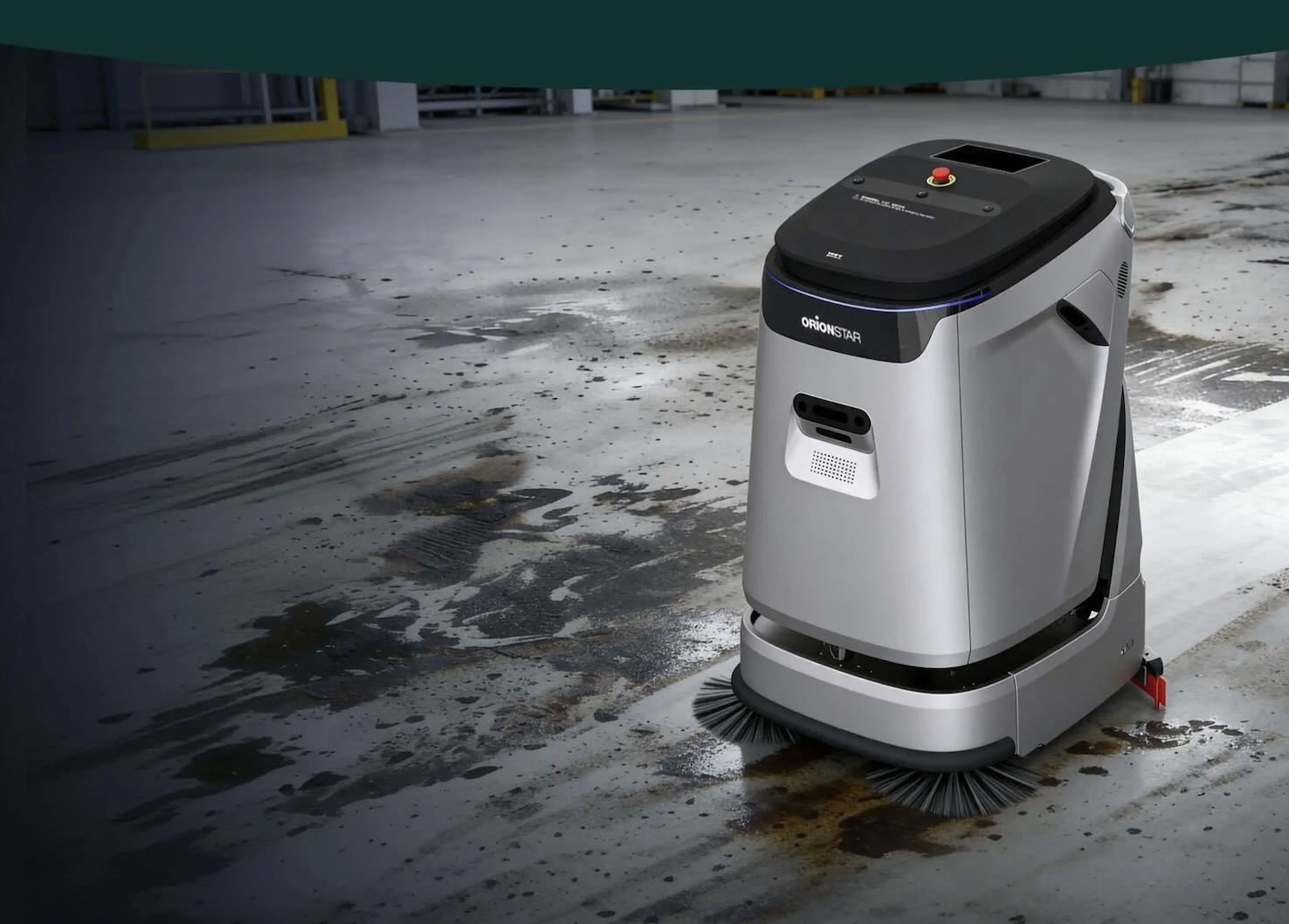
The OrionStar CleaniBot C5 demonstrates these industry-wide autonomous capabilities through its specific engineering tailored for industrial environments. Functioning as a high-performance floor-scrubber, it utilizes automated mapping features that can cover areas of up to 10,000 square meters, according to manufacturer data. It translates autonomous path planning into tangible results with a dual-rolling-brush system applying 25 kg of downward scrubbing pressure, designed for high-efficiency, single-pass removal of typical industrial grime and debris. Furthermore, it supports continuous facility maintenance by leveraging its automated workstation for clean-water refilling and waste-water discharge, capable of achieving a maximum cleaning area capacity of up to 1,980 square meters per hour.

Benefits for facility managers, building service contractors

  • Significant labor reallocation: Deploying a single autonomous floor scrubber during off-hours can replace two to three full-time equivalent cleaning staff, freeing them up for higher-value operational tasks.
  • Measurable return on investment: Facilities typically achieve a positive financial return within 12 to 18 months, with a single robot fleet covering 100,000 square feet potentially generating $70,000 to $135,000 in annual labor reallocation savings, depending on facility size and local labor costs.
  • Consistent, verifiable quality: Automated documentation generates GPS-tagged coverage maps and cleaning scores, significantly reducing the compliance gaps inherent in paper-based systems where a third of tasks go undocumented.
  • Enhanced employee morale: By taking over the repetitive, physically straining task of scrubbing vast floors, automated systems reduce worker exposure to hazardous environments and boost overall team productivity.
  • Demand-based operational efficiency: Utilizing occupancy sensors and data-driven schedules, intelligent cleaning operations can reduce overall cleaning costs by 20% to 30% while maintaining strict cleanliness targets.

Real-world applications

Loading docks

Loading docks face constant exposure to outdoor elements, tire marks from incoming trucks, and heavy foot traffic. Commercial cleaning robots navigate these highly dynamic environments by using sophisticated obstacle avoidance to scrub away stubborn dirt while safely maneuvering around incoming shipments and personnel.

Storage aisles

These extensive, narrow corridors often accumulate fine dust and pallet debris that can degrade air quality and damage moving equipment over time. Autonomous floor scrubbers efficiently clean these long stretches using optimized path planning, ensuring thorough edge-to-edge coverage without disrupting routine forklift operations.

Fulfillment zones

High-paced order processing areas require continuous maintenance to prevent slip-and-fall hazards caused by dropped items or spills. Cleaning robots equipped with real-time monitoring can be deployed precisely when and where they are needed, maintaining safe surfaces for active workers without halting fulfillment productivity.

Packaging areas

These zones are notoriously prone to accumulating soft debris, wrapping films, and discarded packing materials that easily clog traditional walk-behind scrubbers. Advanced robotic systems feature specialized debris handling mechanisms to pick up industrial waste while simultaneously scrubbing the floor, keeping the production line clean and operational.

Integration with other smart systems

To maximize their utility, commercial cleaning robots can be effectively integrated into the broader smart building ecosystem through Computerized Maintenance Management Systems (CMMS) and Building Management Systems (BMS). By connecting via REST APIs, every robotic cleaning cycle becomes a documented maintenance event within the CMMS, where coverage maps auto-populate service histories and consumable wear alerts automatically generate work orders for technicians. Concurrently, integration with IoT-enabled BMS platforms allows robots to adapt their operations based on real-time building conditions, such as dynamically shifting their routes if a warehouse zone is temporarily occupied by heavy traffic or initiating a localized cleaning cycle triggered by connected air quality sensors.

Supporting ESG and sustainability goals

  • Environmental conservation: Automated cleaning algorithms optimize water and energy consumption per square foot, while advanced scrubbing technologies reduce reliance on harsh chemical agents, preventing wastewater contamination.
  • Social responsibility and worker safety: By automating the physically demanding task of industrial floor scrubbing, robots reduce human exposure to hazardous dust, chemical agents, and repetitive physical strain injuries.
  • Governance and auditable compliance: Digitized, timestamped cleaning logs provide an accurate, transparent data trail that directly supports ISO 14001 environmental management standards and internal health compliance audits.

These combined capabilities transition facilities from manual, error-prone reporting to automated, data-driven ESG compliance tracking.

Closing

As labor shortages and operational demands continue to challenge the Facilities Services sector, commercial cleaning robots are fundamentally changing the way operators maintain warehouses. By providing consistent, verifiable, and data-driven maintenance, these automated systems allow facility managers and building service contractors to elevate environmental standards while optimizing long-term costs. For operators looking to implement such automated solutions across various operational scales, the OrionStar CleaniBot series offers multiple configurations designed to address the unique complexities of different industrial environments.