

REQUEST DEMO
Robot CATALOG will be sent to your mailbox immediately after submission.
SUBMIT
Integrated Facility Management in commercial buildings is currently facing significant converging challenges of chronic labor shortages, escalating operational costs, and mounting pressure to meet enhanced facility maintenance protocols. As traditional, static staffing models struggle to deliver consistent quality across millions of square feet, facility professionals are increasingly turning to commercial cleaning robots as a highly effective solution. By automating repetitive floor care tasks, these robotic systems provide a reliable, scalable way to maintain consistent cleaning quality, control budgets, and strategically optimize human workforce allocation to empower and assist cleaning teams in today's demanding built environments.
Facility managers and building service contractors struggle with severe labor shortages and high absenteeism, with up to 15% of the workforce missing shifts daily (Source: Avidbots, "Deploying Automated Floor Cleaning Robots in Facilities Management"), driving the need for reliable automated alternatives.
Rising operational costs and inflation have severely strained facility budgets, prompting an urgent demand for technological interventions that can meaningfully reduce long-term maintenance expenses.
Heightened post-pandemic hygiene benchmarks demand consistent cleaning quality that traditional manual cleaning models often require proportional budget increases to scale effectively.
High workforce turnover rates and widening skill gaps make it exceedingly difficult to maintain safety compliance and ensure scalable, high-quality staffing during peak operational periods.
LiDAR navigation and autonomous path planning allow these machines to efficiently map complex environments and calculate the most efficient cleaning routes. Operating within specific technical limitations—such as a maximum slope of 5 degrees and requiring door widths greater than 880mm—ensures reliable real-world performance.
Auto-charging and docking capabilities enable continuous, multi-shift operations without requiring constant human intervention or manual battery management.
Intelligent obstacle avoidance systems utilize various sensors to safely navigate around dynamic crowds, temporary barriers, and sensitive facility equipment.
Real-time monitoring and cloud-based dashboards provide operators with actionable data on coverage maps and overall productivity metrics. Because modern spatial mapping often utilizes cameras and sensors, operating parties must verify that data collection and processing comply with GDPR requirements, utilizing local processing and data anonymization to protect occupant privacy. OrionStar operates in strict compliance with local data protection regulations (e.g., GDPR). Operational map data and logs are processed solely for path optimization and fleet management, using anonymization where applicable, and are stored temporarily as defined by client-specific Data Processing Agreements (DPA).
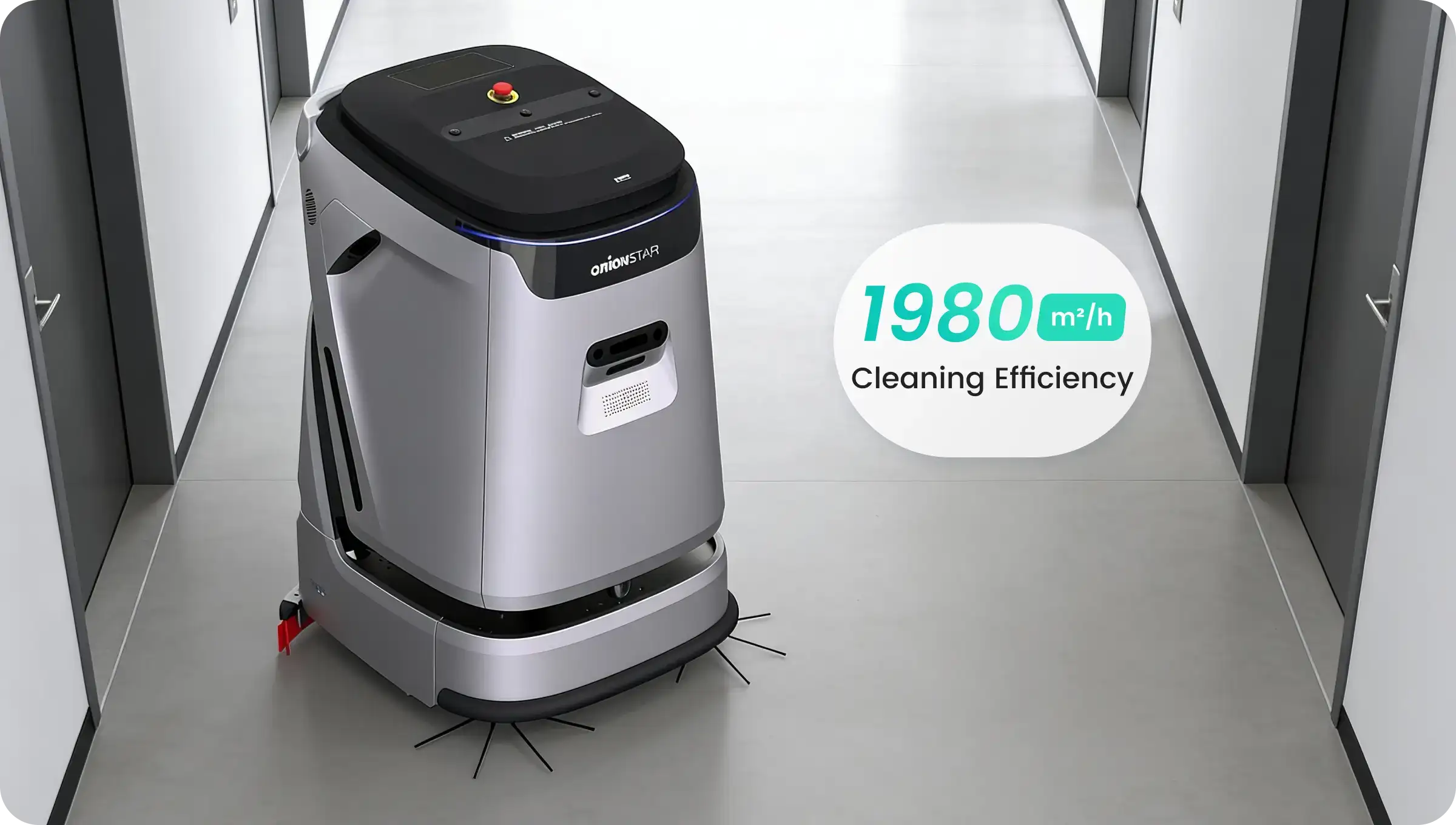
The OrionStar CleaniBot C5 illustrates how these autonomous capabilities are practically applied to high-traffic facility operations. To handle expansive floor plans efficiently, the unit is designed to provide a maximum cleaning area capacity of up to 1,980 square meters per hour, according to manufacturer data. It efficiently navigates and maps commercial areas of up to 10,000 square meters (operating on inclines up to 5 degrees and passing through doorways wider than 880mm) while utilizing an automated docking station for refueling and self-cleaning to minimize manual downtime. Furthermore, operating at a noise level as low as 68 dB(A) under standard scrubbing conditions, the robot demonstrates how floor scrubbing can be executed without causing excessive disturbance in active, populated spaces.
Measurable Cost Savings: Deploying automated cleaning systems can deliver significant financial returns. Internal case studies demonstrate potential annual savings per unit.
Dynamic Workloading: Data generated on actual cleaning coverage allows facility providers to shift away from static task-frequency models and dynamically reallocate labor to higher-value areas.
Consistent Quality: By eliminating the variability of human fatigue, robots maintain a uniform standard of cleanliness, which is crucial since, according to ISSA surveys, 92% of customers consider cleanliness a deciding factor for repeat business.
Higher Staff Utilization: Automating repetitive floor scrubbing empowers teams to assist human workers, shifting their focus to client-facing tasks, supervisory roles, and intricate cleaning duties that require a human touch.
Accelerated Return on Investment: Internal case studies demonstrate that thoughtfully optimized robotic cleaning programs can achieve full ROI within 12 to 24 months.
Building lobbies experience constant foot traffic and serve as the primary visual impression for visitors, demanding continuous maintenance to remove tracked-in dirt. Commercial cleaning robots can maintain these high-visibility areas consistently throughout the day, ensuring spotless floors while safely navigating around moving guests and luggage.
Long, expansive corridors require time-consuming, repetitive manual labor that often leads to worker fatigue and inconsistent cleaning results. Robots excel in these linear environments by utilizing optimized path planning to clean efficiently from edge to edge, significantly reducing the manual workload for custodial staff.
Connected parking facilities frequently accumulate heavy grime, oil spills, and debris that are exceptionally difficult to manage with traditional mops. Industrial-grade cleaning robots tackle these harsh surfaces with 25 kg of downward scrubbing pressure, effectively removing stubborn stains and maintaining safety without requiring intensive human labor.
Cafeterias, lounges, and shared workspaces present dynamic challenges due to frequently moving furniture and unpredictable pedestrian flow. Equipped with real-time obstacle avoidance, cleaning robots intelligently adapt their routes on the fly, ensuring a thorough clean without disrupting the daily routines of building occupants.
Commercial cleaning robots are evolving beyond standalone appliances to become highly integrated nodes within a commercial building's broader digital ecosystem. Through IoT-enabled communication, these machines can interface directly with Building Management Systems (BMS) and elevator control software, allowing for autonomous multi-floor navigation without human assistance. Furthermore, the real-time operational and environmental data collected by the robots can be fed directly into Computerized Maintenance Management Systems (CMMS) and centralized Facility Optimization Management platforms, enabling proactive predictive maintenance and giving facility managers a unified view of asset health and overall building performance.
Optimized path mapping significantly reduces water waste and prevents redundant cleaning passes, conserving vital natural resources during daily operations.
Operating effectively in low-light conditions allows commercial buildings to reduce energy costs typically associated with overnight manual cleaning crews.
The precise dispensing of biodegradable and non-toxic cleaning agents minimizes environmental impact and reduces chemical exposure for both building occupants and custodial staff.
Ultimately, integrating automated cleaning technologies empowers facility management providers to consistently meet stricter environmental regulations and actively support long-term corporate sustainability targets.
The adoption of commercial cleaning robots is significantly enhancing the way Integrated Facility Management approaches the maintenance of commercial buildings, shifting operations from reactive, static models to smart, data-driven strategies. Because facility requirements continue to diversify across different architectural layouts and operational scales, the OrionStar CleaniBot series offers multiple models designed to adapt to a wide variety of specific scenario demands. Facility leaders looking to future-proof their operations, lower operational costs, and elevate their overall service delivery are highly encouraged to explore how these intelligent systems can assist their daily maintenance workflows.
Note: Financial savings are based on internal case studies of mid-to-large facility enterprises calculating redirected labor hours and consumable reductions; actual savings may vary. Note: Actual cleaning efficiency, battery runtime, and mapping capacity may vary depending on floor types, environmental complexity, network stability, and obstacle density.